



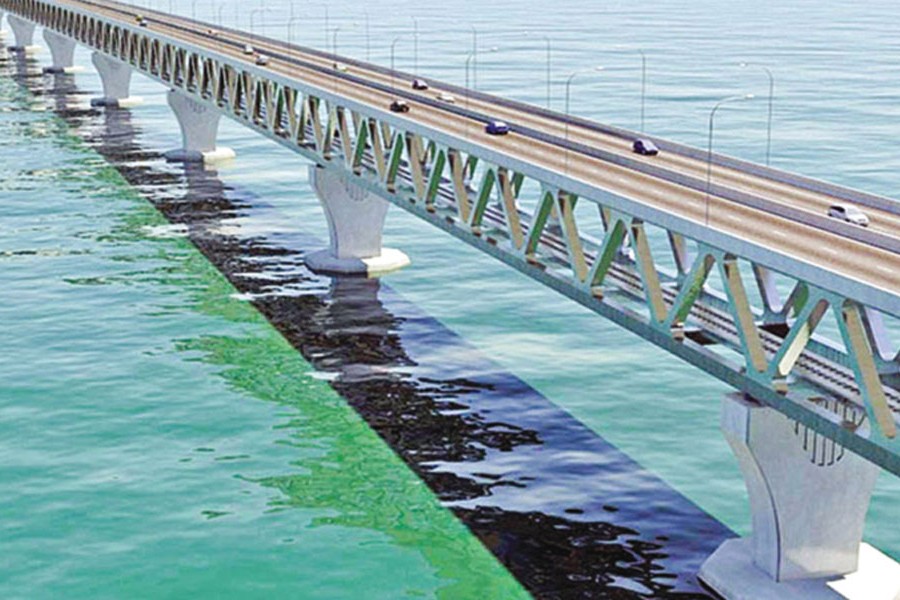

Bangladesh is moving ahead with plans to construct the 2nd Padma Bridge, a mega infrastructure project that authorities believe will reshape transport, trade and regional connectivity once again after the success of the first Padma Bridge.
Recent discussions within the Bridges Division and the Ministry of Finance indicate that the government has started preliminary studies and policy-level preparations for the proposed bridge. Officials have identified the Paturia-Daulatdia corridor as the most likely location for the 2nd Padma Bridge, although alternative alignments are also being examined through updated feasibility assessments.
The proposed project has emerged at a time when Bangladesh is increasingly relying on large-scale infrastructure to sustain economic growth, expand logistics networks and improve regional integration. The 2nd Padma Bridge is expected to become one of the country’s most ambitious transport investments of the coming decade.
According to government planning documents reported by media, the Bridges Division aims to complete the 2nd Padma Bridge by 2032. The proposed bridge would likely be around 4.9 kilometres long and connect national highways linked to western and south-western Bangladesh.
The initiative is also politically significant. Policymakers increasingly see the 2nd Padma Bridge as a strategic necessity rather than merely another development project.
Why Bangladesh Needs the 2nd Padma Bridge?
The first Padma Bridge transformed Bangladesh’s transport map after opening in June 2022. The bridge connected the south-western region directly with Dhaka and the rest of the country through road and rail networks.
Since then, traffic demand across the Padma River has continued to rise sharply. Economic activity around the south-western region has accelerated, industrial investment has expanded and transport volumes have increased faster than many planners initially expected.
Government officials now believe that relying solely on one bridge across such a strategic river corridor may create long-term logistical bottlenecks.
The proposed 2nd Padma Bridge would primarily serve the western districts and reduce pressure on ferry routes between Paturia and Daulatdia, one of the country’s busiest river crossing points. The corridor has historically suffered from severe traffic congestion, long ferry delays and transport inefficiencies.
The urgency for improved crossing infrastructure has become more visible after repeated ferry accidents and disruptions on the Paturia-Daulatdia route. Transport analysts say the 2nd Padma Bridge could drastically reduce travel uncertainty and improve freight movement efficiency.
Bangladesh’s export-oriented economy also requires faster and more predictable logistics systems. The 2nd Padma Bridge is expected to improve access to Mongla seaport, Benapole land port and Darshana land port, all of which are strategically important for regional trade.
Economic Promise Creates Optimism
The success of the original Padma Bridge has strengthened public and political confidence in mega infrastructure investments.
The first bridge significantly reduced travel time between Dhaka and the south-western region. It also boosted land prices, industrial activity and investment prospects across several districts. Economists projected that the first Padma Bridge could raise Bangladesh’s GDP growth by more than 1 percent.
Authorities expect the 2nd Padma Bridge to produce similar economic benefits.
The project could create a stronger transport corridor connecting Dhaka with Rajshahi, Khulna and other western districts. It may also improve freight movement towards India-bound trade routes.
Business leaders believe the 2nd Padma Bridge could support agricultural supply chains, industrial expansion and logistics modernisation. Improved connectivity would reduce transport costs and encourage new investments in manufacturing and warehousing.
The proposed bridge may also complement Bangladesh’s broader connectivity strategy involving expressways, rail corridors and regional transport integration.
Government planners are simultaneously discussing the Dhaka-Chattogram Expressway and a second Jamuna bridge, indicating a wider vision of creating a modern nationwide transport network.
Strategic Location Remains a Critical Question
Although the government appears to favour the Paturia-Daulatdia alignment, final decisions regarding the exact route have not yet been made.
Officials have confirmed that new studies are underway despite earlier feasibility assessments conducted years ago. Authorities are reportedly reassessing economic viability, traffic demand and engineering feasibility before selecting the final alignment.
Some planners favour the Paturia-Goalanda corridor because of its strong connectivity potential with national highways N5 and N7. Others argue that alternative alignments such as Aricha-Nagarbari could offer better long-term benefits.
Choosing the correct alignment is crucial because the 2nd Padma Bridge will shape economic geography for decades.
Transport economists say the selected route must balance several priorities, including freight efficiency, passenger movement, industrial growth potential, railway integration and regional trade access.
River morphology is another important factor. The Padma River is highly dynamic and unpredictable, meaning engineering considerations will significantly influence the final decision.
Negative Challenges Could Slow Progress
Despite the growing enthusiasm, the 2nd Padma Bridge faces multiple challenges.
Financing remains one of the biggest concerns.
Bangladesh is currently dealing with economic pressures linked to foreign exchange reserves, inflation and rising debt servicing obligations. A mega project like the 2nd Padma Bridge could require billions of dollars in investment.
Officials have not yet finalised the financing model. The project may involve government funding, foreign loans or public-private partnership arrangements.
Securing foreign financing may also become more complicated due to global economic uncertainty and tighter lending conditions.
Land acquisition is another sensitive issue.
Large infrastructure projects in Bangladesh often face delays due to compensation disputes, resettlement challenges and legal complexities. The 2nd Padma Bridge would likely require extensive land acquisition for approach roads, railway links and supporting infrastructure.
Environmental concerns may also generate debate.
The Padma River is ecologically important and environmentally fragile. Large-scale river engineering projects can affect fisheries, sediment flow and riverbank stability. Environmental experts may demand stronger impact assessments before construction begins.
There are also technical risks.
The first Padma Bridge was one of the most difficult engineering projects in Bangladesh’s history due to strong river currents, deep piling requirements and complex river training works.
The 2nd Padma Bridge could face similar engineering challenges, particularly if river conditions become more unstable because of climate change and sediment shifts.
Political Commitment Will Shape the Future
Political continuity will play a decisive role in determining whether the 2nd Padma Bridge moves from planning to implementation.
Major infrastructure projects in Bangladesh typically require long-term policy consistency across multiple governments. Experts say the bridge will need sustained political commitment over several years.
Public support could also influence the pace of progress.
Political leaders have already publicly acknowledged the importance of the project. BNP Secretary General Mirza Fakhrul Islam Alamgir recently said there was no denying the need for the 2nd Padma Bridge, although he stressed that political commitment and public demand would be essential for implementation.
Infrastructure projects in Bangladesh often become symbols of political ambition and national development narratives.
The 2nd Padma Bridge may similarly become a symbol of Bangladesh’s next phase of infrastructure expansion.
Regional Trade Could Gain Significantly
The 2nd Padma Bridge is expected to strengthen Bangladesh’s role in regional trade and connectivity.
The bridge would improve transport efficiency between Dhaka and western Bangladesh while also supporting trade with neighbouring India.
Better road and rail links could strengthen access to regional transport corridors connected with South Asia and the broader Asian Highway network.
The first Padma Bridge already enhanced connectivity with Asian Highway routes.
The proposed 2nd Padma Bridge could further integrate Bangladesh into regional supply chains.
Trade specialists say improved connectivity with Benapole land port would be particularly important. Benapole handles a major portion of Bangladesh’s land-based trade with India.
Faster freight movement between Dhaka, western Bangladesh and border points could reduce logistics costs and improve export competitiveness.
The bridge may also support tourism growth by improving accessibility to south-western districts.
Railway Integration Could Be a Major Advantage
Transport planners increasingly favour multimodal infrastructure rather than standalone road projects.
For that reason, railway integration may become a defining feature of the 2nd Padma Bridge.
Reports indicate that the proposed bridge could include a rail component alongside road connectivity.
Bangladesh has been investing heavily in railway modernisation in recent years. Integrating rail infrastructure with the 2nd Padma Bridge would align with national transport goals aimed at reducing dependence on highways alone.
Rail connectivity could support freight transport efficiency, lower fuel consumption and reduce pressure on roads.
The inclusion of rail infrastructure would also strengthen links between western Bangladesh and ports, industrial zones and export hubs.
However, integrating rail systems would increase project complexity and overall costs.
Climate Resilience Will Be Essential
Climate change is emerging as a critical consideration for all major infrastructure projects in Bangladesh.
The Padma River experiences strong seasonal variations, erosion and sediment movement. Climate change could intensify flooding patterns and hydrological instability in the future.
As a result, engineers and policymakers must ensure that the 2nd Padma Bridge is designed with strong climate resilience measures.
River training works, embankment protection and long-term maintenance planning will be crucial.
Bangladesh has already gained valuable experience from constructing the first Padma Bridge under difficult river conditions. That experience could help reduce technical uncertainties for the second project.
Still, experts warn that climate-related risks may significantly increase future maintenance costs.
The 2nd Padma Bridge Could Redefine Bangladesh’s Next Development Phase
The proposed 2nd Padma Bridge represents more than another river crossing.
It reflects Bangladesh’s broader ambition to transform itself into a regional economic and logistics hub through large-scale infrastructure investments.
If implemented successfully, the 2nd Padma Bridge could strengthen national integration, boost trade, accelerate industrialisation and improve connectivity between Dhaka and the country’s western and south-western regions.
At the same time, the project faces substantial financial, environmental and technical challenges.
The government must carefully balance economic ambition with fiscal discipline and environmental sustainability.
The coming years will determine whether the 2nd Padma Bridge remains a political promise or becomes another transformational project in Bangladesh’s development journey.
For now, preliminary studies, policy discussions and political messaging indicate that the government is serious about moving forward with the 2nd Padma Bridge, a project that could once again reshape the country’s economic geography for generations to come.