




Dhaka’s AI Traffic Cameras Signal a Bigger Shift Toward Smart Policing and Digital Urban Governance
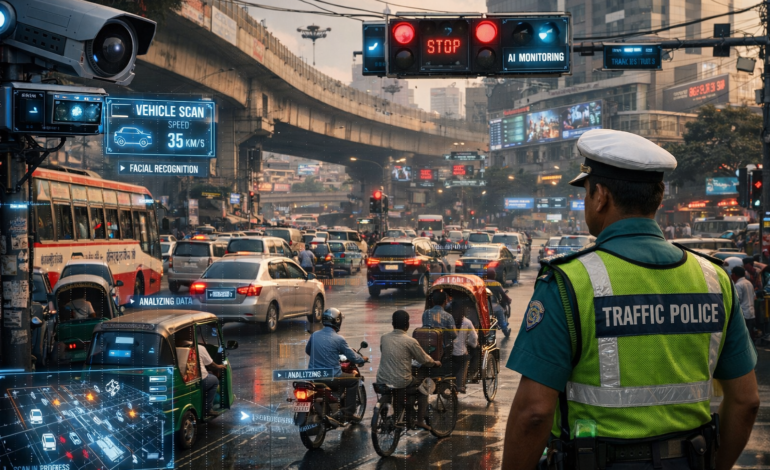

Dhaka’s AI Traffic Cameras Signal a Bigger Shift Toward Smart Policing and Digital Urban Governance
For decades, Dhaka’s traffic congestion has been the chaos of one of the world’s fastest-growing megacities. Endless gridlock, reckless driving, illegal parking, lane violations, and weak enforcement have long frustrated commuters and policymakers alike.
Now, Bangladesh is attempting something different: using artificial intelligence not just to punish traffic violations, but to reshape public behavior and gradually transform Dhaka into a smarter, technology-driven city.
The Dhaka Metropolitan Police (DMP) recently intensified the use of AI-powered traffic surveillance systems across the capital, installing advanced cameras capable of automatically detecting traffic violations and issuing digital prosecutions.
But beyond traffic enforcement, the initiative represents something larger that Bangladesh’s accelerating transition toward AI-based urban governance, digital policing, and automated public monitoring systems.
Officials say the technology is already changing how people behave on Dhaka’s roads. More importantly, analysts believe it could mark the beginning of a wider transformation in how Bangladesh manages public order, security, and city infrastructure.
Dhaka’s Traffic Crisis and the Limits of Traditional Enforcement
Dhaka is consistently ranked among the world’s most congested cities.
The capital’s traffic problems are driven by several overlapping issues, rapid urbanization, poor road infrastructure, weak traffic discipline, Illegal parking.
For years, traffic management depended heavily on police officers stationed at intersections manually controlling vehicle flow.
But the sheer scale of Dhaka’s traffic density made consistent enforcement difficult.
The challenge was not simply legal enforcement, it was behavioral.
Authorities increasingly realized that sustainable traffic reform required changing public habits, not just increasing police presence.
AI Cameras Enter Dhaka’s Streets
To address the issue, DMP introduced AI-powered surveillance systems at major intersections and busy roads throughout Dhaka.
According to police officials, 120 AI-based traffic cameras have already been installed across the capital, with more than 20 currently operational at key intersections.
These cameras use advanced PTZ (Pan-Tilt-Zoom) technology capable of:
- Rotating 360 degrees
- Zooming into distant vehicles
- Capturing number plates
- Recording high-resolution video evidence
The system automatically detects violations under the Road Transport Act 2018 using AI-based monitoring software.
The surveillance system is integrated with Bangladesh Road Transport Authority (BRTA) databases, allowing authorities to instantly identify vehicle ownership information.
Police officials say over 500 cases have already been filed using the AI system.
The Psychology of Surveillance
Perhaps the most interesting development is not technological but psychological.
Traffic police report that drivers are voluntarily changing behavior simply because they know AI cameras are watching.
At intersections like Bijoy Sarani and Karwan Bazar, officials observed:
- Vehicles stopping behind stop lines
- Clear zebra crossings
- Improved signal compliance
- Reduced reckless movement
One traffic officer described how drivers now avoid violations even when police are not actively intervening.
This reflects a broader global trend in smart surveillance systems:
people behave differently when enforcement becomes automated, consistent, and unavoidable.
Unlike human officers, AI cameras:
- Do not get distracted
- Operate continuously
- Apply rules uniformly
- Record permanent evidence
The fear of automatic digital prosecution changes driver calculations instantly.
In many ways, Dhaka’s AI traffic initiative is becoming a social experiment in behavioral engineering through technology.
Bangladesh’s Growing Smart City Ambitions
The traffic camera project also reflects Bangladesh’s broader ambitions to modernize urban governance through digital systems.
Authorities increasingly view AI as a tool for solving large-scale urban challenges involving:
- Traffic management
- Public safety
- Crime prevention
- Data analysis
- Emergency response
Officials say the traffic surveillance expansion is part of a wider nationwide modernization effort involving artificial intelligence and smart policing systems.
AI technologies are already being integrated into:
- Smart CCTV systems
- Cybercrime monitoring
- Fraud detection
- Digital evidence analysis
- Threat detection systems
Police officials say advanced surveillance systems can now identify:
- Suspicious movement
- Unattended objects
- Violent behavior
- Potential security threats
in real time.
This marks a major shift from reactive policing toward predictive and technology-driven monitoring.
The Rise of Automated Governance
Dhaka’s AI traffic cameras are part of a growing global movement toward automated governance systems.
Cities worldwide are increasingly using artificial intelligence for:
- Traffic optimization
- Facial recognition
- Smart surveillance
- Public transport monitoring
- Law enforcement automation
Countries such as:
- China
- Singapore
- United Arab Emirates
- South Korea
have invested heavily in AI-based urban management systems.
Bangladesh now appears eager to adopt similar models on a developing-country scale.
For governments facing:
- Rapid urban population growth
- Infrastructure pressure
- Limited manpower
- Rising security concerns
AI offers a potentially cost-effective solution.
Technology can monitor thousands of vehicles simultaneously in ways impossible through human policing alone.
Transparency and Digital Accountability
One notable aspect of the new system is the planned use of digital evidence sharing.
Officials say drivers will eventually receive:
- SMS notifications
- App-based alerts
- Video links showing violations
This could improve transparency in traffic enforcement, an area historically criticized for inconsistency and disputes.
Instead of arguing with traffic officers, drivers would be able to directly review:
- Video footage
- Images
- Recorded evidence
Digital systems also reduce opportunities for:
- Informal settlements
- Manual manipulation
- Selective enforcement
In theory, automated enforcement creates a more standardized legal process.
However, experts caution that transparency will depend heavily on:
- Proper oversight
- Data security
- Appeal systems
- Privacy protections
The Privacy Debate
As AI surveillance expands, concerns about privacy and civil liberties are also likely to grow.
Globally, AI surveillance systems have triggered debates about:
- Government overreach
- Data collection
- Facial recognition ethics
- Public monitoring
- Citizen privacy
Bangladesh’s expanding surveillance infrastructure raises similar questions.
Critics may ask:
- How long is surveillance data stored?
- Who has access to it?
- How secure are the systems?
- What oversight exists?
- Could surveillance be misused?
Currently, Bangladesh lacks fully developed legal frameworks specifically addressing AI governance and digital surveillance ethics.
As AI policing expands, policymakers may eventually face pressure to establish:
- Data protection standards
- Surveillance oversight rules
- Public accountability mechanisms
Traffic Discipline Alone Cannot Solve Dhaka’s Crisis
Despite improvements, officials themselves acknowledge that AI cameras alone cannot solve Dhaka’s traffic problems.
DMP representatives stressed that broader structural reforms remain essential.
Major challenges still include:
- Insufficient roads
- Unfit vehicles
- Poor public transport systems
- Mixed traffic flow
- Illegal bus stopping
- Weak urban planning
Dhaka’s roads currently accommodate:
- Buses
- Trucks
- Rickshaws
- CNG auto-rickshaws
- Motorcycles
- Easy bikes
often operating simultaneously in the same corridors.
Urban experts argue that long-term improvement requires:
- Mass transit expansion
- Better bus route management
- Pedestrian infrastructure
- Parking reform
- Smarter city planning
AI can improve enforcement, but it cannot fully compensate for infrastructure limitations.
AI and the Future of Policing in Bangladesh
The expansion of AI surveillance may eventually reshape policing far beyond traffic management.
Officials say Bangladesh is increasingly using artificial intelligence to combat:
- Cybercrime
- Financial fraud
- Deepfake-related offences
- Online misinformation
As digital threats evolve, authorities view AI as necessary for:
- Faster detection
- Real-time analysis
- Automated monitoring
- Large-scale data processing
The growing role of AI in public administration suggests Bangladesh is entering an era where technology increasingly influences governance decisions.
Looking Ahead
Dhaka’s AI-powered traffic cameras represent more than a traffic enforcement project as they symbolize Bangladesh’s broader transition toward digital governance and smart-city management.
The early success of the system demonstrates how technology can rapidly influence public behavior when enforcement becomes consistent and automated.
Drivers who once ignored traffic signals are now stopping behind lines, respecting zebra crossings, and avoiding risky violations because AI surveillance has changed the psychology of enforcement.
Yet the initiative also raises larger questions about:
- Privacy
- Digital oversight
- Urban planning
- Automated governance
- The future role of AI in public life
As Bangladesh continues modernizing its cities and policing systems, Dhaka’s traffic cameras may ultimately be remembered not simply as road-monitoring devices, but as the beginning of a larger technological transformation shaping how the country governs urban society in the digital age.