




Bangladesh to Open Ports to U.S. Warships: What the New Defense Shift Means for South Asia

Bangladesh to Open Ports to U.S. Warships: What the New Defense Shift Means for South Asia
Bangladesh is moving toward a major strategic shift in its defense and maritime policy as reports indicate that the country is preparing to open its ports and airfields to United States military vessels and aircraft under new bilateral defense agreements.
The development has drawn global attention because of Bangladesh’s strategic location in the Bay of Bengal is one of the most geopolitically important maritime regions in the Indo-Pacific. Analysts believe the move could reshape regional security dynamics involving the United States, China, and India while strengthening Bangladesh’s role in maritime cooperation and naval logistics.
According to reports published by the defense-focused publication Militarnyi, Bangladesh and the United States are in the final stages of signing agreements that would allow American warships and aircraft access to Bangladeshi facilities for logistics, refueling, maintenance, and operational support.
The potential agreement signals a deeper level of military cooperation between Dhaka and Washington at a time when geopolitical competition in the Indo-Pacific region is intensifying.
Why Bangladesh Matters Strategically
Bangladesh occupies a critical geographic position along the Bay of Bengal, close to key international shipping routes linking South Asia and Southeast Asia.
The country’s ports and naval facilities are located near:
- The Indian Ocean trade corridor
- China-backed infrastructure projects
- Myanmar’s coastline
- Strategic sea lanes used for global commerce
Security analysts have increasingly described the Bay of Bengal as an emerging strategic hotspot because of growing competition among major powers.
A study published by the U.S. Naval Institute argued that Bangladesh could become an important logistics and maritime partner for the United States in the Indian Ocean region.
The report noted that the United States currently lacks permanent naval facilities in the Bay of Bengal and that Bangladesh’s ports could provide operational flexibility during humanitarian missions, maritime security operations, and regional crises.
What Agreements Are Being Discussed?
According to Militarnyi, two agreements are central to the ongoing negotiations:
- GSOMIA (General Security of Military Information Agreement)
- ACSA (Acquisition and Cross-Servicing Agreement)
The ACSA would reportedly permit U.S. warships and military aircraft to use Bangladeshi ports and airfields for:
- Refueling
- Maintenance
- Logistics support
- Resupply operations
Meanwhile, GSOMIA would facilitate secure intelligence and military information sharing between the two countries.
These agreements are commonly used by the United States with strategic defense partners worldwide.
If finalized, they would mark one of the most significant defense cooperation developments between Bangladesh and the United States since the country’s independence.
Bangladesh’s Expanding Naval Ambitions
The development also reflects Bangladesh’s own efforts to modernize its navy and maritime capabilities.
Over the past decade, the Bangladesh Navy has expanded rapidly under the country’s military modernization program known as “Forces Goal 2030.”
Bangladesh has invested in:
- New frigates and patrol vessels
- Naval aviation capabilities
- Submarine facilities
- Deep-sea port infrastructure
- Maritime surveillance systems
The country has also developed several major naval installations, including:
- BNS Sher-e-Bangla in Patuakhali
- BNS Pekua submarine base in Cox’s Bazar
BNS Sher-e-Bangla is considered Bangladesh’s largest naval base and includes submarine and aviation facilities.
Bangladesh’s navy has increasingly participated in:
- Joint naval exercises
- Maritime security operations
- Disaster response missions
- United Nations peacekeeping support
The country also maintains relationships with multiple global defense partners, including China, India, Turkey, Japan, and the United States.
The Indo-Pacific Factor
The proposed U.S.-Bangladesh defense cooperation is closely tied to the broader Indo-Pacific geopolitical landscape.
The United States has been expanding partnerships across the Indo-Pacific region as part of its “Free and Open Indo-Pacific” strategy aimed at maintaining maritime security and balancing China’s growing regional influence.
Bangladesh officially introduced its own Indo-Pacific Outlook in recent years, emphasizing:
- Freedom of navigation
- Maritime security
- Regional stability
- Economic cooperation
Security experts believe Washington sees Bangladesh as an increasingly valuable regional partner because of its:
- Strategic coastline
- Growing naval capabilities
- Expanding port infrastructure
- Position near critical maritime trade routes
The Bay of Bengal has also become important due to major infrastructure investments linked to China’s Belt and Road Initiative.
Possible Regional Reactions
Any expansion of U.S. military access in Bangladesh is likely to attract close attention from neighboring powers.
India
India has historically viewed the Bay of Bengal as part of its strategic sphere of influence. While India and the United States maintain strong defense ties, analysts believe New Delhi will closely monitor any permanent increase in U.S. operational access near its eastern maritime zone.
India already has transit access to Bangladeshi ports under existing bilateral agreements.
China
China has become one of Bangladesh’s largest defense and infrastructure partners.
Beijing has supplied:
- Naval vessels
- Military hardware
- Submarines
- Infrastructure financing
China also assisted Bangladesh in developing submarine facilities and other naval projects.
As a result, deeper U.S.-Bangladesh military cooperation could complicate Dhaka’s balancing strategy between global powers.
Regional Balance
Bangladesh has traditionally followed a foreign policy principle often described as: “Friendship to all, malice toward none.”
Analysts say Dhaka is likely trying to maintain balanced relations with all major powers rather than aligning exclusively with one geopolitical bloc.
Economic and Maritime Implications
The potential opening of Bangladeshi ports to U.S. naval access is not only a military issue , it also carries economic implications.
Bangladesh is investing heavily in maritime infrastructure, including:
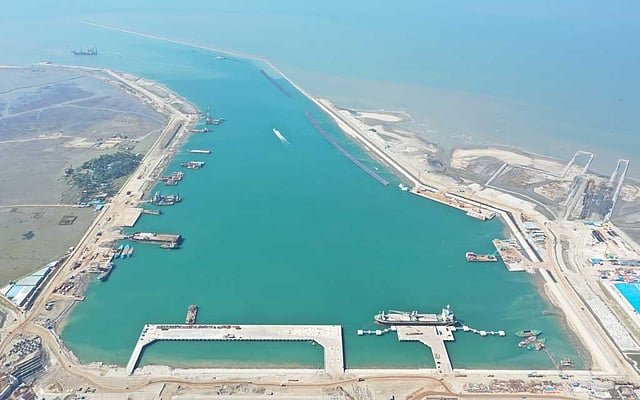
- Matarbari Deep Sea Port
- Payra Port
- Chattogram Port expansion projects
Matarbari Deep Sea Port is expected to become one of the country’s most strategically important maritime projects.
Greater international naval cooperation could:
- Improve maritime security
- Increase port modernization
- Strengthen disaster-response coordination
- Expand logistical capabilities
- Enhance anti-piracy operations
Bangladesh is also highly vulnerable to cyclones and maritime disasters, making naval coordination increasingly important for humanitarian operations.
Growing U.S.-Bangladesh Defense Cooperation
Defense cooperation between the United States and Bangladesh has expanded steadily over recent years.
The two countries already cooperate in:
- Maritime security
- Counterterrorism
- Disaster management
- Peacekeeping support
- Military training exercises
According to available reports, the U.S. Indo-Pacific Command regularly engages with Bangladeshi armed forces in naval exercises and regional security programs.
The United States has also provided maritime security assistance and transferred coast guard equipment to Bangladesh in previous years.
Military analysts believe the new agreements could institutionalize and deepen this cooperation further.
Challenges and Concerns
Despite the strategic benefits, the issue could generate debate within Bangladesh itself.
Critics may raise concerns about:
- National sovereignty
- Foreign military influence
- Regional tensions
- Bangladesh becoming part of major-power rivalry
Others may argue that closer defense cooperation could strengthen Bangladesh’s:
- Maritime protection
- Naval modernization
- Strategic relevance
- Disaster response capacity
The government has not publicly confirmed all reported details of the negotiations, meaning some aspects remain subject to official clarification.
In a Nutshell
Bangladesh’s reported decision to open ports and airfields to U.S. military access marks a potentially significant development in South Asian geopolitics.
The move reflects Bangladesh’s growing strategic importance in the Indo-Pacific region and highlights the increasing global focus on the Bay of Bengal as a key maritime zone.
If finalized, the agreements could deepen defense cooperation between Dhaka and Washington while reshaping regional security calculations involving India and China.
At the same time, Bangladesh appears likely to continue pursuing a careful balancing strategy, strengthening international partnerships without abandoning its long-standing policy of maintaining constructive relations with multiple global powers.
As maritime competition intensifies across the Indo-Pacific, Bangladesh is emerging not only as a regional economic hub but also as a strategically important player in the evolving geopolitical landscape.