




Chittagong University Launches Bangladesh’s First Satellite Ocean Data Centre
In a landmark step toward advancing marine research and technological capability, the University of Chittagong has launched Bangladesh’s first satellite-based ocean data centre, marking a major milestone in the country’s scientific and blue economy ambitions.
The newly established facility titled the Satellite Ocean Observation and Data Innovation Center is expected to significantly enhance Bangladesh’s ability to collect, process, and analyze oceanographic data using satellite technology. At the helm of this groundbreaking initiative is Mohammad Moslem Uddin, a leading figure in marine science and the driving force behind the project.
A Strategic Leap in Marine Research
The launch of the ocean data centre represents a critical advancement in Bangladesh’s scientific infrastructure. Approved during the university’s 566th syndicate meeting on February 21, the centre has been established as an independent entity within the university.
Its core objective is to utilize satellite-based remote sensing technology to gather real-time data from the Bay of Bengal, one of the most strategically important maritime regions for Bangladesh.
Vice-Chancellor Mohammad Al-Forkan described the facility as a “significant national asset,” highlighting its potential to contribute to research, disaster management, and economic development.
What the Ocean Data Centre Will Do
The centre is designed to serve multiple high-impact functions, making it one of the most technologically advanced research initiatives in Bangladesh.
Key Capabilities:
- Satellite Data Collection:
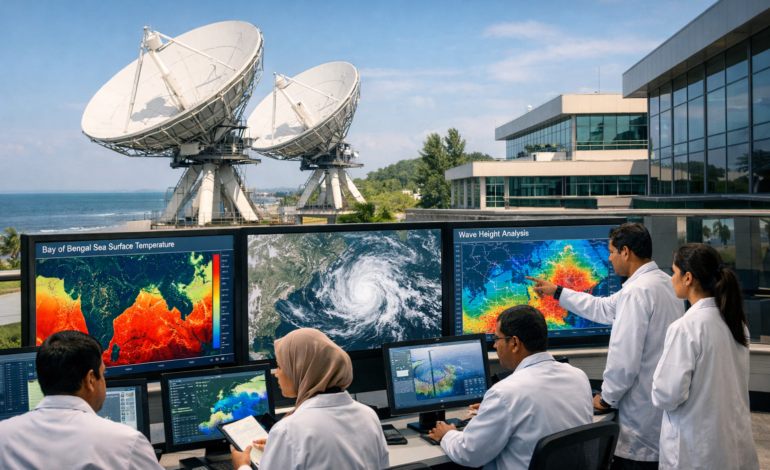
The facility will receive and process satellite data related to ocean conditions, including sea surface temperature, wave patterns, and salinity levels. - Climate and Environmental Monitoring:
Researchers will be able to study climate change impacts, ocean currents, and environmental shifts with greater precision. - Disaster Forecasting:
The system will support early warning mechanisms for cyclones, storm surges, and potential tsunami events. - Marine Resource Management:
Data generated will assist in fisheries development, sustainable resource use, and maritime policy planning. - Big Data Processing:
Advanced computing infrastructure will enable large-scale data analysis, improving research output and decision-making.
Experts believe these capabilities will significantly strengthen Bangladesh’s resilience to climate-related risks while supporting long-term economic planning.
Infrastructure and Technological Setup
The facility includes a comprehensive range of advanced infrastructure:
- Satellite antenna systems
- High-capacity server networks
- Dedicated laboratory space
- Data processing and visualization units
Vice-Chancellor Mohammad Al-Forkan visited the site on April 17, where he reviewed the centre’s components and progress.
Much of the technological support for the project has been provided through collaboration with China, particularly in the development of satellite ground station capabilities.
International Collaboration and Development Timeline
The project’s origins date back to 2019, when Professor Moslem Uddin first proposed the establishment of a satellite ocean data centre.
Key milestones include:
- 2020: Memorandum of Understanding signed with China’s Second Institute of Oceanography
- December 2024: Formal working agreement finalized
- March 26, 2025: Construction begins
- May 2026 (expected): Completion of technical systems
- June 2026 (expected): Full-scale operations
This collaborative approach has enabled Bangladesh to access advanced technology and expertise while building local capacity.
Role of Professor Mohammad Moslem Uddin
At the center of this initiative is Mohammad Moslem Uddin, a professor in the Oceanography Department at the University of Chittagong.
Known for his work in marine science, data analytics, and technological innovation, he has played a key role in conceptualizing and implementing the project.
His leadership reflects a growing emphasis on interdisciplinary research, combining oceanography with modern technologies such as:
- Artificial intelligence
- Machine learning
- Internet of Things (IoT)
These tools are expected to enhance the centre’s analytical capabilities and research output.
Boosting Bangladesh’s Blue Economy
The establishment of the ocean data centre is closely tied to Bangladesh’s ambitions in the blue economy, a sector that includes marine resources, fisheries, shipping, and coastal tourism.
By improving data accuracy and accessibility, the centre will:
- Support sustainable fisheries management
- Enhance maritime planning
- Improve coastal zone management
- Strengthen national security in maritime areas
With the Bay of Bengal playing a crucial role in Bangladesh’s economy, the ability to monitor and analyze ocean data in real time is a game-changer.
Climate Change and Disaster Preparedness
Bangladesh is one of the most climate-vulnerable countries in the world, frequently facing cyclones, flooding, and rising sea levels.
The new centre is expected to significantly improve the country’s disaster preparedness by providing:
- Early warning systems
- Accurate weather and ocean forecasts
- Real-time monitoring of extreme events
This could help reduce loss of life and property while enabling more effective emergency response strategies.
Academic and Research Opportunities
Beyond its national impact, the centre will also serve as a hub for academic research and international collaboration.
Students and researchers at the University of Chittagong will gain access to advanced tools and data, opening new avenues for:
- Marine science research
- Climate studies
- Data science applications
- International joint projects
The centre is also expected to offer training programs, helping build a new generation of experts in oceanography and remote sensing.
Towards Technological Self-Reliance
One of the key goals of the project is to reduce Bangladesh’s dependence on foreign data sources.
Currently, much of the country’s oceanographic data is obtained from external agencies, which can limit accessibility and timeliness.
With the new centre, Bangladesh aims to:
- Develop its own data infrastructure
- Enhance technological independence
- Strengthen national research capabilities
This shift is critical for long-term sustainability and strategic autonomy.
Challenges and the Road Ahead
While the project represents a major achievement, challenges remain.
Key Challenges:
- Ensuring long-term funding and maintenance
- Developing skilled human resources
- Integrating data into policy frameworks
- Expanding collaboration with global research institutions
However, with strong institutional support and international partnerships, the centre is well-positioned to overcome these challenges.
A Milestone for Bangladesh’s Scientific Future
The launch of Bangladesh’s first satellite ocean data centre marks a turning point in the country’s scientific and technological journey.
It reflects a broader shift toward innovation, data-driven decision-making, and global collaboration.
As Professor Moslem Uddin leads this initiative, the centre stands as a symbol of what Bangladesh can achieve through vision, expertise, and strategic investment.
Looking Ahead
The establishment of the Satellite Ocean Observation and Data Innovation Center at the University of Chittagong is more than just a technological achievement, it is a step toward a more resilient, informed, and sustainable future.
By harnessing satellite technology and advanced data analytics, Bangladesh is positioning itself as a regional leader in marine research and climate resilience.
As the centre moves toward full operation in 2026, its impact is expected to extend far beyond academia—shaping policy, protecting lives, and unlocking the vast potential of the country’s marine resources.