



Solar, Battery-Powered Products See Sales Surge in Bangladesh Amid Power Crisis

Solar, Battery-Powered Products See Sales Surge in Bangladesh Amid Power Crisis
Bangladesh’s growing energy crisis is rapidly reshaping consumer behavior, with solar and battery-powered products witnessing a sharp rise in demand across the country. From urban centers like Dhaka to remote rural districts, households and businesses are increasingly turning to alternative energy solutions as frequent power outages disrupt daily life.
The surge reflects a deeper structural shift as solar energy is no longer seen as a luxury or backup option but as a necessity in an increasingly unstable power environment.
Rising Load-Shedding Drives Demand
Bangladesh has been grappling with worsening electricity shortages, with load-shedding becoming a daily reality for millions. The situation has been particularly challenging during the summer months, when high temperatures make power outages even more difficult to endure.
Consumers say the decision to switch to solar solutions is driven by necessity rather than choice.
Many households, especially in rural areas, are facing prolonged outages that affect basic activities such as lighting, cooling, and communication. As a result, demand for solar panels, batteries, and backup systems has surged significantly.
The uncertainty surrounding global energy markets has also contributed to growing anxiety, prompting consumers to invest in long-term energy solutions.
Markets Witness Sharp Increase in Sales
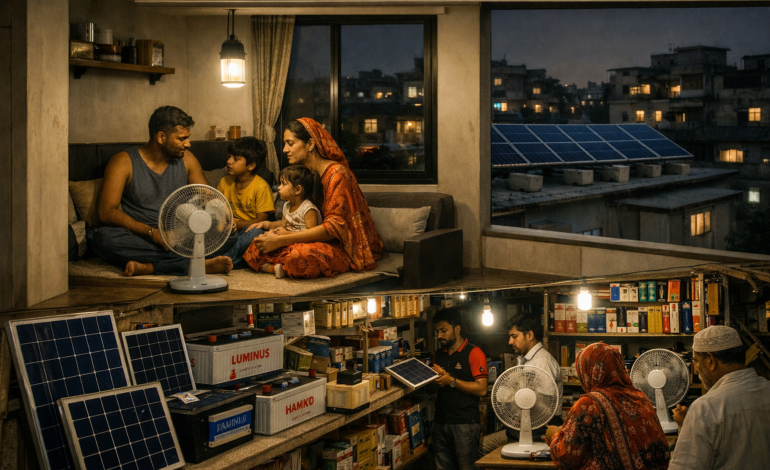
Retail markets in Dhaka, particularly Gulistan and Stadium Market, have seen a noticeable increase in customer traffic at shops selling solar and battery-powered equipment.
Traders report that products such as:
- Solar panels
- Rechargeable batteries
- Battery-powered fans
- LED lights
- Mobile charging systems
are now in high demand.
Retailers say that sales have increased significantly compared to previous months, with customers actively seeking alternatives to cope with unreliable electricity supply.
Interestingly, many buyers are no longer purchasing individual components. Instead, there is a growing preference for complete solar packages, which offer integrated solutions for powering multiple household appliances.
Popular Solar Packages and Pricing
The rising demand has led to a wider range of solar packages being available in the market, catering to different income groups and energy needs.
Typical packages currently available include:
- 65-watt systems: Tk12,000–Tk14,000
- 100-watt systems: Tk14,000–Tk16,000
- 100-watt with fan: Tk17,000–Tk19,000
- 150-watt systems: Tk20,000–Tk22,000
- High-capacity 150-watt: Tk32,000–Tk35,000
- 200-watt systems: Tk36,000–Tk39,000
These packages usually include solar panels, batteries, LED lights, charge controllers, and sometimes fans making them suitable for basic household needs.
For more advanced requirements, hybrid inverter systems are also gaining popularity. These systems, priced between Tk75,000 and Tk80,000, can support multiple appliances including televisions, routers, and fans.
Battery-Powered Devices Gain Popularity
Alongside solar panels, battery-powered appliances are also seeing increased demand.
Consumers are turning to:
- Rechargeable fans
- Portable LED lighting
- Battery-powered televisions
- Backup mobile charging units
These devices offer immediate relief during outages and are often more affordable than full solar systems.
Retailers in district towns such as Lakshmipur and Satkhira report that demand for such products has grown rapidly, particularly in areas where load-shedding is more frequent.
In many regions, battery-powered lighting has become essential for evening activities, highlighting the growing dependence on alternative energy solutions.
Rural Bangladesh Leading the Shift
While urban demand is rising, the most significant transformation is occurring in rural Bangladesh.
In areas where grid reliability has always been a challenge, the current crisis has accelerated the adoption of solar technology. Households are increasingly investing in solar systems to ensure uninterrupted power for essential needs.
This trend is particularly important for vulnerable groups, including children and elderly family members, who are more affected by prolonged power outages.
The shift also reflects Bangladesh’s long-standing success with off-grid solar solutions, with millions of solar home systems already in use across the country.
Changing Consumer Behavior
The ongoing energy crisis is fundamentally changing how people think about electricity.
Previously, solar power was considered an optional investment. Today, it is becoming a necessity.
Consumers are now prioritizing:
- Energy independence
- Reliability over cost
- Long-term savings over short-term expenses
This shift is evident in the growing demand for hybrid systems and complete solar setups rather than temporary fixes.
Experts say this behavioral change could have long-term implications for Bangladesh’s energy landscape.
Expert Insights: A Turning Point for Renewable Energy
Energy experts believe the current crisis could act as a catalyst for renewable energy adoption in Bangladesh.
Officials from the Sustainable and Renewable Energy Development Authority (SREDA) have noted increasing public interest in solar solutions, supported by policy initiatives introduced in recent years.
Analysts argue that Bangladesh has significant solar potential, given its geographic location and high levels of sunlight throughout the year.
However, challenges remain.
Experts highlight the need for:
- Government subsidies to make solar systems more affordable
- Improved quality control in the market
- Access to financing options such as soft loans
- Expansion of large-scale solar infrastructure
Addressing these issues could accelerate the transition toward a more sustainable energy system.
Industry Growth and Market Potential
The rapid increase in demand has created new opportunities for businesses in the solar and battery sector.
Companies involved in solar installation, battery manufacturing, and energy storage are witnessing strong growth, with the market expected to expand further in the coming years.
Bangladesh’s solar industry is already gaining momentum, supported by:
- Government policy incentives
- Rising electricity costs
- Increasing awareness of renewable energy
Industry observers believe that the current surge in demand could lead to long-term market expansion, attracting both local and international investment.
Challenges and Concerns
Despite the positive momentum, several challenges need to be addressed.
Affordability
Many households still find solar systems expensive, especially higher-capacity setups.
Quality Issues
There are concerns about the quality of some products available in the market, particularly low-cost batteries.
Lack of Awareness
Consumers often lack technical knowledge, leading to inefficient purchasing decisions.
Infrastructure Limitations
Large-scale solar adoption requires better infrastructure and grid integration.
Experts warn that without proper regulation and support, these challenges could slow down the sector’s growth.
A Shift From Crisis to Opportunity
While the current energy crisis has created significant challenges, it also presents an opportunity.
The surge in demand for solar and battery-powered products indicates a growing willingness among consumers to adopt renewable energy solutions.
If supported by effective policies and investments, this trend could help Bangladesh:
- Reduce dependence on fossil fuels
- Improve energy security
- Build a more resilient power system
Looking Ahead
The rising demand for solar and battery-powered products in Bangladesh is a direct response to the country’s ongoing power crisis.
What began as a short-term solution to load-shedding is now evolving into a long-term shift toward renewable energy.
As households and businesses continue to invest in alternative power sources, Bangladesh stands at a critical juncture where crisis-driven adaptation could pave the way for a more sustainable and energy-secure future.