
From Child Labour to Classroom: Al-Amin’s Second Chance Reflects Bangladesh’s Fight for Education

From Child Labour to Classroom: Al-Amin’s Second Chance Reflects Bangladesh’s Fight for Education
In a country where thousands of children still balance survival with lost opportunities, one story is quietly capturing national attention, not because it is unique, but because it shows what is possible when intervention meets determination.
The journey of Al-Amin, once a day labourer and night breadwinner, now a school student, offers a powerful lens into Bangladesh’s ongoing struggle against child labour and its push toward inclusive education.
But beyond the emotional appeal, his story raises a deeper question:
“Can Bangladesh systematically turn stories like his into the norm rather than the exception?”
A Childhood Split Between Survival and Sacrifice
For years, Al-Amin lived a life defined by responsibility far beyond his age. Like many children from low-income families, he was forced into work early not out of choice, but necessity.
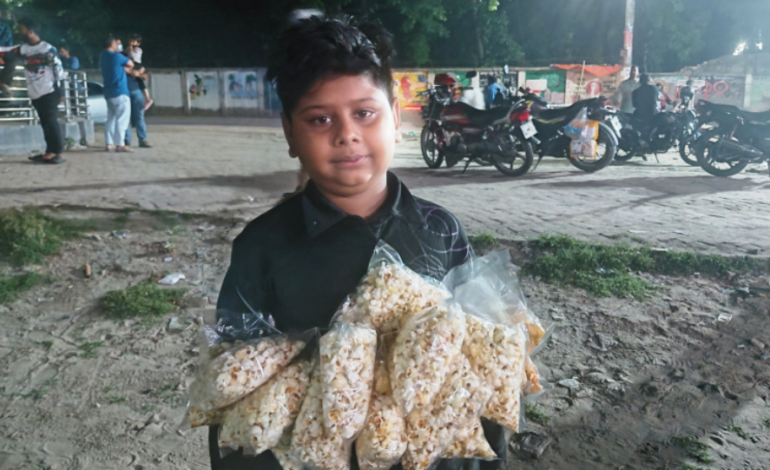
During the day, he worked to support his old grand parents. At night, he carried the burden of being a breadwinner by selling porpcorn, sacrificing what should have been his formative years of education and growth.
This dual existence is not uncommon in parts of Bangladesh, where economic hardship often pushes children into informal labour markets.
The child labour remains a persistent issue in the country particularly in urban slums and rural areas where access to education is limited and financial pressures are high.
The Turning Point: Access to Education
What sets Al-Amin’s story apart is not his struggle but his turning point.
After a report by the the Daily Star he came into spotlight. Through targeted intervention and support from the local school in Rangpur, he was given the opportunity to enroll in school for the first time. This shift from labour to learning, marks the beginning of a new chapter.
Education, in this context, is not just about literacy. It represents:
- A pathway out of poverty
- A chance to reclaim childhood
- A foundation for long-term stability
For children like Al-Amin, stepping into a classroom is nothing short of transformative.
Why Stories Like This Matter
It’s easy to frame Al-Amin’s journey as an inspiring human-interest story. But doing so risks overlooking its broader significance.
His experience highlights three critical realities:
1. Child Labour Is Often an Economic Issue, Not a Cultural Choice
Families rarely send children to work willingly. In most cases, it is a survival strategy driven by poverty.
2. Access Is the Real Barrier
Even when families value education, barriers such as cost, distance, and lack of support prevent enrollment.
3. Intervention Works
When systems step in through NGOs, government programs, or community initiatives children can transition back into education.
Bangladesh’s Ongoing Battle Against Child Labour
Bangladesh has made notable progress in expanding access to primary education. Enrollment rates have improved significantly over the past two decades.
However, challenges remain:
- Economic inequality continues to push children into labour
- Urban migration creates vulnerable populations in informal settlements
- Dropout rates increase at higher levels of education
The government and various organizations have introduced programs aimed at reducing child labour and encouraging school attendance. These include:
- Stipend programs for low-income families
- Free textbook distribution
- Non-formal education initiatives
Yet, stories like Al-Amin’s reveal that gaps still exist between policy and ground reality.
Education as Economic Strategy, Not Just Social Policy
Al-Amin’s transition from labourer to student is not just a social success, it is an economic investment.
Educated individuals are more likely to:
- Secure stable employment
- Contribute to national productivity
- Break cycles of generational poverty
In this sense, addressing child labour is not merely a humanitarian issue, it is a strategic priority for national development.
The Role of Community and Institutions
One of the most critical factors in Al-Amin’s story is the role played by institutions and individuals who facilitated his transition.
Whether through formal programs or informal support networks, these actors provide:
- Financial assistance
- Emotional encouragement
- Logistical support for school enrollment
Scaling such interventions is essential if Bangladesh hopes to replicate this success across thousands of similar cases.
The Psychological Shift: From Worker to Student
The transition from labour to education is not just physical, it is deeply psychological.
Children like Al-Amin must adapt to:
- Structured routines
- Academic expectations
- Social environments they may have missed for years
This adjustment requires support systems within schools, including:
- Flexible learning approaches
- Counseling and mentorship
- Inclusive classroom environments
Without these, many children risk dropping out again.
A Glimpse Into Bangladesh’s Future
Al-Amin’s story offers a glimpse into what Bangladesh’s future could look like if systemic barriers are addressed effectively.
Imagine a scenario where:
- No child is forced into labour due to poverty
- Every child has access to quality education
- Social safety nets prevent early dropout
While ambitious, this vision is not unattainable as it requires sustained policy commitment and grassroots execution.
The Bigger Question: Can This Be Scaled?
The real challenge is scalability.
Individual success stories, while inspiring, must translate into:
- Nationwide policy improvements
- Increased funding for education programs
- Stronger monitoring of child labour practices
If Bangladesh can replicate the conditions that enabled Al-Amin’s transition, the impact could be transformative.
Looking Ahead
The journey of Al-Amin is a powerful reminder that change is possible but not automatic.
It requires intervention, resources, and a collective commitment to ensuring that no child is forced to choose between survival and education.
As Bangladesh continues its development journey, stories like his should not remain exceptions. They should become the standard.
Because ultimately, the true measure of progress is not just economic growth, it is whether every child has the opportunity to learn, grow, and build a better future.
From child labour to classroom, Al-Amin’s story highlights Bangladesh’s fight for education and the need to turn individual success into nationwide change.