


Bangladesh Announces Free Undergraduate Education for Girls: A Landmark Step Toward Gender Equality
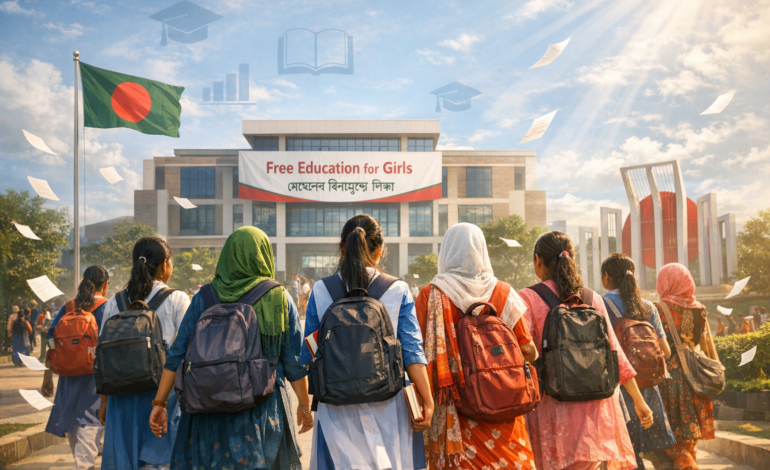
In a major policy shift aimed at transforming the country’s education landscape, Tarique Rahman has announced that girls’ education in Bangladesh will be made free up to the undergraduate level. The decision is being seen as one of the most ambitious education reforms in recent years, with far-reaching implications for gender equality, economic growth, and social development.
The announcement, made at a public rally in Jashore, builds on decades of progressive policies that have steadily expanded access to education for girls across Bangladesh.
A Historic Policy Announcement
According to official statements, the government plans to eliminate tuition fees for female students up to undergraduate and degree levels, significantly expanding existing benefits.
The Prime Minister framed the initiative as part of a long-term commitment to women’s empowerment. He also linked the policy to earlier reforms introduced by former Prime Minister Khaleda Zia, who had made education free for girls at secondary and later higher secondary levels.
“Khaleda Zia made secondary education free for girls between 1991 and 1996 to promote women’s education. Later, during the 2001-2006 term, she extended it to higher secondary level. To complete her unfinished work, we have decided to make girls’ education free up to the undergraduate and degree levels,” he said.
By extending this benefit to the undergraduate stage, the government aims to complete what it describes as an unfinished agenda in women’s education reform.
Building on a Strong Foundation
Bangladesh has long been recognized for its efforts to improve female education. Over the years, several initiatives have contributed to increased enrollment and retention of girls in schools.
Key milestones include:
- Free education for girls up to secondary level
- Stipend programs for female students
- Nationwide distribution of free textbooks
- Expansion of rural schooling infrastructure
These policies have already helped Bangladesh achieve near gender parity in primary and secondary education.
The new undergraduate-level initiative represents the next logical step in that progression.
Why This Policy Matters
1. Expanding Access to Higher Education
While many girls in Bangladesh complete secondary education, financial constraints often prevent them from pursuing university degrees. Removing tuition fees directly addresses this barrier.
2. Boosting Women’s Participation in the Workforce
Higher education is strongly linked to employment opportunities. By increasing the number of female graduates, the policy is expected to:
- Improve workforce participation
- Increase household incomes
- Strengthen the national economy
3. Reducing Early Marriage Rates
Education has a well-documented impact on delaying early marriage. When girls remain in school longer, they are more likely to:
- Marry later
- Have fewer and healthier children
- Achieve greater financial independence
Economic and Social Impact
The long-term impact of free undergraduate education for girls could be transformative.
Economic Growth
Educated women contribute significantly to GDP growth. Studies consistently show that increasing female education leads to higher productivity and innovation.
Poverty Reduction
Education enables women to secure better-paying jobs, reducing poverty at both household and national levels.
Health and Social Development
Educated women are more likely to:
- Invest in their children’s education
- Access healthcare services
- Participate in community decision-making
Challenges in Implementation
While the policy is ambitious, its success will depend on effective implementation.
Funding Constraints
Providing free education at the undergraduate level will require substantial government investment. Ensuring sustainable funding will be critical.
Infrastructure and Capacity
Universities may face increased enrollment pressure, requiring:
- More classrooms and facilities
- Additional faculty members
- Improved administrative systems
Quality Assurance
Expanding access must not come at the cost of quality. Maintaining academic standards will be essential.
Additional Support Measures
The government has indicated that the policy may be complemented by other initiatives aimed at supporting women.
These include:
- Expansion of stipend programs for high-performing students
- Welfare schemes such as the Family Card program
- Introduction of LPG cards to reduce household burdens for women
Together, these measures aim to create a comprehensive support system for women’s development.
Regional and Global Context
Bangladesh’s decision aligns with global trends emphasizing gender equality in education.
International organizations such as UNESCO and the World Bank have long advocated for:
- Universal access to education
- Gender parity in higher education
- Investment in human capital
By extending free education to the undergraduate level, Bangladesh positions itself as a regional leader in gender-focused education reform.
Public Reaction and Expectations
The announcement has generated widespread discussion among educators, students, and policymakers.
Supporters view it as:
- A bold and necessary step toward equality
- A continuation of Bangladesh’s education success story
- A potential game-changer for women’s empowerment
However, some analysts caution that the policy’s success will depend on:
- Clear implementation frameworks
- Transparent funding mechanisms
- Strong institutional support
What This Means for the Future
The introduction of free undergraduate education for girls could reshape Bangladesh’s socio-economic landscape over the next decade.
A More Skilled Workforce
An increase in female graduates will contribute to a more skilled and competitive workforce.
Greater Gender Equality
Education is one of the most effective tools for reducing gender disparities.
Long-Term National Development
By investing in women’s education, Bangladesh is investing in its future.