



Will victory of BJP in WB impact relations with Bangladesh?
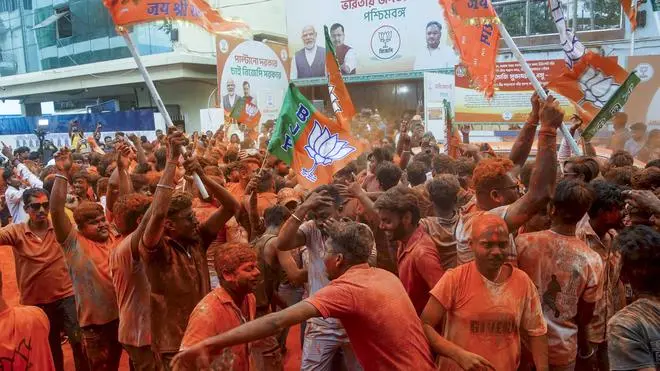

The West Bengal Legislative Assembly elections of 2026 have produced a historic political shift, with the Bharatiya Janata Party (BJP) securing a sweeping victory and ending over a decade of Trinamool Congress dominance.
This outcome is not merely a domestic political development in India. It has immediate and long-term implications for Bangladesh, a country deeply interconnected with West Bengal through geography, history, economy, and shared rivers. The West Bengal Legislative Assembly elections therefore carry significance far beyond India’s borders, especially for Dhaka–New Delhi relations.
Historical interdependence with cautious optimism
To understand the implications of the West Bengal Legislative Assembly elections, one must first examine the historical relationship between Bangladesh and India, particularly West Bengal.
West Bengal acts as a critical gateway between mainland India and Bangladesh. The two sides share over 2,200 kilometres of border, along with rivers, trade routes, cultural linkages, and migration flows. For decades, political dynamics in West Bengal have influenced bilateral cooperation on water sharing, border management, and connectivity.
Under the previous Trinamool Congress government, relations between Dhaka and Kolkata were sometimes complex. Chief Minister Mamata Banerjee had, for instance, opposed the Teesta water-sharing agreement, creating friction in India–Bangladesh diplomacy.
The West Bengal Legislative Assembly elections thus became crucial because they could remove or reinforce such state-level constraints on bilateral agreements.
At the national level, India’s BJP government has pursued closer ties with Bangladesh, particularly during Sheikh Hasina’s tenure. However, political rhetoric, especially around migration and identity, has periodically strained perceptions.
A landslide win that changes the eastern balance
The West Bengal Legislative Assembly elections of 2026 marked a turning point. The BJP’s victory, crossing a commanding majority, reflects a transformation in the state’s political landscape.
Several factors contributed to this outcome, including organisational strength, fragmented opposition votes, and targeted outreach strategies.
The victory also completes the BJP’s consolidation across eastern India, strengthening its influence in border regions adjacent to Bangladesh.
This shift is critical because, for the first time, the same political party now controls both the central government in New Delhi and the state government in West Bengal. This “double engine” governance structure may significantly alter the implementation of policies affecting Bangladesh.
Positive signals for cooperation despite political tension
In the immediate aftermath of the West Bengal Legislative Assembly elections, analysts and policymakers have highlighted both opportunities and concerns.
On the positive side, the BJP’s control of West Bengal may remove previous political barriers to bilateral agreements. Reports suggest that this alignment could facilitate progress on long-pending issues such as the Teesta water-sharing deal, cross-border connectivity, and trade facilitation.
Bangladesh’s government has also taken a measured approach. Officials have emphasised that bilateral relations will remain stable regardless of the outcome of the West Bengal Legislative Assembly elections.
This reflects Dhaka’s pragmatic foreign policy, which prioritises continuity over political fluctuations in neighbouring states.
However, there are also underlying tensions. During the campaign for the West Bengal Legislative Assembly elections, BJP leaders used strong rhetoric on illegal migration, often implicitly referring to Bangladesh.
Such narratives, while electorally effective, risk creating negative perceptions in Bangladesh and complicating diplomatic engagement.
Security concerns may intensify bilateral friction
One of the most sensitive areas influenced by the West Bengal Legislative Assembly elections is border management.
The BJP has consistently framed migration from Bangladesh as a security and demographic issue. Campaign narratives in the West Bengal Legislative Assembly elections emphasised terms such as “infiltrators” and “illegal entrants,” linking them to national security concerns.
If these narratives translate into stricter border enforcement, Bangladesh could face increased pressure regarding undocumented migration and repatriation.
There are already concerns within Bangladesh about potential “push-in” incidents, where individuals are forced across the border. These issues have historically strained bilateral relations and could resurface more prominently after the West Bengal Legislative Assembly elections.
At the same time, stronger coordination between New Delhi and Kolkata may improve border infrastructure and surveillance, potentially reducing illegal crossings in the long term.
Opportunities for growth
The West Bengal Legislative Assembly elections also have important economic implications for Bangladesh.
West Bengal serves as a key transit route for trade between India’s northeast and Bangladesh. Improved political alignment could enhance connectivity projects such as road, rail, and port linkages.
Greater coordination may lead to faster implementation of bilateral trade agreements, boosting exports and regional integration. Analysts suggest that trade flows and infrastructure cooperation are likely to benefit from the outcome of the West Bengal Legislative Assembly elections.
However, economic cooperation could be affected if political tensions over migration or identity issues escalate. Trade relations between neighbouring regions are often sensitive to public sentiment and political narratives.
Water diplomacy after West Bengal Legislative Assembly elections
Water sharing remains one of the most critical issues in Bangladesh–India relations, and the West Bengal Legislative Assembly elections could play a decisive role in this area.
The Teesta river agreement has been stalled for years due to opposition from the West Bengal state government. With the BJP now in power both at the centre and in the state, there is renewed optimism that the agreement could finally be concluded.
For Bangladesh, securing a fair share of Teesta waters is a priority, particularly for agriculture and livelihoods in northern regions.
However, water politics in India is complex and often influenced by local interests. Even after the West Bengal Legislative Assembly elections, domestic considerations in India may continue to delay progress.
Political rhetoric and perception
While policy alignment may improve cooperation, political rhetoric surrounding the West Bengal Legislative Assembly elections poses a significant challenge.
The BJP’s campaign frequently linked Bangladesh to issues of illegal migration and demographic change.
Such narratives can shape public opinion in both countries, potentially creating mistrust. In Bangladesh, these statements are often perceived as hostile, even if they are primarily intended for domestic political consumption in India.
The gap between diplomatic engagement and political rhetoric is therefore a key concern following the West Bengal Legislative Assembly elections.
Strategic patience with pragmatic engagement
The impact of the West Bengal Legislative Assembly elections must also be viewed in the context of Bangladesh’s own political landscape.
The 2026 general election in Bangladesh brought a new government to power, which has signalled a pragmatic approach towards India.
Dhaka appears committed to maintaining stable relations, focusing on mutual interests such as trade, connectivity, and regional security.
Officials have clearly stated that Bangladesh’s engagement with India will continue regardless of the outcome of the West Bengal Legislative Assembly elections.
This indicates a shift towards a more balanced and interest-driven foreign policy.
Three possible trajectories for Bangladesh–India relations
The long-term impact of the West Bengal Legislative Assembly elections on Bangladesh–India relations will depend on several factors.
Political alignment between New Delhi and Kolkata leads to faster implementation of agreements on water sharing, trade, and connectivity.
Despite political differences, both countries maintain stable relations through diplomatic engagement, while contentious issues remain unresolved.
Hardline rhetoric and stricter border policies create friction, leading to periodic diplomatic tensions.
Each of these scenarios is influenced by how the outcomes of the West Bengal Legislative Assembly elections are translated into policy.
A complex mix of opportunity and uncertainty
The West Bengal Legislative Assembly elections of 2026 represent a watershed moment in eastern India’s politics, with significant implications for Bangladesh.
On one hand, the BJP’s victory creates opportunities for improved cooperation, particularly in areas such as water sharing, trade, and connectivity. On the other hand, political rhetoric and border concerns pose risks to mutual trust.
Ultimately, the impact of the West Bengal Legislative Assembly elections will depend on how both governments navigate the balance between domestic politics and diplomatic priorities.
For Bangladesh and India, geography makes cooperation inevitable, but politics will determine whether that cooperation deepens or becomes more complicated in the years ahead.