


IMF Predicts Bangladesh to Overtake India in Per Capita GDP by 2026: What It Really Means

IMF Predicts Bangladesh to Overtake India in Per Capita GDP by 2026: What It Really Means
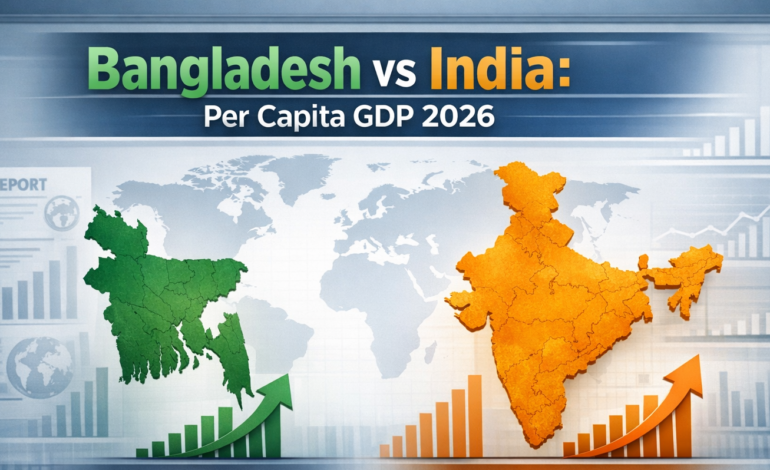
A recent projection by the International Monetary Fund (IMF) has sparked widespread debate across South Asia. According to its latest World Economic Outlook, Bangladesh is expected to surpass India in per capita GDP in 2026, a development that carries both economic and symbolic weight.
While the projected gap is relatively small, the implications are far-reaching. But does this mean Bangladesh’s economy is stronger than India’s? The answer is more complex than it appears.
IMF Projection: Bangladesh Slightly Ahead in 2026
According to IMF estimates, Bangladesh’s per capita GDP is expected to reach $2,911, compared to India’s $2,812 in 2026.
This marks a narrow lead of around $100 per person, small in absolute terms but significant in perception. It suggests that, on average, an individual in Bangladesh could generate slightly more economic output than one in India, at least based on current dollar calculations.
However, this is not the first time Bangladesh has overtaken India in this metric. Historically, Bangladesh has led India in per capita income during multiple periods, including between 2018 and recent years, before fluctuations reversed the trend.
Understanding Per Capita GDP: Why It Matters
Per capita GDP is calculated by dividing a country’s total economic output by its population. It is often used as a rough indicator of:
- Average income levels
- Standard of living
- Economic productivity per person
But crucially, when measured in current US dollars, the figure is heavily influenced by exchange rates.
This means that even if an economy grows steadily, currency depreciation can reduce its dollar-based per capita GDP, making international comparisons volatile.
The Currency Factor: A Key Driver Behind the Shift
One of the main reasons behind Bangladesh’s projected lead is exchange rate movement.
Both the Bangladeshi taka and the Indian rupee have experienced fluctuations against the US dollar. However, differences in the rate of depreciation can significantly affect per capita GDP calculations.
As highlighted in the IMF analysis, the 2026 crossover reflects how exchange-rate dynamics have brought the two economies’ income levels very close in dollar terms.
In simple terms:
- A weaker currency reduces GDP when converted to dollars
- A relatively stable currency can boost comparative rankings
This explains why such crossovers can happen even without major structural changes in the economy.
The Bigger Picture: India’s Economy Is Still Much Larger
Despite Bangladesh’s projected lead in per capita GDP, India’s overall economy remains significantly larger.
- India’s economy is valued at nearly $3.9 trillion
- Bangladesh’s economy stands at around $458 billion
This means India’s total economic output is roughly eight times larger than Bangladesh’s.
So while Bangladesh may edge ahead on a per-person basis, India still dominates in:
- Total GDP
- Global economic influence
- Industrial scale
PPP vs Nominal GDP: A More Accurate Comparison?
To better understand living standards, economists often use Purchasing Power Parity (PPP)-adjusted GDP.
Unlike nominal GDP, PPP accounts for the actual cost of living and purchasing power within each country.
Under this measure:
- India remains significantly ahead of Bangladesh
- The gap is expected to widen in the coming years
For example:
- India’s PPP per capita GDP is projected to remain higher through 2031
- Bangladesh still trails when adjusted for real purchasing power
This suggests that while nominal figures may show a temporary crossover, real income differences still favor India.
A Temporary Shift? IMF’s Long-Term Outlook
The IMF does not expect Bangladesh to maintain this lead for long.
According to projections:
- India is likely to regain the lead in 2027
- The gap will gradually widen in India’s favor through 2031
This indicates that the 2026 crossover is more of a short-term statistical shift rather than a long-term economic transformation.
Why Bangladesh’s Growth Story Still Matters
Even if the lead is temporary, Bangladesh’s economic progress remains noteworthy.
Over the past decade, the country has shown strong performance in:
- Export growth, especially in the garment sector
- Remittance inflows from overseas workers
- Women’s workforce participation
- Steady GDP expansion
Bangladesh is also on track to graduate from the Least Developed Country (LDC) category, marking a major milestone in its development journey.
Challenges Facing Bangladesh’s Economy
Despite positive projections, Bangladesh faces several economic challenges:
- Rising inflation and global economic uncertainty
- Pressure from energy imports and commodity prices
- Increasing debt repayment obligations
- Currency volatility
Additionally, reliance on a few key export sectors makes the economy vulnerable to global demand shocks.
Regional Reactions and Debate
The IMF projection has sparked strong reactions, particularly in India.
Some economists described the development as “surprising,” while others argued that it reflects statistical quirks rather than deep structural changes.
The debate highlights a broader issue: how economic indicators are interpreted in public discourse.
What This Means for South Asia
The Bangladesh-India comparison reflects a shifting economic landscape in South Asia.
Key takeaways include:
- Smaller economies can achieve rapid per capita growth
- Exchange rates play a critical role in global comparisons
- Economic rankings are dynamic and often temporary
It also underscores increasing competition and interdependence between neighboring economies.
Symbolic Victory or Economic Reality?
The IMF’s projection that Bangladesh will surpass India in per capita GDP in 2026 is both significant and nuanced.
On one hand, it highlights Bangladesh’s impressive economic progress and resilience. On the other, it reflects the limitations of relying solely on nominal GDP metrics for comparison.
Ultimately, this is less about one country “beating” another and more about understanding how economic indicators work. The real story lies in long-term growth, structural reforms, and improving living standards for citizens.