

Metro Rail Expansion from Bhatara to Hemayetpur Gains Momentum: Dhaka’s Game-Changer by 2030
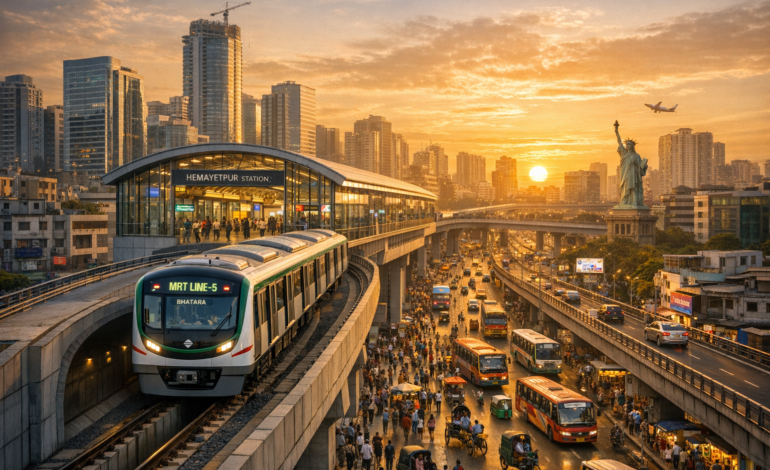

Metro Rail Expansion from Bhatara to Hemayetpur Gains Momentum: Dhaka’s Game-Changer by 2030
Dhaka, one of the world’s most densely populated cities, is taking another major step toward transforming its urban transport system. The planned metro rail expansion from Bhatara to Hemayetpur part of the MRT Line 5 Northern Route is gaining momentum, with authorities targeting a full launch by 2030.
This ambitious project is expected to redefine how millions of people travel across the capital, cutting journey times, easing traffic congestion, and modernizing Dhaka’s infrastructure.
A Landmark Project in Dhaka’s Transport Evolution
The Bhatara–Hemayetpur metro rail extension is not just another infrastructure project it is a cornerstone of the broader Dhaka Metro Rail network.
Spanning approximately 20 kilometres, the route will connect the eastern part of Dhaka (Bhatara) with the western outskirts (Hemayetpur in Savar). It is designed as a combination of:
- Underground rail (about 13.5 km)
- Elevated track (around 6.5 km)
This hybrid design allows the system to navigate densely populated urban areas while maintaining efficiency and speed.
The project is being developed in 10 construction packages, enabling parallel progress across multiple segments.
First East-West Metro Corridor in Dhaka
One of the most significant aspects of this project is that it will be Dhaka’s first east-west metro corridor.
Currently, most of the city’s transport infrastructure is aligned north-south, which contributes to severe congestion. The new route will:
- Link key residential and commercial zones
- Provide alternative travel options
- Reduce dependency on road transport
Once operational, it is expected to carry around 1.23 million passengers daily, making it one of the busiest metro lines in the country.
Stations and Route Coverage
The MRT Line 5 Northern Route will feature a total of 14 stations, strategically located across major urban hubs.
Underground Stations:
- Gabtoli
- Darus Salam
- Mirpur-1
- Mirpur-10
- Mirpur-14
- Kachukhet
- Banani
- Gulshan-2
- Natun Bazar
Elevated Stations:
- Hemayetpur
- Baliarpur
- Bilamalia
- Amin Bazar
- Bhatara
These stations are designed to connect key economic and residential zones, significantly improving accessibility across Dhaka.
Travel Time: From Hours to Minutes
One of the most compelling benefits of this metro line is its ability to drastically reduce travel time.
Currently, commuting between Bhatara and Hemayetpur can take several hours, especially during peak traffic. With the new metro line:
- Travel time will be reduced to just 32 minutes
- Commuters will experience predictable and efficient journeys
This shift could have a transformative impact on daily life, particularly for office workers, students, and business professionals.
Progress So Far: Construction and Development
As of 2026, significant progress has already been made on the project.
- Hemayetpur depot development is nearly 78% complete
- Land acquisition for stations and tracks is ongoing
- Basic design and planning phases have been finalized
Officials confirm that construction work is advancing steadily, with the goal of completing the project by 2030.
Investment and Financing
The MRT Line 5 Northern Route is a large-scale investment, with an estimated cost of approximately Tk 41,238 crore.
Funding is being provided through a combination of:
- Government of Bangladesh
- Japan International Cooperation Agency support
JICA is contributing a significant portion of the financing, reflecting strong international confidence in Bangladesh’s infrastructure development.
Advanced Technology and Sustainability
The project incorporates modern engineering and environmental considerations.
Key Features:
- Continuous welded rails to reduce vibration
- Sound barrier walls for noise control
- Energy-efficient electric trains
These measures aim to ensure that the metro system is not only efficient but also environmentally sustainable.
Urban planners emphasize that this project aligns with global trends in green transportation, reducing carbon emissions and promoting public transit usage.
Impact on Traffic Congestion
Dhaka is notorious for its traffic congestion, often ranking among the worst in the world.
The Bhatara–Hemayetpur metro line is expected to:
- Reduce the number of private vehicles on roads
- Improve traffic flow in major corridors
- Decrease commuting stress
With a capacity of over 53,000 passengers per hour in both directions, the system will significantly ease pressure on the city’s road network.
Economic and Social Benefits
Beyond transportation, the metro rail expansion will have wide-ranging economic and social impacts.
Economic Growth:
- Increased productivity due to reduced travel time
- Boost to local businesses near stations
- Job creation during construction and operation
Urban Development:
- Improved connectivity between city and suburbs
- Rise in property values along the corridor
- Better access to education and healthcare
Social Impact:
- Enhanced quality of life
- Safer and more reliable commuting options
- Greater inclusivity in urban mobility
Challenges Ahead
Despite strong progress, the project faces several challenges.
Land Acquisition Issues
Acquiring land in densely populated areas remains complex and time-consuming.
Coordination with Road Projects
There have been concerns about alignment conflicts with existing highway plans, particularly near Amin Bazar.
Meeting Deadlines
Large infrastructure projects in Bangladesh often face delays, raising questions about whether the 2030 deadline will be met.
However, authorities remain optimistic, citing improved project management and international collaboration.
Dhaka’s Future Metro Network
The Bhatara–Hemayetpur route is part of a larger vision to transform Dhaka’s transport system.
The metro network will eventually include multiple lines, creating an interconnected system across the city.
Projects like:
- MRT Line 1
- MRT Line 6 (already operational)
- Other planned routes
are all part of a comprehensive strategy to modernize urban mobility.
Together, these developments aim to position Dhaka as a smart, connected megacity.
A Step Toward a Modern Dhaka
The metro rail expansion reflects Bangladesh’s broader ambition to invest in infrastructure and improve urban living standards.
For decades, Dhaka has struggled with:
- Overpopulation
- Traffic congestion
- Limited public transport options
Projects like MRT Line 5 represent a shift toward sustainable and efficient solutions.
Looking Ahead
The metro rail expansion from Bhatara to Hemayetpur is more than just a transportation project it is a transformative initiative that could reshape Dhaka’s future.
With a targeted launch by 2030, the project promises:
- Faster and more reliable commuting
- Reduced traffic congestion
- Enhanced economic opportunities
While challenges remain, the progress so far indicates that Bangladesh is moving in the right direction.
As construction continues, millions of Dhaka residents are looking forward to a future where commuting is no longer a daily struggle but a seamless, efficient experience.