




Japanese Economic Zone in Bangladesh Gains Momentum with $353 Million Investment
Bangladesh is rapidly positioning itself as a major destination for foreign direct investment (FDI), and the Japanese Economic Zone (JEZ) in Narayanganj is emerging as a key pillar of this transformation. With confirmed investments of $353 million from 12 companies and more firms in the pipeline, the project reflects growing global confidence in Bangladesh’s industrial potential and economic stability.
What Is the Japanese Economic Zone?
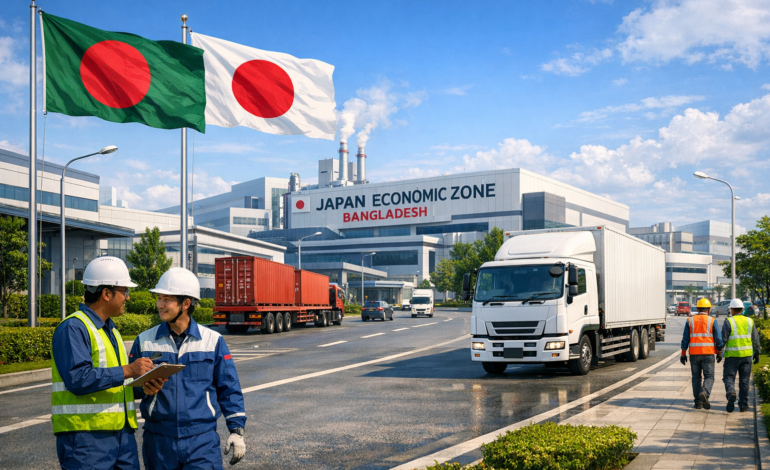
The Japanese Economic Zone, also known as the Bangladesh Special Economic Zone (BSEZ), is a flagship industrial project jointly developed by the Bangladesh government and Japan. Located in Araihazar, Narayanganj just 32 kilometers from Dhaka spans approximately 1,000 acres and is designed to host high-quality manufacturing and export-oriented industries.
The project is being implemented through collaboration between the Bangladesh Economic Zones Authority (BEZA) and Japan’s Sumitomo Corporation, with financial and technical support from the Japan International Cooperation Agency (JICA).
$353 Million Investment: A Strong Start
The zone has already secured $353 million in investment commitments from 12 companies, signaling strong early traction. These companies represent a mix of Japanese and international firms across sectors such as electronics, textiles, chemicals, and light engineering.
This initial wave of investment is only the beginning. Authorities confirm that several more companies are in advanced discussions, with the long-term goal of attracting around 100 companies and up to $1 billion in total investment.
Such momentum demonstrates that Bangladesh is increasingly seen as a viable alternative manufacturing hub in Asia.
Why Global Companies Are Choosing Bangladesh
The rise of the Japanese Economic Zone must be understood within the broader global economic context. Multinational companies are actively diversifying supply chains, especially under the “China Plus One” strategy, which encourages firms to expand production beyond China.
Bangladesh offers several competitive advantages:
- Cost-effective labor: A young and affordable workforce makes manufacturing highly competitive.
- Strategic location: Proximity to major Asian markets and shipping routes enhances export potential.
- Policy incentives: Investors benefit from tax holidays, duty-free imports, and simplified regulations within economic zones.
- Stable growth: Bangladesh has maintained consistent economic growth over the past decade.
These factors have contributed to a steady increase in Japanese business presence, with over 300 Japanese companies already operating in Bangladesh.
Infrastructure Designed for Global Standards
One of the defining features of the Japanese Economic Zone is its commitment to world-class infrastructure. Unlike traditional industrial areas, the JEZ is being developed to meet international standards, ensuring efficiency, sustainability, and investor confidence.
Key infrastructure components include:
- Dedicated power supply systems, with capacity expected to reach up to 100MW
- Modern road networks capable of supporting heavy industrial transport
- Water treatment and effluent management facilities
- Reliable gas and telecommunications connectivity
This integrated approach aims to eliminate common bottlenecks faced by industries in developing economies.
Sectoral Diversity and Industrial Potential
The JEZ is not limited to a single industry. Instead, it is designed as a multi-sector industrial hub, accommodating a wide range of manufacturing activities.
Key sectors expected to operate within the zone include:
- Automobile assembly and components
- Electronics and electrical appliances
- Textile chemicals and garments
- Agro-processing and food production
- Pharmaceuticals and light engineering
Major global brands and suppliers including companies linked to automotive and electronics industries—have already shown interest in setting up operations in the zone.
This diversification enhances the resilience of the zone and aligns with global demand trends.
Employment and Economic Impact
The Japanese Economic Zone is expected to create approximately 10,000 jobs once fully operational.
These jobs will range from factory work to technical and managerial roles, contributing to skill development and income growth in Bangladesh. However, experts note that the country will need to invest in technical education and workforce training to meet the demands of advanced manufacturing industries.
Beyond employment, the JEZ is expected to:
- Boost exports significantly
- Strengthen industrial supply chains
- Increase foreign currency earnings
- Encourage technology transfer and innovation
Strategic Importance for Bangladesh–Japan Relations
The JEZ is more than just an industrial project as it represents a deepening economic partnership between Bangladesh and Japan.
Japan holds a majority stake in the project, reflecting its strong commitment to Bangladesh’s economic development.
For Japan, the zone provides access to a cost-effective manufacturing base. For Bangladesh, it brings capital, technology, and global market integration.
This partnership could serve as a model for future collaborations, including potential economic zones in Chattogram and Cox’s Bazar if the Araihazar project succeeds.
Challenges and Considerations
While the Japanese Economic Zone holds immense promise, several challenges must be addressed to ensure its long-term success:
1. Skilled Workforce Shortage
Bangladesh currently lacks sufficient technically trained workers for high-end manufacturing. Addressing this gap will be critical.
2. Infrastructure Execution
Although plans are ambitious, timely completion of infrastructure remains essential.
3. Environmental Management
Industrial zones must ensure compliance with environmental standards to maintain sustainability.
4. Global Competition
Bangladesh competes with countries like Vietnam and India for foreign investment, requiring continuous policy improvements.
A Global Manufacturing Hub?
The Japanese Economic Zone represents a turning point in Bangladesh’s industrial journey. With strong investor interest, robust infrastructure plans, and strategic global positioning, the project has the potential to transform the country into a regional manufacturing powerhouse.
As more companies join the pipeline and production begins at scale, the JEZ could significantly reshape Bangladesh’s economic landscape—moving it from a primarily garment-based economy to a diversified industrial hub.
In a Nutshell
The Japanese Economic Zone in Bangladesh is rapidly taking shape as one of the most promising industrial projects in South Asia. With $353 million already committed and a strong pipeline of future investments, the zone highlights Bangladesh’s growing appeal to global investors.
If executed effectively, the JEZ could serve as a catalyst for economic transformation driving industrialization, job creation, and international trade. For global businesses seeking new manufacturing destinations, Bangladesh is no longer just an option, it is becoming a strategic choice.