
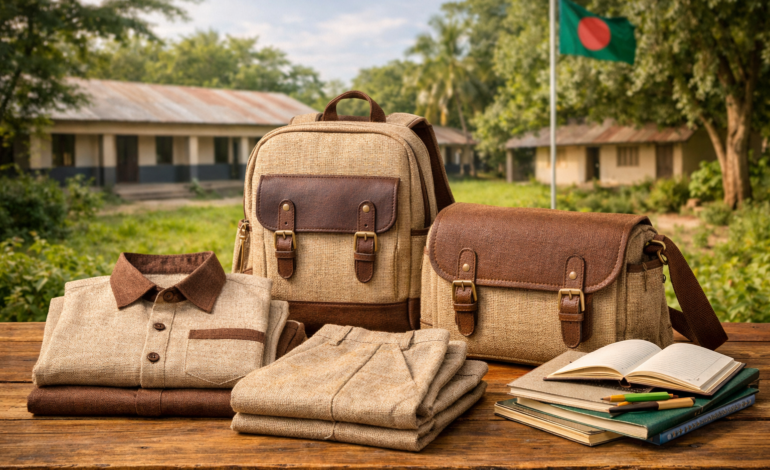

Bangladesh to Provide Free Jute-Made Uniforms and Schoolbags: A Sustainable Shift in Education Policy
In a significant policy move that blends education support with environmental sustainability, the Government of Bangladesh has announced a nationwide initiative to provide free school uniforms and schoolbags made from jute to primary-level students. The program, set to begin in July 2026, is expected to benefit thousands of children while revitalizing the country’s traditional jute industry.
This initiative highlights Bangladesh’s dual focus on supporting low-income families and promoting eco-friendly alternatives in public policy.
A Nationwide Initiative Starting July 2026
The government planned to roll out the program across all upazilas, marking a major expansion in school support services.
Prime Minister Tarique Rahman announced the decision at a meeting on the distribution of the schoolbags at his office in the Secretariat on Wednesday, Additional Press Secretary Atiqur Rahman Rumon told reporters.
“This programme aims to protect the domestic jute industry and help the country reduce environmental pollution,” Rumon said.
The prime minister’s education adviser, Mahdi Amin said distribution would begin in July at two schools in each upazila selected by the local administration.
“In the first month, 100,000 students at primary schools will be given free schoolbags and uniforms,” he said, adding that all primary school students would gradually be brought under the scheme.
Key Highlights:
- Launch scheduled for July 2026
- Initial phase to cover 100,000 students
- Target: Primary-level students nationwide
The program aims to gradually expand, eventually reaching millions of students across Bangladesh.
Why Jute? A Strategic and Sustainable Choice
Jute, often referred to as the “golden fiber” of Bangladesh, has long been a cornerstone of the country’s agricultural and export economy.
By choosing jute as the primary material for uniforms and schoolbags, the government is addressing multiple objectives:
Environmental Benefits
- Biodegradable and eco-friendly
- Reduces reliance on plastic-based materials
- Supports global sustainability goals
Economic Impact
- Boosts demand for locally produced jute
- Supports farmers and small-scale industries
- Revives a sector that has faced global competition
This move aligns with global trends toward sustainable materials while reinforcing Bangladesh’s traditional strengths.
Supporting Students and Families
One of the core goals of this initiative is to reduce the financial burden on families, particularly in rural and low-income communities.
Direct Benefits for Students:
- Free uniforms eliminate clothing costs
- Schoolbags improve access to basic learning tools
- Encourages regular school attendance
For many families, the cost of school supplies can be a barrier to education. By removing these expenses, the program promotes greater inclusivity in primary education.
Strengthening the Education System
Beyond financial support, the initiative also contributes to improving the overall learning environment.
Positive Outcomes Expected:
- Increased enrollment rates
- Reduced dropout rates
- Greater uniformity and discipline in schools
Providing standard uniforms can also foster a sense of equality among students, minimizing visible economic disparities in classrooms.
Reviving Bangladesh’s Jute Industry
The jute sector has historically played a vital role in Bangladesh’s economy. However, in recent decades, it has faced challenges due to competition from synthetic materials.
This government initiative could serve as a major boost to the industry.
Potential Impact:
- Increased domestic demand for jute products
- Job creation in manufacturing and supply chains
- Encouragement for innovation in jute-based goods
By integrating jute into public programs, the government is creating a sustainable demand cycle that benefits both industry and society.
Aligning with Global Sustainability Goals
The use of jute-based products aligns with international efforts to reduce plastic waste and promote environmentally friendly alternatives.
Globally, there is increasing pressure on governments to:
- Reduce carbon footprints
- Encourage sustainable production
- Support green industries
Bangladesh’s initiative positions the country as a leader in eco-conscious policymaking, particularly among developing nations.
Implementation Strategy and Challenges
While the initiative is promising, its success will depend on effective implementation.
Key Challenges:
- Ensuring timely production and distribution
- Maintaining quality standards for uniforms and bags
- Coordinating logistics across all upazilas
Government Approach:
- Phased rollout starting with 100,000 students
- Collaboration with local manufacturers
- Monitoring and evaluation mechanisms
Addressing these challenges will be crucial to achieving long-term success.
Social and Cultural Impact
The introduction of jute-based uniforms also carries symbolic significance.
It reflects:
- A return to locally sourced materials
- Pride in national heritage
- A shift toward self-reliance
For students, wearing uniforms made from Bangladesh’s traditional fiber could foster a sense of identity and connection to the country’s cultural roots.
A Step Toward Sustainable Public Policy
This initiative is part of a broader trend in Bangladesh’s policymaking, where economic development is increasingly linked with sustainability.
By combining:
- Education support
- Environmental responsibility
- Industrial growth
the government is adopting a holistic approach to development.
Future Expansion Plans
If successful, the program could expand in several ways:
Possible Developments:
- Inclusion of secondary school students
- Introduction of additional jute-based products
- Export opportunities for similar initiatives
Such expansion could further strengthen Bangladesh’s position as a global leader in sustainable solutions.
Public Response and Expectations
The announcement has generated positive reactions among educators, parents, and industry stakeholders.
Key Expectations:
- Smooth implementation
- High-quality products
- Long-term continuation of the program
Many see this initiative as a practical and impactful step toward improving both education and environmental outcomes.
Looking Ahead
The decision to provide free jute-made uniforms and schoolbags to primary students represents a forward-thinking policy that addresses multiple national priorities.
It supports:
- Students and families
- The jute industry
- Environmental sustainability
If implemented effectively, this initiative could serve as a model for other countries seeking to integrate education policy with sustainable development.
As Bangladesh moves forward, programs like this demonstrate how innovative ideas can create meaningful change, benefiting both people and the planet.