




Why Bangladesh’s Blue Economy Needs Long-Term Reform, Not Quick Fixes
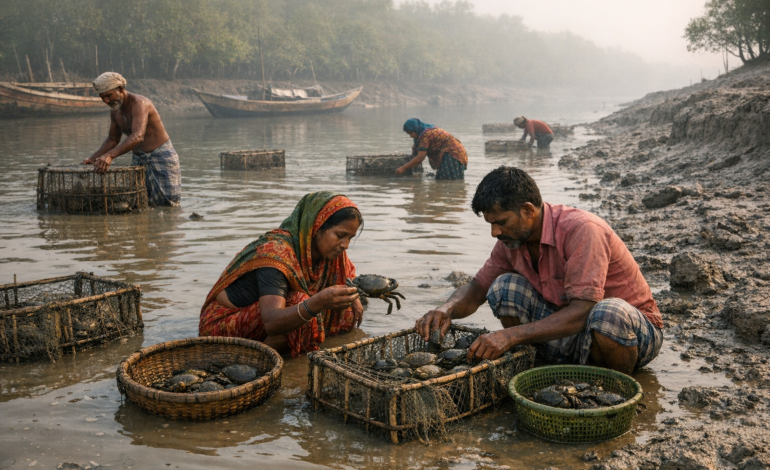
Bangladesh’s coastal economy is quietly powered by a small but valuable resource called mud crabs. Over the past few decades, crab farming and exports have evolved from a marginal activity into a promising sector within the country’s blue economy. However, beneath this growth lies a structural crisis due to severe shortage of sustainable crab seed supply.
While policymakers and entrepreneurs have increasingly looked for quick technological fixes, experts argue that Bangladesh’s crab seed crisis is not a problem that can be solved overnight. Instead, it reflects deeper issues within the country’s marine resource management, research ecosystem, and policy framework.
The Hidden Backbone of a Growing Export Industry
Mud crab farming, particularly in the coastal districts of Khulna, Satkhira, and Cox’s Bazar, has become a key contributor to Bangladesh’s seafood exports. Once an incidental catch in estuarine waters, crabs are now cultivated and exported to high-value markets in East Asia, where demand continues to rise.
The sector supports thousands of coastal livelihoods, from collectors and farmers to exporters. More importantly, it is considered a high-potential segment of Bangladesh’s blue economy, which includes all economic activities related to oceans, seas, and coastal resources.
However, the sustainability of this sector depends heavily on one critical input: crab seeds.
The Core Problem: Overdependence on Wild Crab Seeds
At present, Bangladesh relies overwhelmingly on wild crab seed collection rather than hatchery-produced seeds. This practice has led to several structural problems:
- Overharvesting of natural crab populations
- Damage to coastal ecosystems
- Unstable supply for farmers and exporters
The demand for small crabs—especially for soft-shell crab production—has intensified pressure on wild stocks. Processors often use even very small crabs, accelerating depletion.
This unsustainable extraction model threatens not only the crab industry but also the broader marine ecosystem that supports it.
Why Quick Technological Fixes Are Failing
One of the most common responses to the crisis has been to attempt importing or replicating foreign hatchery technologies. However, experts caution that such “plug-and-play” solutions are unlikely to succeed in Bangladesh’s unique ecological context.
Crab hatchery development is highly complex. It depends on:
- Local water salinity and temperature conditions
- Species-specific biological characteristics
- Availability of suitable feed for larval stages (zoea)
- Technical expertise and long-term research
As highlighted in the analysis, Bangladesh cannot simply purchase a “crab hatchery in a box”; solutions must be tailored to local environments and species.
This is where many short-term initiatives fall short—they focus on immediate outputs rather than building a sustainable knowledge base.
Research and Institutional Investment
A major gap in Bangladesh’s blue economy strategy is the lack of long-term scientific investment in marine aquaculture.
Although organisations like:
- Department of Fisheries (DoF)
- Bangladesh Fisheries Research Institute (BFRI)
- FAO and WorldFish
have contributed to early groundwork, efforts remain fragmented and often short-lived.
Experts argue that what is needed instead is:
- A decade-long national research programme
- Funding for postgraduate and field-level research
- Development of locally adapted hatchery systems
- Strengthening of training and extension services
Without sustained investment, hatchery development will remain experimental rather than commercially viable.
Blue Economy at Risk
The crab seed crisis reflects a broader challenge within Bangladesh’s blue economy: balancing economic growth with environmental sustainability.
Following maritime boundary settlements with India and Myanmar, Bangladesh gained access to vast marine resources, opening new opportunities for fisheries, aquaculture, and marine industries.
However, the sector faces multiple risks:
- Overfishing and resource depletion
- Climate change impacts (cyclones, salinity intrusion)
- Weak regulatory enforcement
- Limited technological capacity
Crab farming is just one example of how these challenges intersect. Without sustainable practices, short-term gains could lead to long-term losses.
A Policy Shift: Creating Demand for Hatchery Seeds
One of the most effective solutions proposed is a market-driven policy intervention.
Instead of focusing solely on supply (hatcheries), policymakers can influence demand by requiring processors to source a certain percentage of crabs from hatcheries.
Such a policy would:
- Create immediate market demand for hatchery-produced seeds
- Encourage private investment in hatchery development
- Reduce dependence on wild seed collection
This approach addresses both economic and environmental concerns simultaneously.
Climate and Environmental Pressures Add Urgency
Bangladesh’s coastal ecosystems are already under stress from climate change, including rising sea levels, cyclones, and salinity intrusion.
Marine aquaculture systems, including crab farming, are particularly vulnerable to these changes. Disruptions in water quality and habitat conditions can directly affect crab survival and reproduction.
This makes sustainable seed production even more critical. Without it, the entire value chain—from farmers to exporters—remains exposed to environmental shocks.
The Human Impact: Coastal Livelihoods at Stake
The crab sector is not just an economic activity; it is a lifeline for coastal communities.
Thousands of families depend on:
- Collecting wild crab seeds
- Farming and fattening crabs
- Processing and exporting seafood
However, as wild stocks decline, these livelihoods become increasingly uncertain.
A transition to hatchery-based systems could:
- Stabilize income for farmers
- Reduce environmental degradation
- Create new employment opportunities in aquaculture technology
But this transition must be carefully managed to avoid disrupting existing livelihoods.
The Way Forward: Building a Sustainable Ecosystem
To address the crab seed crisis effectively, Bangladesh needs a holistic, long-term strategy rather than isolated interventions.
Key priorities should include:
1. Long-Term Research Investment
Develop locally adapted hatchery technologies through sustained funding and academic collaboration.
2. Policy Reforms
Introduce regulations that encourage hatchery-based sourcing while limiting unsustainable wild collection.
3. Private Sector Engagement
Support entrepreneurs with incentives, financing, and technical assistance.
4. Capacity Building
Train farmers, technicians, and researchers in advanced aquaculture practices.
5. Environmental Protection
Strengthen conservation efforts in mangrove ecosystems, which are critical habitats for crab populations.
A Test Case for Bangladesh’s Blue Economy
The crab seed crisis is more than a sector-specific issue—it is a test case for Bangladesh’s broader blue economy ambitions.
If the country can successfully transition from resource extraction to sustainable aquaculture, it will set a precedent for other marine sectors.
But achieving this requires a shift in mindset—from short-term fixes to long-term investment, from imported solutions to local innovation, and from exploitation to sustainability.
Only then can Bangladesh unlock the full potential of its coastal resources while ensuring that future generations continue to benefit from them.