



Turning Sandy Soil into Sweet Success: Watermelon Revolution in Jamuna Char Lands

Turning Sandy Soil into Sweet Success: Watermelon Revolution in Jamuna Char Lands
In the shifting sands of the Jamuna char lands of Bhuiyanpur upazila in Tangail, a remarkable agricultural breakthrough is taking root. Suman Mia, a 28-year-old college student turned innovator, has successfully cultivated high-quality watermelons in areas previously considered unsuitable for such crops. His achievement is attracting attention from farmers, policymakers, and agricultural experts, offering a blueprint for sustainable development in Bangladesh’s flood-affected char regions.
This story is not only about agricultural experimentation. It reflects resilience, innovation, and a shift in mindset — transforming “unproductive” land into a source of income and food security. In a country where river erosion frequently displaces families and disrupts farming cycles, Suman’s success offers both hope and a practical model for future ventures.
From Classroom to Char Field: The Journey of a Young Farmer
Suman Mia’s journey is unique. A degree student at Bhuiyanpur Government Ibrahim Khan College, Suman was not born into a long line of commercial farmers nor did he inherit traditional agricultural expertise. Rather, his interest grew from curiosity and self-education.
After experimenting successfully with maize and almonds in char lands, Suman turned to watermelon — a crop few dared to try in the sandy soil along the Jamuna River. Inspired by online cultivation videos, particularly on platforms like YouTube, he decided to test the feasibility of watermelon cultivation in an area historically dominated by high-risk crops such as tobacco.
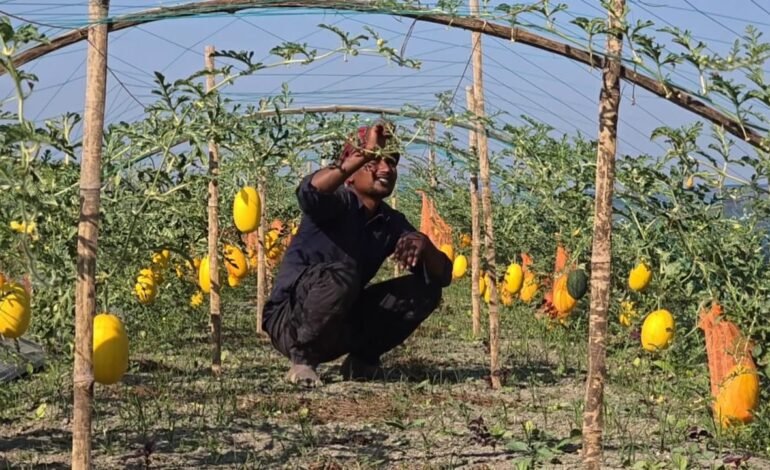
With determination and a willingness to defy conventional wisdom, Suman managed to convert five bighas (about two acres) of unused, erosion-prone land into a thriving watermelon farm. His efforts are now creating buzz among local agricultural circles.
Watermelon Cultivation in Char Lands: Techniques and Varieties
The cultivation that Suman introduced focused on three specific watermelon varieties: Tripti, Madhumala, and Pakija. Each has distinct characteristics:
- Tripti and Madhumala: Yellow on the outside with sweet, juicy flesh
- Pakija: Traditional green-skinned variety with red, succulent flesh
- Fruits typically weigh between 5–7 kilograms, making them ideal for both local consumption and commercial sale.
Watermelon as a winter crop requires only about three months to mature, which makes it a strategically ideal crop in char lands. Its short growth cycle reduces the risk posed by unpredictable flooding and soil erosion, common challenges in the Jamuna char region.
Suman, who invested around Taka 6 lakh in his first watermelon venture, expects about Taka 5 lakh in profit from this single harvest, a remarkable return on investment that highlights the economic potential of char farming.
Breaking Norms: Moving Beyond Tobacco and Traditional Crops
The Jamuna char lands have long been seen as marginal farmland. In the past, local farmers primarily planted almonds, maize or tobacco, crops that can tolerate nutrient-poor soils and erratic water exposure. However, tobacco farming, while providing income, carries health and environmental concerns, prompting calls for alternative crops.
Suman’s success with watermelon, a nutritious and high-demand fruit, is shifting that paradigm. Watermelon brings multiple advantages:
- Higher Market Prices: Off-season watermelons fetch premium prices in marketplaces.
- Lower Production Costs: Compared to long-term or high-risk crops.
- Short Growth Cycle: Reduces exposure to environmental risks.
- Health Benefits: Fruit is rich in vitamins, antioxidants, and natural hydration.
His farm has attracted visitors from nearby villages, and at least 10 farmers who previously grew tobacco have already expressed interest in switching to watermelon cultivation in upcoming seasons.
Agricultural Support and Expansion Efforts
The District Agricultural Extension Department has observed a growing interest in watermelon cultivation across Tangail’s char areas, including Nagarpur, Kalihati, and Sadar upazilas. Approximately four hectares of char land is now being used for this crop this year, and interest continues to grow.
Officials are also piloting cultivation of newer varieties such as Golden Crown, which has a yellow exterior and red internal flesh. Golden Crown is noted for its high yield, sweet taste, and market popularity.
The Bhuiyanpur Upazila Agriculture Officer, Mokhlesur Rahman, emphasised that monitoring and advisory services are being provided to encourage broader adoption. According to him, with proper training and government support, watermelon cultivation in char lands can boost farmers’ incomes and contribute to local food supply.
Economic and Social Impact
Suman Mia’s watermelon project is more than a personal success — it’s a model of rural innovation with broad socioeconomic implications:
1. Livelihood Enhancement
By converting unused char land into a productive farm, Suman has turned agricultural uncertainty into economic opportunity. His profits demonstrate how strategic crop choices can enhance livelihoods in vulnerable regions.
2. Diversification of Farming
Watermelon cultivation offers farmers an alternative to tobacco and other less profitable or harmful crops, helping diversify income streams and reduce dependency on seasonal staples.
3. Community Empowerment
The rise of watermelon farming is inspiring farmers to explore modern agricultural techniques, share knowledge, and work together to strengthen local food systems.
4. Youth Engagement
Suman’s story also highlights how young people can play a transformative role in rural development through innovation, digital learning, and modern farming approaches.
Challenges and the Road Ahead
Despite the promise, scaling watermelon cultivation in char regions will require addressing several challenges:
- Climate Risks: Flooding, erosion, and unpredictable weather remain ongoing threats.
- Infrastructure Needs: Better irrigation, transportation, and market access are essential.
- Training & Extension Services: Continued support from agricultural agencies will help farmers adopt best practices.
- Access to Finance: Affordable credit is crucial for farmers wanting to invest in inputs and land preparation.
However, with targeted policies and community collaboration, such challenges can be mitigated, unlocking greater agricultural productivity across Bangladesh’s char lands.
A Sweet Harvest of Innovation
Suman Mia’s success in cultivating watermelon on once disregarded char land stands as a powerful testament to what innovation, resilience, and education can achieve in rural Bangladesh. By transforming risky terrain into profitable farmland, he has opened a new chapter for char agriculture and inspired farmers to rethink traditional practices.
As farmers across Tangail and beyond embrace watermelon cultivation, this story may mark the beginning of broader changes in how Bangladesh’s char regions approach farming — turning uncertainty into opportunity, one watermelon at a time.