



Tobacco Industry in Bangladesh: Economic Powerhouse or Public Health Crisis?
The tobacco industry in Bangladesh stands at a complex intersection of economic contribution and public health risk. While it remains one of the country’s largest sources of government revenue and employment, recent data reveals a shifting landscape, which is marked by declining consumption rates, rising regulation, and increasing scrutiny over its long-term impact.
As Bangladesh pushes toward its ambitious goal of becoming tobacco-free by 2040, the industry is undergoing a critical transformation.
A Major Economic Contributor
Tobacco continues to play a significant role in Bangladesh’s economy, particularly through taxation.
In the fiscal year 2023–24, the government earned approximately Tk 40,000 crore from tobacco taxes, making it one of the largest single sources of revenue.
Additionally, tobacco taxation has historically contributed a substantial portion of national income, with earlier estimates suggesting around 11% of total tax revenue coming from tobacco products, especially cigarettes.
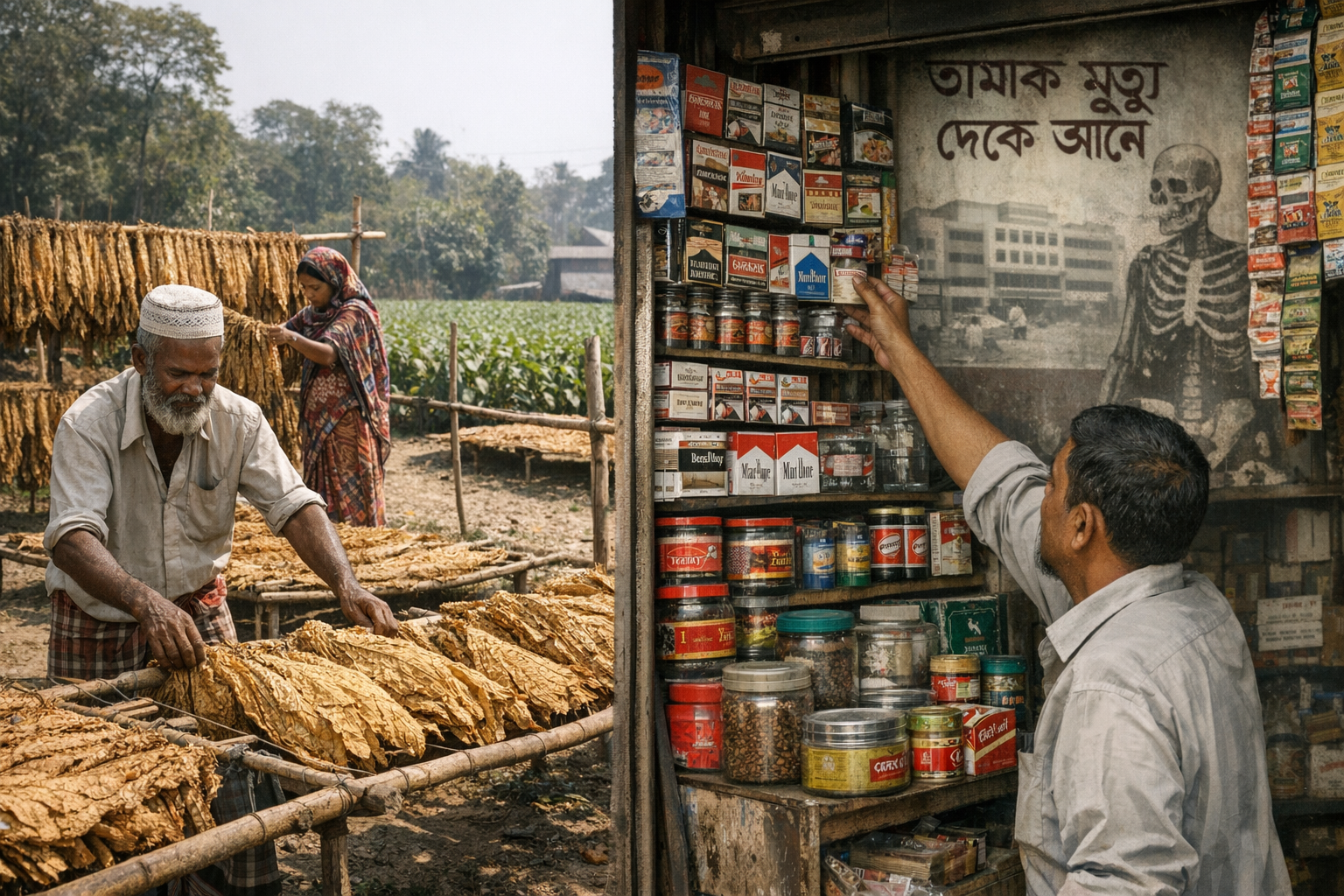
Large companies dominate the formal market, particularly cigarette manufacturing, while the informal sector including bidi and smokeless tobacco supports thousands of low-income workers across rural Bangladesh.
However, recent financial data suggests the industry is facing pressure. In 2025, domestic tobacco sales declined significantly, with major companies reporting reduced revenues due to higher taxes and regulatory changes.
Consumption Trends: Declining but Still High
Despite economic significance, tobacco use remains widespread in Bangladesh. Around 15.9% of adults were smokers, representing nearly 19.7 million people.
When including all forms of tobacco such as smokeless products, it shows the picture becomes even more striking. In 2024, approximately 32% of adults used tobacco, with significantly higher rates among men.
Projections indicate overall tobacco use prevalence at 31.4%, reflecting a gradual decline from previous decades but still above global averages.
Smokeless tobacco remains a major concern. Nearly 24.8% of adults use products like zarda and gul, which are often less regulated but equally harmful.
Encouragingly, long-term trends show progress. Tobacco use has dropped significantly from over 44% in 2010 to current levels near 31%, indicating the impact of sustained public health efforts.
Health Burden and Economic Costs
While tobacco generates revenue, its broader economic and health costs are far higher.
A 2025 study found that tobacco consumption and production cost Bangladesh approximately Tk 87,544 crore annually more than double the revenue it generates.
Tobacco-related illnesses are a leading cause of death in the country. Around 130,000 deaths annually are linked to smoking alone, accounting for a significant share of national mortality.
Overall, tobacco use contributes to roughly 18% of all deaths in Bangladesh, highlighting its severe public health impact.
Diseases commonly associated with tobacco use include:
- Lung Cancer
- Chronic Obstructive Pulmonary Disease
- Cardiovascular Disease
This growing health burden places immense pressure on Bangladesh’s healthcare system and reduces overall productivity.
Market Structure and Industry Dynamics
The tobacco industry in Bangladesh is divided into three main segments:
- Cigarettes (formal sector)
- Bidis (semi-formal, labor-intensive)
- Smokeless tobacco (largely informal)
Multinational and local companies dominate different segments, with cigarettes contributing the majority of tax revenue nearly 96% of tobacco tax income.
However, the market is evolving.
Recent trends show:
- Declining cigarette consumption due to higher prices and taxes
- Growth in low-cost cigarette segments
- Continued demand for smokeless tobacco
Additionally, purchasing behavior is shifting. Around 70% of smokers buy single cigarettes, making tobacco more accessible, especially to young and low-income consumers.
Regulation and Government Action
Bangladesh has taken increasingly aggressive steps to control tobacco use in recent years.
The country is a signatory to the WHO Framework Convention on Tobacco Control and has implemented several measures, including:
- Graphic health warnings on packaging
- Restrictions on advertising
- Higher excise duties and VAT
- Public smoking bans
In 2026, Bangladesh introduced a landmark ordinance banning emerging tobacco and nicotine products such as e-cigarettes and heated tobacco devices, strengthening its regulatory framework.
These actions align with the government’s long-term vision of a tobacco-free Bangladesh by 2040.
Challenges: Enforcement and Industry Influence
Despite strong policies, enforcement remains a major challenge.
One issue is widespread retail promotion. A 2025 study found that nearly 69% of shops near schools displayed tobacco advertisements, raising concerns about youth exposure.
Another challenge is tax evasion. Reports suggest tobacco companies may have avoided paying over Tk 5,000 crore in taxes in 2025, highlighting weaknesses in regulatory oversight.
Moreover, the government’s dual role as both regulator and beneficiary of tobacco revenue complicates policy implementation and reform efforts.
Environmental and Social Impact
Beyond health and economics, tobacco production has significant environmental consequences.
Tobacco farming contributes to:
- Deforestation
- Soil degradation
- Heavy pesticide use
Social issues are also prevalent, particularly in the bidi sector, where labor conditions are often informal and poorly regulated.
A Declining Industry?
Looking ahead to 2026 and beyond, the tobacco industry in Bangladesh is expected to face gradual decline.
Market forecasts suggest negative growth rates through 2025–2029, driven by stricter regulations, rising taxes, and increasing public awareness.
At the same time, companies are adapting by:
- Expanding product portfolios
- Targeting low-cost segments
- Adjusting pricing strategies
However, the long-term trajectory appears clear: tobacco consumption is slowly decreasing, and regulatory pressure is intensifying.
Looking Ahead
The tobacco industry in Bangladesh remains a powerful economic force, but its sustainability is increasingly under question.
While it contributes billions in revenue and supports livelihoods, the health, social, and environmental costs far outweigh its benefits. The data from 2024 to 2026 shows a country in transition reducing tobacco use while grappling with enforcement challenges and economic dependence.
As Bangladesh moves toward its 2040 tobacco-free goal, the future of the industry will depend on a delicate balance between public health priorities and economic realities.