



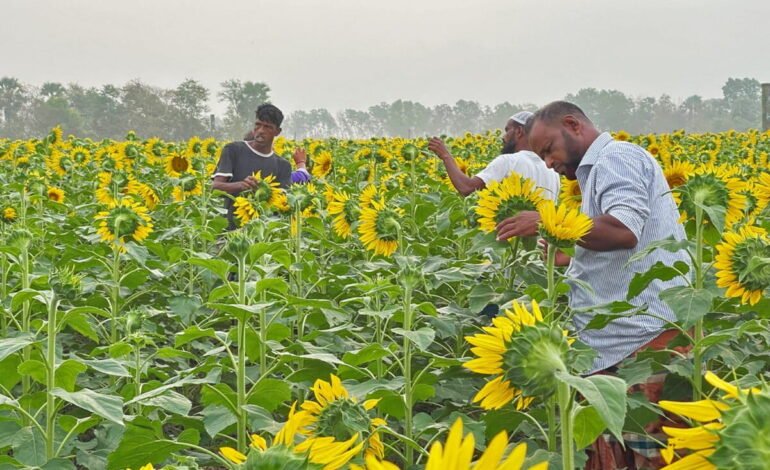

A New Agricultural Story Emerging Sunflower Farming Along the Teesta
A remarkable transformation is taking place on the sandy char lands along the Teesta River in Lalmonirhat, northern Bangladesh. Fields that were once dominated by tobacco cultivation are now covered with bright yellow sunflowers, signalling a major shift in farming practices and economic opportunities for local farmers.
This change is particularly visible in Govardhan village in Mohishkhocha Union under Aditmari upazila, where farmers have begun cultivating sunflowers commercially for the first time under an agricultural development project aimed at reducing tobacco farming and boosting edible oil production.
The shift is not only altering the landscape but also reshaping the livelihoods of farmers who are exploring more sustainable and profitable crops.
From Tobacco Fields to Golden Sunflowers
For decades, tobacco had been a dominant crop in many char lands of northern Bangladesh. Tobacco cultivation often attracted farmers because of guaranteed buyers and financial incentives provided by companies.
However, the crop also brought significant challenges, including environmental damage, health risks, and high labour demands. Many farmers eventually started looking for alternatives that could provide better income while reducing these problems.
Now, sunflowers are emerging as a promising replacement. Farmers in Lalmonirhat say the change is both visible and financial, with many reporting encouraging returns from the crop.
Local farmer Abu Bakkar Siddique, one of the pioneers of the initiative, described the current season as particularly successful, as sunflower cultivation has shown strong potential in the sandy char lands near the river.
Profitability Driving the Crop Shift
One of the main reasons farmers are embracing sunflower cultivation is its economic viability. According to local growers, cultivation costs range between Tk6,000 and Tk7,000 per bigha, while sunflower seeds can sell for around Tk30,000 per bigha, making the crop financially attractive.
Additionally, sunflowers require limited irrigation usually just two or three rounds, making them suitable for char areas where water access can be uncertain. Farmers have also reported that the crop demands less labour compared to tobacco, which traditionally requires intensive manual work.
In northern Bangladesh, several farmers who previously grew tobacco have already switched to sunflower cultivation after witnessing higher profits and lower production costs.
Growing Demand for Edible Oil
Another important factor behind the shift is Bangladesh’s increasing demand for edible oil. Sunflower seeds are widely used to produce cooking oil, which is a major household commodity. Agricultural officials have been encouraging farmers to grow sunflower because of this demand and its potential to reduce dependence on imported oil.
Experts say expanding sunflower farming could strengthen Bangladesh’s agricultural economy while also improving food security. The crop is considered versatile and valuable, as its seeds can also be used in animal feed and other products.
Environmental and Health Benefits
The move away from tobacco cultivation also has environmental advantages. Tobacco farming has long been criticized for damaging soil fertility, consuming large amounts of water, and contributing to environmental degradation in farming regions.
In contrast, sunflowers are seen as a more sustainable crop. They can grow in challenging conditions and often require fewer resources. Some studies suggest that crops like sunflower, tea, and mustard use less water and provide better long-term benefits for farmers.
This transition is therefore not only about economic gains but also about improving environmental sustainability in agricultural communities.
Char Lands: A Challenging Yet Promising Landscape
Char lands, river islands formed by silt deposits are known for their unique agricultural challenges. These areas often experience floods, soil instability, and limited infrastructure, making farming difficult.
Despite these obstacles, char lands can also be highly fertile and suitable for innovative agricultural practices when supported by proper techniques and development projects.
The success of sunflower cultivation in Lalmonirhat demonstrates how farmers can adapt to these conditions and find new opportunities for growth.
The Role of Agricultural Projects and Support
Government initiatives and agricultural development projects have played a significant role in promoting sunflower cultivation. By providing training, seeds, and technical guidance, these programmes encourage farmers to adopt crops that are both profitable and environmentally friendly.
In many parts of Bangladesh, similar projects have helped build value chains for sunflower production and improve farmers’ access to markets and modern agricultural practices.
Such support is essential in helping farmers transition from traditional crops like tobacco to more sustainable alternatives.
A Wider Trend Across Northern Bangladesh
The shift toward sunflower cultivation is not limited to Lalmonirhat alone. In other districts of the Rangpur region, farmers have also begun switching from tobacco to sunflowers after seeing promising yields and profits.
Agricultural officials say the cultivation area is gradually expanding as more farmers observe successful harvests and stable market demand.
This growing trend suggests that sunflowers could become an important crop in northern Bangladesh in the coming years.
Transforming Livelihoods in Rural Communities
For farmers living in char areas, agriculture is often the primary source of income. Any change in crop patterns can significantly affect their economic stability.
By shifting from tobacco to sunflower cultivation, farmers are gaining new opportunities to improve their livelihoods. Lower production costs, easier farming methods, and reliable market demand are making the crop increasingly popular among rural communities.
Moreover, the bright sunflower fields have also brought a sense of optimism and pride to farmers who see the transformation as a positive step toward sustainable agriculture.
Challenges That Remain
Despite the promising results, challenges remain. Farmers need consistent access to quality seeds, market stability, and continued support from agricultural authorities.
Climate risks such as flooding and extreme weather events also pose threats to char land agriculture. Ensuring proper infrastructure and disaster preparedness will be essential to sustaining sunflower farming in the long term.
However, experts believe that with continued support and innovation, the transition away from tobacco could become a lasting success story.
Looking Ahead
The emergence of sunflower cultivation on the Teesta’s char lands represents a powerful example of how agricultural innovation can transform rural economies. What was once a region dominated by tobacco is now witnessing a golden shift toward a more sustainable and profitable crop.
For farmers in Lalmonirhat, sunflowers symbolize more than just a new harvest—they represent hope for improved livelihoods, healthier farming practices, and a stronger agricultural future for Bangladesh.
As the fields continue to bloom with yellow flowers, this transformation may inspire other farming communities across the country to explore similar changes and embrace crops that benefit both people and the environment.