




Strawberry Boom in Rangpur: How a Winter Fruit is Redefining Rural Dreams

Strawberry Boom in Rangpur: How a Winter Fruit is Redefining Rural Dreams
Strawberry cultivation in the Rangpur region is expanding and reshaping how Bangladesh farmers think, earn, and dream.
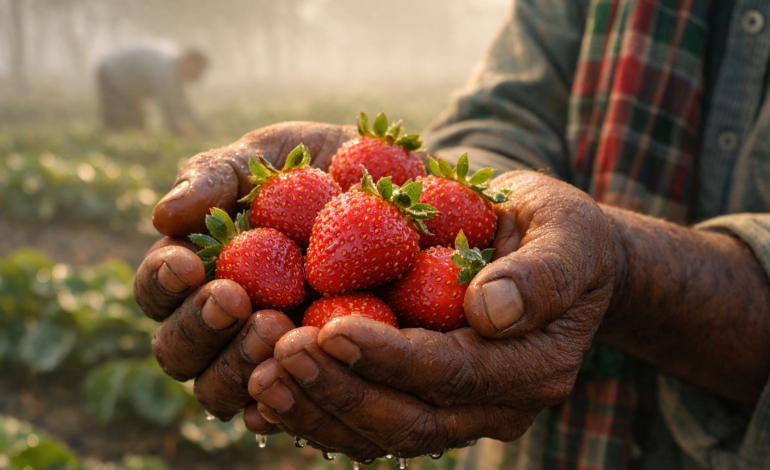
Instead of the usual green of paddy or maize, patches of land glow with a different color, bright red strawberries hanging delicately beneath green leaves. Farmers bend carefully to pick the fruit, placing them into small baskets, knowing each piece carries both fragility and promise.
What was once an unfamiliar fruit in Bangladesh has now become a symbol of change.
A Shift Away from Tradition
For generations, farmers in Rangpur relied on conventional crops like rice, potatoes, and maize. These crops provided stability but often limited profits.
Season after season, many farmers found themselves trapped in a cycle of low returns and rising costs.
Strawberries have begun to break that cycle.
Unlike traditional crops, strawberries offer significantly higher returns within a short growing period. The crop matures within a few months, allowing farmers to earn quickly and reinvest.
This shift is not just agricultural, it is psychological. Farmers who once hesitated to take risks are now experimenting, learning, and expanding.
The Rise of a New Farming Mindset
The strawberry boom has introduced a new kind of farmer in Rangpur.
These are not just cultivators but they are planners, investors, and entrepreneurs.
Many farmers now calculate input costs, monitor market demand, and adopt modern techniques to maximize profit. Raised beds, mulching, and careful irrigation are becoming standard practices.
Some even produce their own seedlings, reducing dependency on external suppliers and increasing margins.
This transformation reflects a broader change in rural Bangladesh, where farming is slowly evolving from subsistence activity into business.
Youth Returning to the Fields
One of the most striking aspects of this transformation is the involvement of young people.
In many parts of Bangladesh, young individuals leave villages for cities in search of better opportunities. But in Rangpur, strawberries are reversing that trend is at least partially.
Young entrepreneurs are stepping into agriculture with fresh ideas.
Some are graduates who have chosen farming over traditional jobs. Others are returnees from cities who see potential in high-value crops.
They bring with them a different mindset—one that embraces innovation, branding, and direct marketing.
For them, strawberry farming is not just about cultivation. It is about building something of their own.
The Economics Behind the Boom
Behind the vibrant red fruit lies a compelling economic story.
Strawberry farming requires a higher initial investment compared to traditional crops. Costs include quality seedlings, fertilizers, mulching materials, and labor. But the returns often justify the risk.
Farmers can earn significantly higher profits per bigha compared to rice or maize. With strong market demand, strawberries sell at premium prices, especially in urban centers.
For many farmers, this has been life-changing.
Higher income means better living conditions, improved access to education for children, and greater financial security.
In a region where economic opportunities are often limited, strawberries are opening new doors.
The Fragility of Success
Yet, the success of strawberry farming is not without its challenges.
The fruit is highly perishable.
Unlike grains that can be stored for months, strawberries must be sold quickly. Any delay in transportation or market access can lead to losses.
Farmers often depend on middlemen who purchase directly from fields. While this ensures quick sales, it also limits farmers’ bargaining power.
There is also a noticeable gap between farmgate prices and retail prices in cities.
In many cases, farmers receive far less than what consumers ultimately pay.
This imbalance highlights the need for better infrastructure such as cold storage, efficient transportation, and fair market systems.
Nature as Both Ally and Risk
Rangpur’s climate plays a crucial role in the success of strawberry cultivation.
The region’s cool winter temperatures provide ideal growing conditions. The fruit thrives in mild cold, making northern Bangladesh particularly suitable. But agriculture always carries risks.
Unpredictable weather, unexpected rainfall, or temperature fluctuations can affect production.
Farmers must constantly adapt, balancing opportunity with uncertainty.
A Growing Market Appetite
The rise of strawberries is also linked to changing consumer behavior in Bangladesh.
Urban populations are increasingly drawn to fresh, high-quality fruits. Strawberries, once considered rare, are now widely available in city markets, supermarkets, and even online platforms.
Their appeal goes beyond taste.
They represent a modern lifestyle, often associated with health, quality, and premium consumption.
This growing demand continues to drive expansion in production.
Women and Family Involvement
Another subtle but important aspect of strawberry farming is family participation.
Unlike some traditional crops, strawberry cultivation often involves careful picking, sorting, and packaging, these tasks engage multiple members of a household.
In many cases, women play an active role in the process. This shared involvement strengthens family-based farming and creates additional income opportunities within households.
Opportunity Meets Responsibility
The future of strawberry cultivation in Rangpur appears promising.
With proper support from agricultural authorities, improved logistics, and better access to markets, the sector could expand even further.
But growth must be managed carefully.
Ensuring fair pricing, reducing post-harvest losses, and maintaining quality standards will be crucial for long-term sustainability.
Farmers also need continued training and access to resources to navigate challenges effectively.
More Than Just a Fruit
In the end, strawberries in Rangpur represent more than a profitable crop and they symbolize change.
They reflect the courage of farmers willing to take risks, the ambition of youth choosing agriculture, and the evolving landscape of rural Bangladesh.
In the bright red fields of Rangpur, a quiet revolution is underway.
One that is not only transforming agriculture. But also redefining what it means to dream in rural Bangladesh.