



Middle East War Poses Fresh Threat to Bangladesh Exports: Economic Risks and Strategic Responses
The ongoing conflict in the Middle East involving the United States, Israel, and Iran is creating renewed economic risks for Bangladesh’s export sector. While the country’s trade relationship with the region may appear modest in absolute terms, the indirect effects on global supply chains, logistics networks, and energy markets have the potential to ripple through Bangladesh’s export-oriented economy in significant ways.
Bangladesh’s Export Landscape: A Snapshot
Bangladesh’s export sector has been a crucial driver of economic growth for decades, with ready-made garments (RMG) being the dominant export category, accounting for about 80% of total merchandise exports. In the 2025-26 fiscal year, exports have faced headwinds, with shipment values declining year-on-year amid weaker global demand and multiple external pressures.
In this context, the Middle East conflict introduces further uncertainty:
-
The Arab states collectively account for about $900 million in Bangladesh’s annual exports, a small overall share but meaningful for certain niche sectors such as perishables and regional apparel shipments.
-
More importantly, Middle Eastern countries including Saudi Arabia, the United Arab Emirates (UAE), Qatar, and Kuwait are also significant labour destinations for Bangladesh and key links in international logistics.
Why the Middle East Conflict Matters to Bangladesh’s Exports
While Bangladesh’s top export destinations remain the United States, the European Union, and the United Kingdom, the Middle East plays a strategic role in multiple interconnected ways:
1. Disrupted Air and Sea Logistics
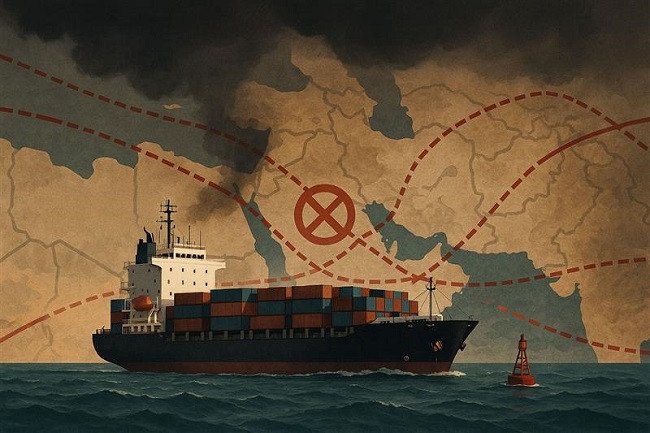
The Strait of Hormuz, a narrow maritime passage connecting the Persian Gulf to the Arabian Sea, is one of the world’s most vital shipping arteries. Roughly one-fifth of global crude oil shipments pass through this corridor daily.
Conflict in the region has led to:
-
Suspended flights and rerouted airspace: Airlines have cancelled routes and reduced Middle East flights, affecting cargo connections that exporters depend on, especially for products requiring fast shipment like perishables.
-
Increased freight costs: Longer shipping routes, higher fuel usage, and inflated insurance premiums for vessels passing near conflict zones all raise transportation costs.
-
Cold chain impacts: Agricultural exporters, such as vegetable and fruit firms based in Chattogram, have reported spoilage and financial losses linked to sudden flight cancellations.
These logistics disruptions directly affect Bangladesh’s export volumes and delivery reliability, threatening the competitiveness of its goods in global markets.
2. Rising Energy Prices and Import Costs
Bangladesh is dependent on imported energy, including crude oil and liquefied natural gas (LNG), for industrial production and transportation. A prolonged Middle East conflict can lead to:
-
Higher global oil prices, which increase production costs for manufacturers and exporters.
-
Supply uncertainties for LNG, particularly from Qatar and Oman, which supply a significant portion of Bangladesh’s gas imports.
This combination can strain the country’s balance of payments and forex reserves while pushing up domestic production costs. Higher energy prices also feed into inflation, reducing consumer purchasing power in key export markets.
3. Labour Market and Remittance Risks
The Middle East hosts a large number of Bangladeshi migrant workers over 7.5 million in Gulf cooperation countries like Saudi Arabia, UAE, Qatar, Kuwait, and Oman.
Remittances sent by these workers are a major source of foreign currency and have a stabilising influence on the exchange rate. Conflict-related economic slowdowns in the Gulf could:
-
Slow recruitment or lead to job losses for Bangladeshis abroad.
-
Reduce remittance inflows, tightening foreign exchange reserves.
-
Limit consumer spending at home, indirectly affecting demand for locally produced goods.
Economic Forecast: Risks, Shortfalls, and Spillovers
Experts warn that even if Bangladesh’s direct export exposure to the Middle East is limited relative to markets like the EU or the US, the spillover effects from geopolitical instability may nevertheless impact:
-
Shipping timelines and global supply chain continuity.
-
Input prices for manufacturers reliant on imported raw materials and energy.
-
Consumer demand in major markets where inflation and recessionary pressures could reduce orders.
One industry stakeholder described the situation as a complex set of interlinked risks where geopolitical tensions, logistics disruptions, and rising energy costs combine to threaten both exports and overall trade performance.
Government and Industry Responses
In response to mounting risks, Bangladesh authorities have taken several precautionary steps:
-
Monitoring export logistics: Government officials and trade bodies are tracking shipments and aviation routes to identify bottlenecks and alternative pathways.
-
Protecting migrant workers: The government is prioritising the safety and welfare of its citizens in conflict-affected Gulf countries and is in close contact with employers and families abroad.
-
Energy strategy adjustments: Plans to secure alternate energy sources and diversify import partnerships are underway to reduce dependency on any single region.
Nevertheless, many industry leaders emphasise that durable solutions will require sustained global diplomatic efforts to de-escalate tensions and guarantee stability in trade and logistics corridors.
Strategic Diversification: Long-Term Imperatives
The ongoing geopolitical headwinds underscore longstanding structural challenges for Bangladesh’s economy:
-
Heavy dependence on a few export markets (EU, US) means that regional disruptions still affect global supply chains and order flows.
-
Relying heavily on the RMG sector makes export earnings vulnerable to shocks because nearly four-fifths of merchandise exports come from textiles.
To mitigate future risks, policymakers and strategists often recommend:
-
Export diversification: Strengthening sectors like light engineering, pharmaceuticals, IT services, and agro-industry to reduce reliance on any single product group or market.
-
Improved logistics infrastructure: Enhancing air and sea freight alternatives reduces over-reliance on specific hubs.
-
Strategic energy procurement: Multilateral energy agreements and domestic renewable energy investments can buffer against global price volatility.
Navigating Uncertainty in a Turbulent Era
The Middle East conflict is a reminder that global geopolitical dynamics can have outsized economic impacts, even on countries whose direct trade links with conflict zones are comparatively limited. For Bangladesh, the combined effects of logistics disruptions, rising energy costs, and potential remittance slowdowns pose real risks to export performance and broader economic stability.
Addressing these risks will require coordinated policy action, diplomatic engagement to keep supply routes open, and forward-looking economic diversification strategies. Continued vigilance and strategic planning remain essential as Bangladesh navigates what has become an increasingly uncertain global external environment.