

Inside the Informal Economy: The Businesses That Run Without Paperwork

Inside the Informal Economy: The Businesses That Run Without Paperwork
In cities and towns across Bangladesh, a large part of the economy runs quietly outside official systems. From footpath vendors selling tea and snacks to small home-based tailoring businesses, thousands of people earn a living without trade licenses, tax registration, or formal documentation. This network of informal enterprises often overlooked in official statistics plays a critical role in daily life and urban survival.
Economists call it the informal economy, but for many Bangladeshis, it is simply the only option available.
A Daily Struggle for Livelihood
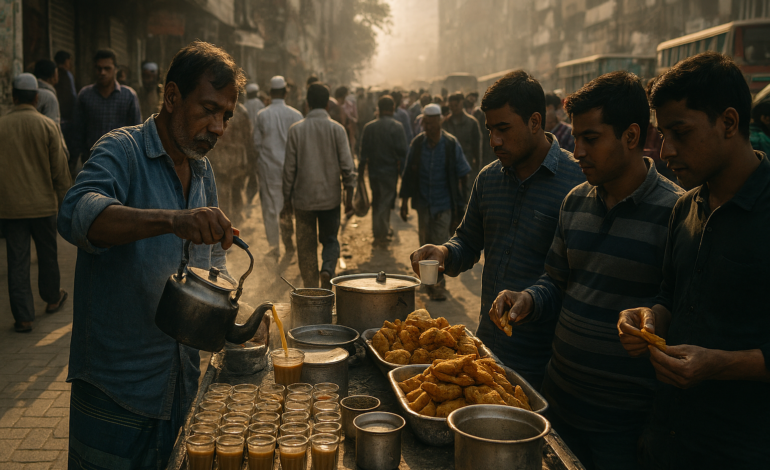
Every morning before sunrise, street vendors set up their makeshift stalls along busy roads. Some sell fruits and vegetables, while others offer tea, fried snacks, phone accessories, or clothing. Many of these entrepreneurs have little capital and limited access to formal employment.
For them, the footpath is both workplace and opportunity.
Without paperwork or official permits, these vendors operate in a constant state of uncertainty. Police drives, city corporation eviction campaigns, or sudden construction projects can disrupt their businesses at any time. Still, the demand for affordable goods and quick services keeps customers coming.
In urban centers like Dhaka, Chattogram, and Khulna, the informal economy has become deeply woven into everyday life. Office workers rely on roadside tea stalls, commuters buy breakfast from street vendors, and students purchase low-cost accessories from temporary shops.
Why Many Businesses Remain Informal
There are several reasons why entrepreneurs choose or are forced to operate without formal registration.
First, the process of obtaining trade licenses and permits can be complex and time-consuming for small vendors who may lack education or resources. Many small sellers also cannot afford the fees associated with formal registration.
Second, some businesses operate on such a small scale that formalization feels unnecessary. A vendor selling tea from a cart or a tailor working from home often earns just enough to support their family.
“I only sell enough tea to feed my family. Registering a business feels like something for big shops, not for people like us,” said a tea vendor who runs a small cart on a busy roadside.
“Our income is small and uncertain. We focus on surviving day to day, so formal registration is not something we think about,” said a street vendor.
Third, informal businesses provide flexibility. Vendors can relocate quickly, adjust their products based on demand, and operate with minimal overhead.
However, the absence of official documentation also means limited access to loans, business training, and legal protection.
The Hidden Cost: Informal Payments and Local Extortion
One of the most sensitive but widely discussed realities within this ecosystem is the issue of informal payments.
Many footpath vendors say they are required to pay daily or weekly money to local groups, middlemen, or individuals who claim control over certain areas. These payments are often described as “line fees” or “protection money,” allowing vendors to keep their stalls in specific locations.
For small entrepreneurs already operating on thin profit margins, such payments can significantly reduce their earnings.
Some vendors also report that these collections are sometimes linked to unofficial local power structures. In certain areas, individuals may act as gatekeepers, deciding who can sell where and for how long.
While not every informal market faces this problem, the issue has been raised repeatedly by vendors and urban researchers studying the street economy.
Urban development experts say the lack of clear regulation creates a vacuum where such practices can emerge. Without structured policies for street vendors, many are left negotiating their place in the city on an informal basis.
A System That Serves the City
Despite the challenges, the informal economy provides significant benefits to society.
It generates employment for millions of people who might otherwise struggle to find work. It also supports low-income households by offering affordable goods and services.
Street businesses contribute to the vibrancy of urban spaces, turning sidewalks and marketplaces into active commercial zones. In many neighborhoods, small vendors form the backbone of local commerce.
Researchers have often pointed out that informal entrepreneurship reflects resilience and adaptability—qualities that help cities function even during economic uncertainty.
Calls for a Balanced Approach
Urban planners and economists increasingly argue that the solution is not to eliminate informal businesses but to integrate them more effectively into the formal economy.
Several proposals have been discussed over the years:
- Creating designated vending zones
- Simplifying trade license processes
- Offering microfinance support
- Providing training and business development programs
- Introducing transparent systems to reduce harassment and unofficial payments
Some cities around the world have successfully implemented such policies, recognizing that street vendors are an essential part of urban economies.
In Bangladesh, discussions about formalizing footpath businesses occasionally surface in policy debates, but consistent implementation remains limited.
The Future of Informal Entrepreneurship
As Bangladesh continues to urbanize and its cities grow, the role of informal businesses is unlikely to disappear anytime soon.
In fact, many experts believe the informal sector will remain a major economic force, especially for youth, migrants, and low-income families trying to build a livelihood.
For vendors working long hours under uncertain conditions, the hope is simple: stability.
A system that recognizes their contribution while ensuring fairness and transparency could transform thousands of small enterprises into sustainable businesses.
Until then, the informal economy will continue to operate quietly running shops without paperwork, serving millions of customers, and keeping the wheels of urban life moving every day.