




How Bangladesh Is Moving Toward Self-Sufficiency in Onion Production?
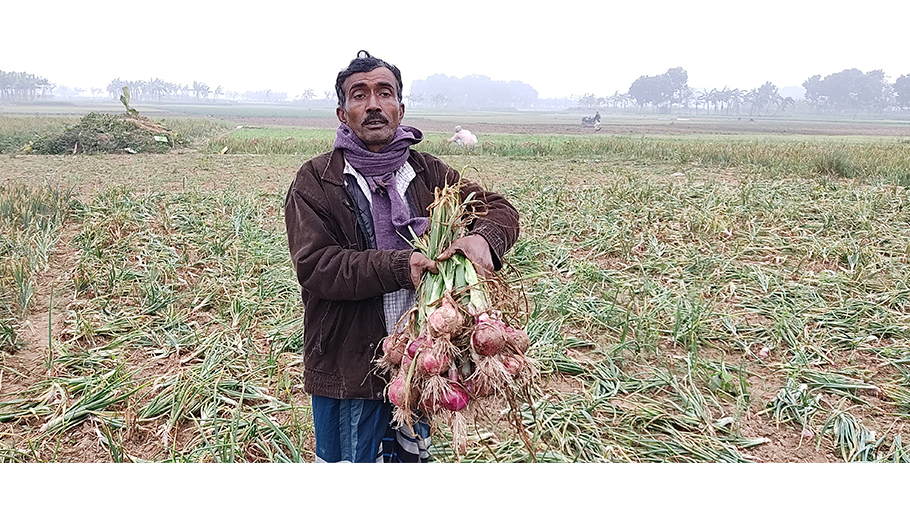

For decades, onion production in Bangladesh symbolised one of the country’s most persistent agricultural vulnerabilities. Every year between October and December, Bangladesh’s largest consumer goods hub Khatunganj would overflow with imported Indian onions, while local farmers struggled to secure fair prices for their harvest. Price volatility, supply shocks, and cross border dependency defined the market, leaving both consumers and growers exposed.
In 2025, that long standing pattern began to shift decisively. For the first time in recent history, Bangladesh has moved close to self-sufficiency in onion production, relying primarily on domestic supply rather than imports. Warehouses in Khatunganj are now filled with locally grown onions, farmers are enjoying stable prices, and imports have dropped to a historic low.
This transformation did not happen overnight. It is the outcome of sustained policy intervention, improved agricultural practices, storage innovation, seed development, and a firm political stance against market manipulation. Together, these factors are reshaping onion production in Bangladesh and offering lessons for food security in import dependent economies.
A volatile past driven by import dependence
Onion is a core ingredient in almost every Bangladeshi household. Despite its importance, onion production remained insufficient for decades, making Bangladesh heavily reliant on imports, particularly from India. Each year during the lean season, prices would surge abnormally, often reaching Tk150 to Tk300 per kilogram across the country.
To stabilise the market, successive governments imported large volumes of onions from India, creating a recurring cycle. Cheap imports depressed local prices during harvest season, discouraging farmers, while sudden export restrictions by India frequently triggered shortages and price hikes in Bangladesh. Onion production stagnated as growers faced uncertainty, poor storage facilities, and limited access to quality seeds.
Demand dynamics shaping onion production policy
According to FAO Bangladesh, the country’s annual onion demand stands at approximately 2.8 million tonnes. This steady and predictable demand made onion production a strategic priority for food security planners. However, meeting this demand domestically was long considered unrealistic due to high post harvest losses and seasonal supply gaps.
In recent years, the government recalibrated its approach, shifting focus from short term import solutions to long term onion production capacity. Policymakers recognised that stabilising onion production would not only protect consumers but also strengthen rural incomes and reduce foreign exchange outflows.
A dramatic drop in imports signals change
The impact of this shift is reflected clearly in trade data. According to the National Board of Revenue, onion imports were 1.091 million tonnes in the 2019 to 2020 fiscal year, followed by 667,151 tonnes in 2020 to 2021, 602,029 tonnes in 2021 to 2022, 750,068 tonnes in 2022 to 2023, 605,337 tonnes in 2023 to 2024, and 481,968 tonnes in 2024 to 2025.
In stark contrast, onion imports in the current 2025 to 2026 fiscal year dropped to just 12,600 metric tonnes. Nearly 95 percent of previous imports came from India, while shipments from Myanmar, Egypt, and Turkey have fallen to zero since January.
This sharp reduction reflects confidence in domestic onion production and a willingness by the government to allow market forces to support local farmers rather than defaulting to imports.
Supply data confirms surplus onion production
The Department of Agricultural Extension reports that up to 19 November 2024, Bangladesh produced 4.448 million tonnes of onions. After accounting for wastage, the net usable stock stands at 3.114 million tonnes, supplemented by an additional 350,000 tonnes carried over from the previous season.
These figures indicate a surplus well above national demand. Officials confirm that current stocks are sufficient to meet consumption needs in the coming months. Summer onion cultivation covered 6,227 hectares this year, with an expected yield of 87,000 tonnes by December. Meanwhile, the muri kata variety was cultivated on 17,347 hectares, with an expected harvest of 242,800 tonnes by the end of December.
The winter onion crop is scheduled to enter the market in the second week of February 2026, further reinforcing supply stability and sustaining onion production momentum.
Storage innovation strengthens onion production resilience
One of the most transformative developments in onion production has been the introduction of air flow storage technology. Historically, nearly 30 percent of onions were lost annually due to inadequate storage, leading to artificial shortages toward the end of the season.
Under a Ministry of Agriculture initiative, around 4,000 air flow storage units have been distributed across 25 districts. Each unit can store up to 12 tonnes of onions and regulates temperature, humidity, and ventilation. Subsidies of Tk40,000 to Tk50,000 made the technology accessible to small and medium farmers.
According to the Department of Agricultural Extension, improved storage increased onion preservation by at least 200,000 tonnes this year, significantly boosting effective onion production.
Seed development unlocks year round onion production
Seed quality was another long standing constraint. Since 2020, Bangladesh Agricultural Research Institute, Bangladesh Atomic Energy Commission, Bangladesh Agricultural Development Corporation, and the Department of Agricultural Extension have collaborated to expand domestic seed production.
Annual demand for onion seeds is about 1,100 tonnes. Previously, domestic production covered only around 600 tonnes. This has now increased to more than 1,000 tonnes, sharply reducing dependency on imported seeds.
High yielding varieties such as BARI Onion 5 for summer and BARI Onion 4 and 6 for winter have enabled farmers to expand onion production beyond traditional seasons. This seasonal diversification has narrowed supply gaps and stabilised markets.
Summer onion cultivation expands production base
To further strengthen onion production, authorities have prioritised summer onion cultivation, traditionally considered risky due to climate conditions. Nearly 300,000 hectares have now been facilitated for summer onion farming.
In 2024 alone, the Department of Agricultural Extension provided training, seeds, and pesticides through 1,063 demonstration plots across about 100 districts. These efforts helped farmers adopt climate adaptive practices and improved productivity during non-traditional seasons.
The expansion of summer onion production has been critical in ensuring supply continuity and reducing pressure on winter harvests.
Breaking syndicates restores market balance
For years, onion production gains were undermined by market manipulation. Syndicates operating in Dhaka’s Shyambazar and Babubazar, Hili in Dinajpur, and Khatunganj in Chattogram artificially inflated prices toward the end of the season. Officials say these groups often coordinated with exporter syndicates in India to trigger imports.
Following the recent mass uprising, the interim government adopted a firm stance. Despite receiving 2,800 import permit applications, none were approved until September. This decision disrupted entrenched interests and signalled a new policy direction focused on protecting onion production.
In early December, prices briefly spiked by around Tk40 per kilogram, reaching Tk120 to Tk140. To calm the market, the government allowed limited imports from 7 December. Only 50 import permits were issued per day, each capped at 30 tonnes.
The announcement alone was enough to push prices down by Tk40 per kilogram within a day, demonstrating improved market discipline. Officials emphasised that these token imports would not undermine local onion production.
Challenges that still threaten onion production
Despite significant progress, challenges remain. Climate variability poses ongoing risks to onion production, particularly during summer cultivation. Energy costs for storage facilities and access to finance for small farmers require continued policy attention.
There is also the risk that relaxed import controls in future could discourage growers if safeguards are not maintained. Strengthening farmer cooperatives, improving market transparency, and expanding cold chain infrastructure will be crucial to sustaining gains in onion production.
The way forward for onion production self-sufficiency
Bangladesh’s experience shows that self-sufficiency in onion production is achievable through coordinated policy, investment, and enforcement. Continued support for storage technology, seed research, and farmer training will be essential.
Experts suggest focusing on export oriented onion production once domestic stability is secured, allowing Bangladesh to capture regional markets during surplus years. Developing processing facilities for dehydrated onions could also add value and absorb excess supply.
Above all, maintaining a balanced import policy that protects farmers while preventing price shocks will determine the long term success of onion production reforms.
A turning point for food security
The transformation unfolding in onion production marks a rare success story in Bangladesh’s agricultural sector. From chronic import dependence to near self-sufficiency, the journey reflects what targeted interventions can achieve.
As warehouses remain full, farmers earn fair returns, and consumers face stable prices, onion production has emerged as a symbol of resilience and reform. If momentum is sustained, Bangladesh may soon turn a former vulnerability into a competitive advantage in regional agricultural markets.