

From One to Four Tonnes per Bigha: Chapainawabganj’s Mango Farming Revolution
In Chapainawabganj, a district long known as one of Bangladesh’s mango-growing powerhouses, a farming transformation is quietly underway. Through the adoption of an Ultra-High-Density (UHD) mango planting method, local growers have quadrupled their yield from around 1 tonne per bigha to 4–5 tonnes, according to recent reports.
This method, backed by technical and financial support from the PRABRIDDHI project, a collaboration between the Bangladeshi government and Swisscontact is redefining mango cultivation, harvesting, and profitability in the region.
What Is Ultra-High-Density Mango Planting?
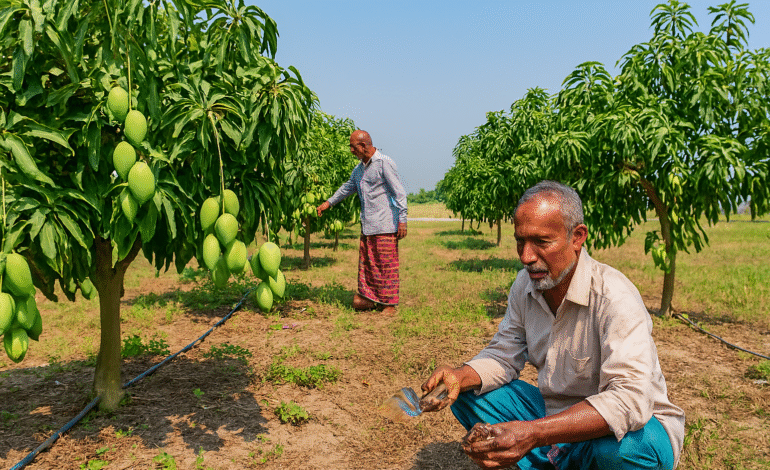
UHD mango planting is a modern orchard system that packs more trees per unit area, keeping them short and manageable. Instead of the traditional model of 8–12 large mango trees per bigha, UHD allows for over 200 trees per bigha by planting them much closer together.
Key features of the system include:
- Maintaining trees at human height, making branch pruning, fruit bagging, and disease monitoring much easier
- Pruning large branches annually to manage growth and productivity; this practice supports strong yields for 25–30 years.
- Using tighter spacing (for example, 6.5 ft north-south by 9 ft east-west) to maximize land use
- Bagging fruit and manually controlling pests, which significantly reduces losses
Farmers report that in traditional mango orchards, as much as 30% of fruit is lost due to pests, disease, or inaccessibility—problems that UHD effectively reduces to under 5%.
The Chapainawabganj Success Story: Shamim’s Orchard
A key figure in this transformation is Ismail Khan Shamim, an agricultural entrepreneur and secretary of the Shibganj Mango Producer Co-operative Society. After studying mango orchards in the Philippines, India, and Thailand, he returned and implemented the UHD method on his four-bigha orchard in Shibganj Upazila.
Shamim planted roughly 1,000 Katchimon trees, which now produce a dense canopy of fruit. His careful pruning and management have enabled fast fruiting, he began harvesting in the first year, rather than waiting 7–10 years as in traditional plantations.
Financially, the results have been impressive. Shamim estimates he earned Tk 350,000 extra in recent seasons by using UHD. He also sells his mangoes through B2B channels at Tk 8,000–10,000 per maund (40–45 kg), significantly more than the older model allowed.
Institutional Support and Market Linkages
The success of UHD in Chapainawabganj would not have been possible without institutional backing. The PRABRIDDHI project, supported by the Bangladeshi Local Government Division and Swisscontact, has played a critical role by:
- Training farmers on UHD techniques
- Establishing demonstration plots
- Helping local mango co-ops connect with buyers
Through this initiative, about 200 farmers have already adopted the UHD method, and 10 demonstration orchards have been launched by the Shibganj Mango Association.
PRABRIDDHI also built market links: they connected growers to 57 e-commerce companies, six retail sellers, and 16 Facebook vendors. In 2023 alone, 270 tons of premium-quality mangoes were sold nationally via these channels, enabling farmers to capture higher prices.
Economic and Environmental Benefits
Higher Income for Farmers
By boosting yields and improving efficiency, UHD has raised growers’ incomes significantly. The combination of higher productivity and better market access makes mango farming far more profitable than before.
Efficient Land Use
The UHD method maximizes land usage. Instead of sprawling, low-density orchards, every square meter is used efficiently—key in a country where agricultural land is increasingly precious.
Lower Labor and Loss Costs
Shorter trees mean less labor for pruning and bagging, while reduced fruit losses improve profitability. Inspecting every branch becomes feasible, increasing pest and disease control.
Water and Input Efficiency
Studies and local farmer testimonies show that UHD mango systems can reduce irrigation needs and improve fertilizer uptake, helping sustainably intensify farming.
Value Addition and Future Vision
Shamim and other UHD adopters are not just thinking about fresh mangoes but they are also diving into value-added products. With help from PRABRIDDHI, farmers visited orchards in Thailand to learn processing techniques.
A prototype machine for producing dried mangoes has already been designed. The plan is to develop a local processing industry that can:
- Make dried mango products
- Produce flat-skinned mango varieties
- Create spiced mango products
These value-added options can significantly expand income opportunities especially for women, who may find easier participation in drying and packaging than in field labor.
Challenges and Considerations
Despite the success, adopting UHD is not without its challenges:
- Initial Investment: Setting up dense orchards and training for pruning, bagging, and disease control requires capital and technical support.
- Crop Management: High-density trees demand more careful upkeep—especially of irrigation, canopy health, and branch pruning.
- Market Dependence: To benefit from premium prices, farmers must maintain quality and access to established buyers.
- Sustainability: There must be careful balancing of tree density with long-term tree health and soil fertility.
Implications for Mango Farming Across Bangladesh
Chapainawabganj’s success is already inspiring mango growers across the country, especially in water-stressed and densely farmed regions like Barind and Naogaon.
Officials in the Department of Agricultural Extension (DAE) and local research centers are promoting UHD, not just for mango fruit but as part of a broader climate-smart agriculture strategy.
In Rajshahi and Naogaon, UHD has been adopted to double yields, reduce costs, and improve the sustainability of mango plantations.
Why This Matters Globally
Though this innovation is local, it resonates with global agricultural themes:
- Intensification: UHD mango planting is a smart example of how smallholder farmers can intensify production without expanding land.
- Sustainable Farming: By reducing waste and water usage, it aligns with climate-resilient farming goals.
- Value Chains: The integration of e-commerce and value-added processing shows how technology can connect rural producers to national and even global markets.
- Economic Inclusion: The model supports small farmers and women, contributing to equitable growth.
What’s Next for Chapainawabganj Mango Farmers
- Scaling Up: More farmers will likely adopt UHD, especially as demonstrator plots and cooperative networks expand.
- Processing Units: As production grows, local processing for dried mango and other products can help stabilize income and reduce post-harvest losses.
- Export Potential: With consistent high quality, Chapainawabganj mangoes produced via UHD could find new international markets.
- Training Expansion: Continued training from institutions like PRABRIDDHI will be essential to maintain orchard health and maximize yield.
- Research and Technology: Ongoing R&D—on improved pruning methods, irrigation, and agro-input optimization—will underpin the long-term success of UHD systems.
Conclusion
Chapainawabganj’s move to Ultra-High-Density mango farming is a landmark shift in Bangladesh’s agricultural story. What began as one farmer’s bold experiment has turned into a scalable model that boosts yield, income, and sustainability.
By quadrupling output per bigha and blending modern agronomy with smart market linkages, farmers in this district are not just growing more mangoes—they’re cultivating a future. A future where mango farming is more profitable, climate-resilient, and inclusive.