

Bangladesh’s Automobile Industry: From Assembly to Electric Ambitions

Bangladesh’s Automobile Industry: From Assembly to Electric Ambitions
The automobile industry of Bangladesh is entering a new era. Thanks to recent government policies, rising middle-class demand, and investments in electric vehicles, the country is moving from import dependence toward a more self-reliant auto ecosystem. As global automakers increasingly view Bangladesh as a strategic location, this shift holds promise not only for local mobility but also for the nation’s industrial and environmental future.
Why Bangladesh’s Auto Sector Is Emerging Now
For many years, Bangladesh has primarily relied on imported vehicles, including used and reconditioned cars, due to high duties and limited local manufacturing capacity. But in recent years, the government introduced the Automobile Industry Development Policy (2020 and 2021) to promote local assembly and component manufacturing.
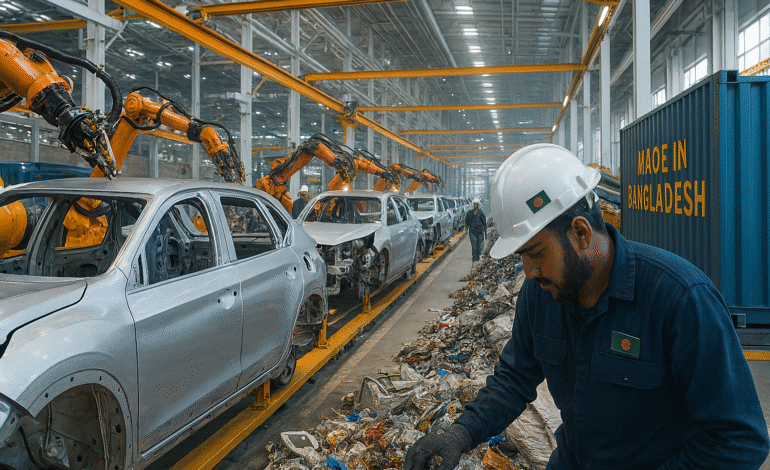
Under the policy, car makers assembling SKD (semi-knocked-down) and CKD (completely knocked-down) units benefit from significant tax incentives. This has encouraged both local and foreign companies to build or expand assembly plants in Bangladesh.
Local Assembly Takes Off: Key Players and Projects
Several companies have responded to the policy with concrete investments:
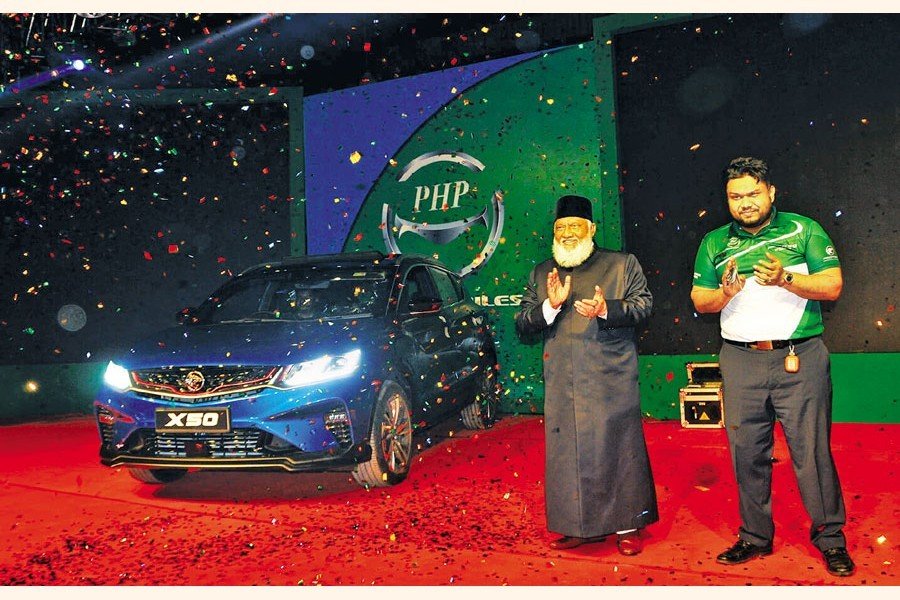
PHP Group was among the first to set up a private assembly plant, producing Proton-branded cars in Chattogram.
Fair Technologies Limited operates a plant in Kaliakoir, assembling Hyundai sedans, SUVs and MPVs.
Rangs Limited is planning to assemble Mitsubishi vehicles locally, while Uttara Motors aims to bring Suzuki sedans and MPVs into the assembly mix.
On the state side, Pragoti Industries: Bangladesh’s oldest assembler continues to play a strategic role.
These developments point to a growing ecosystem in which local assembly becomes more viable and scaled over time.
Electric Vehicles: A Green Future on Wheels
The electric vehicle (EV) segment is a major pillar of Bangladesh’s auto-industry ambition. The government has set a goal: at least 15% of all registered vehicles should be “environment friendly” by 2030.
Key EV projects underway include:
Bangladesh Auto Industries Ltd (BAIL) is developing a Battery Electric Vehicle (BEV) plant in the Bangabandhu Industrial Park. The company has announced an ambitious plan to invest USD 1 billion over five years.
Nitol Motors (Nitol-Niloy Group) is building a 350-crore-taka EV plant in Ishwardi, Pabna, with an expected annual capacity of 20,000 EVs.
Their prototype is a 25 kWh battery-powered sedan, which is expected to retail for around BDT 10-12 lakh — making EVs more accessible in Bangladesh.
These initiatives could help reduce carbon emissions, lower dependence on fossil fuel imports, and create a greener transport sector.
Economic and Industrial Impact
Job Creation and Skills Development
Local car assembly and EV manufacturing are not just about building vehicles — they’re also about building an industrial workforce. Assembly plants will need workers for production, quality control, and logistics, while EV plants will require new skills in battery technology, power electronics, and green manufacturing.
Strengthening Local Supply Chains
As assembly scales up, there’s growing momentum to develop a local auto parts industry. Many in the business community are calling for policies that encourage the local production of components such as engines, transmissions, and wiring harnesses. A more mature supply chain will help reduce import dependence and strengthen the long-term viability of the industry.
Market Expansion and Affordability
If locally assembled vehicles become significantly cheaper (as some estimates suggest), demand could grow rapidly. According to projections, annual sales of brand-new cars could double by 2025, with a large share attributed to locally assembled vehicles. This aligns with data from industry experts who believe the domestic car market could expand tenfold under favorable policy conditions.
Challenges and Policy Gaps
Despite the optimism, key constraints remain:
Policy Uncertainty: Experts note that long-term policy support is still lacking, which is critical for building investor confidence in local manufacturing.
Need for an Integrated Auto Policy: Some stakeholders call for a unified policy that links road transport, rail, maritime and automobile sectors, especially to drive green transport.
Logistic and Industrial Scale: Bangladesh’s component industry is still nascent. Many essential auto parts are imported, which increases costs and disrupts supply.
Quality Standards: As more vehicles are assembled locally, ensuring global-quality production (safety, emissions, durability) is a continuous challenge that needs regulatory and technical alignment.
Bangladesh in the World Auto Stage
Emerging Manufacturing Hub
With its large population and growing middle class, Bangladesh represents a huge potential market for automobiles. Local assembly plants help global carmakers access cost-effective production and benefit from lower labor costs and attractive government incentives.
Participation in the Green Mobility Shift
Bangladesh’s EV ambitions align with a global shift toward sustainable mobility. As countries worldwide push for zero-emission transport, Bangladesh’s developing EV ecosystem could become a regional player — both as a market and a producer.
Export Potential
Over time, the country could produce not only for its domestic market but also for export to neighboring countries. With high-quality CKD or SKD assembly, Bangladesh has the potential to contribute to regional supply chains for affordable vehicles.
The Role of Foreign and Local Partnerships
International investment is already playing a role. Brands like Hyundai, Mitsubishi, and Proton are part of local assembly partnerships. Meanwhile, business leaders call for deeper partnerships between global OEMs and Bangladeshi firms to scale up auto parts production.
Such collaborations could drive technology transfer, skill development, and local value addition — similar to industrial ecosystems in Southeast Asia.
The Road Ahead: Strategic Priorities
To fully realize the potential of the automobile industry of Bangladesh, stakeholders must focus on:
1. Policy Implementation & Clarity
Ensuring the long-term enforcement of the Automobile Industry Development Policy
Strengthening incentives for both EV and CKD assembly
2. Component Industry Development
Encouraging the growth of local suppliers to reduce imports
Facilitating joint ventures for critical parts production
3. Quality Control & Certification
Adopting global safety and emissions standards
Establishing local testing and certification facilities
4. Skills and R&D
Building training centers for automotive technologies
Promoting research into EV batteries, lightweight materials, and green manufacturing.
5. Green Mobility Infrastructure
Supporting charging infrastructure for EVs
Incentivizing electric public transport and EV fleet adoption
A Transformative Journey
The automobile industry of Bangladesh is at a crucial inflection point. With favorable policies, increasing localization, and strong investment in EVs, the industry could reshape how Bangladesh moves, manufactures, and competes globally.
If the country manages to scale assembly, develop its parts ecosystem, and address policy challenges, it could become a regional manufacturing and green mobility hub. For consumers, this means more affordable vehicles; for the economy, more jobs and higher value-added output; and for the environment, a cleaner transport future.
Bangladesh’s auto story is not just about cars — it’s about ambition, innovation, and sustainable development.