



Tanchangya Community Self Reliance in Bandarban

When the Tanchangya Community Self Reliance Rewrote a Village Story
High in the hills of Bandarban, far from paved highways and government pipelines, a small village chose action over waiting. The story of Tanchangya community self reliance did not begin with funding or official plans. It began with women climbing steep paths before sunrise, carrying heavy containers, and returning home hours later with water that still needed boiling.
Shuknachari Para sits about thirty kilometers from Bandarban Sadar in Ruma Upazila. The village has only thirty five Tanchangya families. Dense forest surrounds it. Narrow hill tracks twist through slopes that grow slippery in the monsoon. Public infrastructure rarely reaches this part of the Chittagong Hill Tracts. According to the Bangladesh Bureau of Statistics, nearly 28 percent of rural households in remote hilly regions still lack safe water sources within short walking distance. For Shuknachari, that number once felt even higher.
However, instead of waiting for outside support, the villagers made a bold decision. They would build what they needed with their own hands. That choice shaped the powerful example of Tanchangya community self reliance that now inspires people far beyond Bandarban.
The Long Walk for Water That Sparked Change
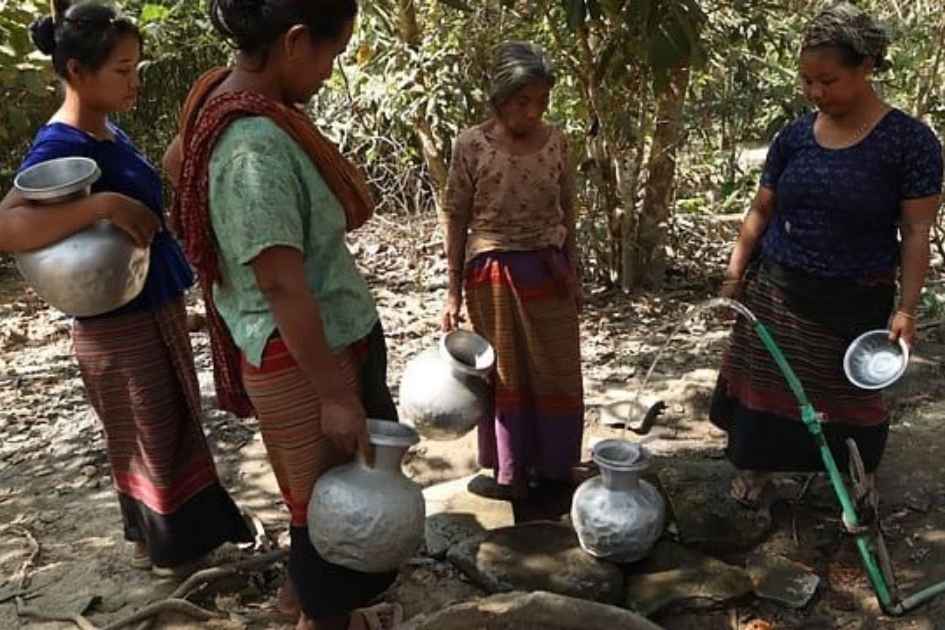
Five years ago, daily life revolved around water scarcity. Women and children walked two to three hours each day to reach small hill streams. The climb strained elderly residents. Children often missed school because they helped collect water. During the dry season, streams shrank. Families rationed every drop.
Globally, UNICEF reports that women and girls spend around 200 million hours every day collecting water. Although that statistic spans many countries, the reality matched life in Shuknachari. Time lost to water collection meant lost income, lost study hours, and higher health risks. Diarrheal diseases still affect rural communities in Bangladesh, especially where safe water remains limited.
The villagers recognized that water scarcity did not simply inconvenience them. It limited opportunity. It weakened health. It trapped them in a cycle of hardship. Therefore, they decided to change the story themselves.
Building a Pipeline Through Determination
The first major step in Tanchangya community self reliance focused on water. The villagers identified a reliable mountain spring located about two kilometers away. The route crossed uneven slopes and rocky terrain. Still, they refused to see the distance as an obstacle.
They raised around 400000 BDT by selling bananas from small gardens and harvesting bamboo from a reserved twenty acre forest area. According to recent rural income data, the average monthly income for many hill farming families remains below 15000 BDT. That means the community pooled resources equal to many months of earnings. This financial sacrifice shows how serious they felt about change.
With half the funds, they purchased pipes and basic equipment. Then they organized labor. Each family contributed manpower. Over one intense week, they carried pipes up hills, dug trenches, and carefully laid the line from the spring to the village. They installed three water tanks at key points to distribute supply evenly.
Today, clear mountain water flows directly into courtyards. Hygiene has improved. Bathing has become regular. Children leave for school on time. Women reclaim hours that they once spent walking steep paths. In this way, Tanchangya community self reliance turned a two hour burden into daily relief.
Roads That Connected More Than Land
Water solved one urgent problem. Yet isolation still shaped daily life. During the rainy season, muddy tracks blocked easy movement. Farmers struggled to transport fruit and crops to nearby markets. Emergency medical travel became risky and slow.
Therefore, the villagers turned their attention to roads. They constructed a two kilometer dirt road that links Shuknachari to the main access route. They cleared brush, leveled soil, and reinforced sections vulnerable to erosion. Although the road remains simple, it changed the village economy.
Recent data from Bangladesh Rural Development Board shows that rural road connectivity can increase household income by up to 20 percent in remote regions because farmers reach markets faster and reduce transport costs. In Shuknachari, fruit from orchards now travels more easily to local buyers. Families earn more stable cash income. Mobility has improved for students and elderly residents alike.
The road represents more than soil and stone. It represents connection. It demonstrates how Tanchangya community self reliance strengthens both economic resilience and social mobility.
A School Built From Faith and Vision
Education stands at the heart of long term change. Bangladesh has achieved impressive progress in primary school enrollment, reaching over 97 percent nationwide according to recent government reports. However, access in remote hill areas still faces gaps due to distance and infrastructure challenges.
Shuknachari Para once lacked a formal classroom. Children studied in limited spaces. Weather often disrupted lessons. Recognizing this barrier, the villagers used remaining funds to construct a semi permanent dining hall attached to their Buddhist monastery. That hall now serves as a primary school classroom.
They built walls with bamboo and reinforced them with simple materials. The monastery doubles as a spiritual center and a learning space. This shared use reflects strong community bonds. Teachers conduct lessons in a space that villagers created themselves.
Through this effort, Tanchangya community self reliance ensured that children do not sacrifice education due to geography. Instead, young learners now grow up in a village that values both tradition and knowledge.
Climate Challenges and Local Solutions
Bandarban faces increasing climate pressure. The region experiences heavy rainfall, flash floods, and occasional landslides. Climate experts note that Bangladesh ranks among the most climate vulnerable countries in the world. Although coastal flooding often draws attention, hill districts also face erosion and water stress during dry periods.
Shuknachari Para practices jhum cultivation, a traditional shifting farming method. Climate variability affects crop yield and soil stability. Therefore, the pipeline project also serves as climate adaptation. Reliable water supports hygiene during drought periods. The road improves emergency access after heavy rain. Community forest management helps prevent excessive deforestation.
Studies on community based climate adaptation show that locally led solutions often prove more sustainable because residents understand terrain and risk patterns. In Shuknachari, villagers did not wait for external consultants. They studied their own hills. They protected their forest. They invested in infrastructure that fits their landscape.
Thus, Tanchangya community self reliance aligns closely with modern climate adaptation principles, even though the villagers may not use technical language to describe it.
Women at the Center of Change
When water arrived at home, women felt the greatest relief. They once carried heavy containers across steep slopes. Now they manage time differently. Some women expand small kitchen gardens. Others help children with homework. Health improves because families use cleaner water regularly.
Across Bangladesh, women participate actively in rural agriculture and household management. However, unpaid labor often limits their economic opportunity. By reducing time spent on water collection, Shuknachari freed hours for productive work. Although no formal survey measures the exact impact yet, global research suggests that improved water access can significantly boost female participation in income generating activities.
In this way, Tanchangya community self reliance quietly advanced gender equity. It empowered women without slogans. It delivered practical freedom through infrastructure.
Leadership Rooted in Unity
Nilboron Tanchangya, the village leader, guided coordination but did not act alone. Collective decision making shaped every step. Each household rotated maintenance duties for the pipeline. Shared responsibility prevents conflict and ensures sustainability. Local officials have recognized this unity. Representatives from the union parishad have praised the village for not waiting passively for assistance. Meanwhile, engineers have expressed willingness to support technical maintenance if requested. Yet the initiative always remains with the villagers.
Strong local leadership often determines whether rural projects succeed or fail. Many development efforts collapse when maintenance weakens. In Shuknachari, community ownership protects longevity. Because families built the system themselves, they protect it carefully.
Therefore, Tanchangya community self reliance rests not only on physical labor but also on social trust.
A Model That Speaks Beyond the Hills
Stories like this resonate because they combine dignity and practicality. Bangladesh continues to invest heavily in rural development. Government data shows that access to safe drinking water nationwide exceeds 98 percent when counting various sources. Yet statistics sometimes mask the hardship of remote pockets.
Shuknachari Para reminds us that development does not always flow from center to margin. Sometimes it rises from the margin upward. A village of thirty five families proved that organized effort can overcome terrain and poverty.
Moreover, the example encourages other indigenous communities in the Chittagong Hill Tracts. When people see neighbors succeed through cooperation, confidence spreads. That ripple effect may inspire similar projects across Bandarban and beyond.
In the end, Tanchangya community self reliance tells a simple truth. Progress does not always wait for permission. It grows where people believe in their own strength. In Shuknachari Para, clean water runs through pipes that villagers carried themselves. Children study in a hall that families built with bamboo and savings. Farmers travel on a road shaped by their own hands. Their achievement stands as living proof that resilience begins at home.