



Portrait of a City: The People Keeping Dhaka Running Before Sunrise

Portrait of a City: The People Keeping Dhaka Running Before Sunrise
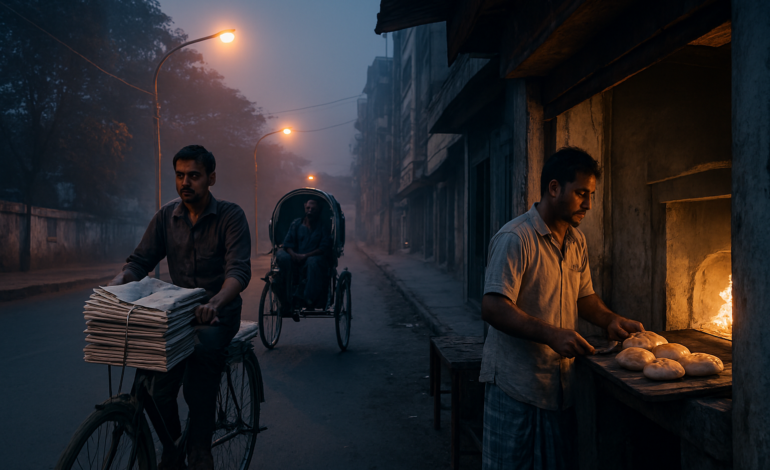
Before the city of Dhaka wakes to the sound of traffic horns and office alarms, a quieter workforce is already shaping the day. In the blue-grey hours before sunrise, newspaper hawkers set out with bundled headlines, rickshaw pullers warm up their muscles for long shifts, and bakers fire their ovens so fresh bread reaches doorsteps by morning. These workers rarely appear in official statistics or glossy urban narratives, yet they are the unseen foundation of Bangladesh’s capital.
This is a portrait of the people who keep Dhaka moving before most of the city even opens its eyes
City That Never Truly Sleeps
Dhaka is often described as a city that never sleeps. But more accurately, it is a city that works in shifts of silence and sound. While nightlife fades around 2 or 3 a.m., another rhythm begins. Streetlights still glow as early workers step into near-empty roads. The stillness allows their labor to flow uninterrupted, preparing the city for the surge of millions that will follow.
For these workers, dawn is not a beginning but it is the middle of their day.
Newspaper Hawkers: Delivering the First Stories of the Day
Long before digital notifications buzz on smartphones, newspaper hawkers cycle through alleys and main roads carrying the printed pulse of the nation. By 4:30 a.m., many have already collected stacks from distribution points, sorting papers by neighborhood routes.
For decades, hawkers have been vital in connecting people with news especially older readers who still prefer the rustle of printed pages. Their work requires precision: delivering on time, handling payments, and remembering dozens of regular customers.
In an age dominated by online media, these hawkers are not merely vendors; they are custodians of a tradition that values slow reading, morning tea, and reflection before the rush begins.
Rickshaw Pullers: Powering the Early Commute
As the sky lightens, rickshaw pullers begin to appear at street corners, ready for the city’s earliest commuters. Factory workers heading for dawn shifts, hospital staff reporting early duty, and market vendors carrying goods all depend on these pedal-powered vehicles.
For many pullers, the morning hours are the most productive. The roads are less congested, the air slightly cooler, and passengers more appreciative of punctual service. Each ride before sunrise sets the tone for a day that may stretch for 10 to 12 hours.
Despite physical exhaustion, rickshaw pullers embody resilience. Their labor is not just transport, it is mobility for a city where public transit remains limited for many.
Bakers: Crafting Mornings Before They Begin
While most families are still asleep, bakers across Dhaka are already at work. In small neighborhood bakeries and large commercial kitchens alike, ovens glow as early as 2 a.m. Dough is kneaded, trays are stacked, and the scent of fresh bread spreads quietly through streets.
These bakers ensure that schoolchildren have buns for breakfast, office workers can grab snacks on the way, and tea stalls are stocked with fresh items. Their work is precise and time-sensitive; a late batch can disrupt dozens of daily routines.
Bakers are often invisible contributors to urban life, yet their consistency creates comfort — the simple pleasure of fresh food at the start of the day.
The Discipline of the Dawn Workforce
What unites newspaper hawkers, rickshaw pullers, and bakers is discipline. Their schedules run counter to the rest of the city. They sleep early, wake while it is still dark, and measure time differently.
Their routines require:
- Physical endurance in demanding conditions
- Time management without digital reminders
- Mental resilience to work in isolation
- Community trust built through consistency
These are not temporary jobs for many as they are lifelong professions that support families, fund education, and sustain entire neighborhoods.
Dignity in Everyday Labor
Too often, urban narratives celebrate CEOs, politicians, and celebrities while overlooking those who perform the daily tasks that keep cities functional. Yet dignity does not come from status, it comes from contribution.
A hawker ensuring a retired teacher receives the morning paper, a rickshaw puller helping a nurse reach the hospital on time, or a baker preparing bread for hundreds of children these acts carry quiet heroism.
Their work does not seek applause, but it deserves recognition.
Urban Challenges, Rural Roots
Many early-morning workers in Dhaka are migrants from rural districts. They arrive with hope for better livelihoods, often sending most of their earnings back home. For them, pre-dawn labor is not only survival, it is investment in the future of their families.
Yet they face challenges:
- Limited access to healthcare
- Insecure housing
- Long working hours
- Rising living costs
Despite this, their commitment rarely wavers. They adapt, endure, and continue to serve a city that depends on them more than it realizes.
Why Their Stories Matter
Telling the stories of Dhaka’s dawn workers is not just an act of appreciation, it is a reminder of how cities truly function. Infrastructure alone does not make a metropolis work; people do.
In an era of automation and smart cities, human labor remains irreplaceable in the intimate rhythms of daily life. The city wakes up smoothly because someone, somewhere, started working while the rest of us slept.
A Morning Salute to the Unseen Workforce
Next time you open your newspaper with tea, ride a rickshaw through a quiet street, or enjoy fresh bread at breakfast, remember the hands behind those moments. Dhaka’s mornings are built on their effort.
Before sunrise, while the city dreams, these workers are already shaping reality.
They are not just part of the city.
They are the reason the city works.