



Largest Eid-ul-Fitr Jamaats in Bangladesh: From Historic Sholakia to National Eidgah

Largest Eid-ul-Fitr Jamaats in Bangladesh: From Historic Sholakia to National Eidgah
1. Sholakia Eidgah (Kishoreganj): The Traditional Giant
- Capacity: Over 600,000 worshippers.
- Unique Feature: The congregation is so large that devotees spill over into the surrounding railway tracks, streets, and courtyards for miles.
- 2026 Expectation: It will host its 199th jamaat, typically starting at 10:00 AM.
2. Gor-e-Shahid Boro Maidan, Dinajpur: South Asia’s Largest Eid Field
Located in Dinajpur, the Gor-e-Shahid Boro Maidan is often described as the largest Eidgah field in South Asia.
- Capacity: Approximately 600,000 devotees.
- Unique Feature: The vast, unobstructed open field allows for a highly organized and visually stunning prayer formation.
- 2026 Expectation: Prayers are usually held at 9:00 AM.
3. National Eidgah, Dhaka: Where the Nation Prays Together
The National Eidgah in Dhaka holds a special place in Bangladesh’s religious and political landscape.
Located near the High Court, it is the country’s central Eid congregation venue, where top figures including the President, Prime Minister, ministers, and diplomats join the prayer.
One of its most distinctive features is the large weather-proof pandal system, built using thousands of bamboo and ropes to protect worshippers from rain or intense sun.
Every year, extensive preparations are undertaken to transform the open field into a structured prayer ground capable of accommodating tens of thousands.
The National Eidgah is not just a place of prayer rather it is a symbol of unity.
- Capacity: 35,000 to 100,000 (depending on security and weather arrangements).
- Unique Feature: High-profile attendance and top-tier security. It also features dedicated sections for women to offer prayers.
- 2026 Expectation: The main jamaat is scheduled for 8:30 AM.
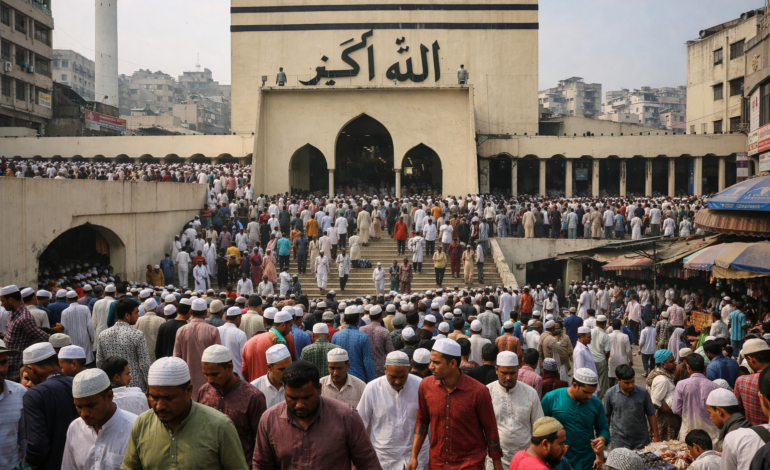
4. Baitul Mukarram National Mosque (Dhaka): The Urban Powerhouse
This structured approach reflects the realities of urban life in Dhaka, where space constraints require innovative solutions to accommodate large numbers of worshippers.
- Capacity: Hundreds of thousands across five shifts.
- Unique Feature: The “Golden Jubilee” architecture and the convenience of multiple prayer times (starting from 7:00 AM).
- 2026 Expectation: Five jamaats held hourly from 7:00 AM to 10:45 AM.
5. Shahi Eidgah (Sylhet): The Mughal Heritage
- Capacity: Over 100,000 devotees.
- Unique Feature: The ancient Mughal architecture provides a unique spiritual atmosphere that is unmatched by modern grounds.
- 2026 Expectation: The jamaat is typically held at 8:30 AM.
Comparison of the Top Eid Grounds
| Location | Ground Name | Estimated Capacity | Historical Age |
|---|---|---|---|
| Kishoreganj | Sholakia Eidgah | 600,000+ | ~198 Years |
| Dinajpur | Gor-e-Shahid Maidan | 600,000 | ~7 Years (Modernized) |
| Dhaka | National Eidgah | 100,000 | ~40 Years |
| Sylhet | Shahi Eidgah | 100,000+ | ~300+ Years |
| Dhaka | Baitul Mukarram | Massive (5 shifts) | ~60 Years |
The Spirit Behind the Gatherings
While these five Eid jamaats differ in size, history, and structure, they share a common essence.
They are not just about numbers. They are about unity.
From the biggest attendance in Sholakia to the minaret of Dinajpur, from the National Eidgah in High Court area to the organized congregations at Baitul Mukarram, and the Mughal elegance of Sylhet—each site reflects a different dimension of Bangladesh’s Islamic culture.
Together, they form a powerful narrative of faith that brings millions together every Eid.
Practical Tips for Attending Large Jamaats
- Security Protocols: Due to the massive scale, security is tight. Do not bring bags, backpacks, or umbrellas unless explicitly permitted. Most grounds only allow a prayer mat (Jainamaz) and a cap.
- Arrive Early: For Sholakia or Dinajpur, devotees often arrive 2-3 hours before the prayer starts to secure a spot within the main field.
- Transport: Look for “Eid Special” trains. Bangladesh Railway usually operates special services to Kishoreganj and Dinajpur specifically for these congregations.
- Ablution (Wudu): While facilities are provided, they get extremely crowded. It is highly recommended to perform Wudu at home before heading to the ground.
Looking Ahead
Which of these historic grounds do you plan to visit for your next Eid prayer?