




Is Cashless Bangladesh Possible? The Reality Behind Mobile Banking Growth
Bangladesh is rapidly moving toward a digital financial ecosystem, driven by the growth of mobile financial services and mobile banking platforms such as bKash, Nagad, and Rocket. These services have transformed how millions of Bangladeshis send money, pay bills, purchase goods, and manage everyday financial needs. But as the nation advances toward the idea of a “cashless society,” questions remain: Is cashless Bangladesh truly possible? What opportunities do mobile banking platforms create, and what are their limits?
This article explores the evolution of mobile finance in Bangladesh, assesses the benefits and challenges of digital adoption, and examines the structural changes needed to make a cashless economy a sustainable reality.
The Rise of Mobile Finance in Bangladesh
Mobile financial services (MFS) in Bangladesh have grown exponentially over the past decade. Platforms like bKash and Nagad have become household names, bringing financial tools to populations that were previously excluded from traditional banking.
bKash: A Pioneer in Mobile Money
Launched in 2010 as a joint venture between BRAC Bank and international partners, bKash quickly became the market leader in mobile financial services. It provided millions of users with a convenient alternative to cash, enabling:
- Peer-to-peer money transfers
- Retail payments
- Bill payments
- Merchant transactions
With intuitive USSD menus, smartphone apps, and extensive agent networks, bKash helped mainstream digital financial services among both urban and rural users.
Nagad: A Fast-Growing Competitor
Introduced by the Bangladesh Post Office in 2019, Nagad entered the arena with competitive pricing and government backing. It gained market traction by offering zero fees for certain transactions and benefits for government disbursements including pensions, social support, and salaries.
As Nagad’s infrastructure expands, it attracts users looking for low-cost digital payment solutions.
Rocket and Traditional Mobile Banking
Rocket, a service provided by Dutch-Bangla Bank, represents the mobile banking arm of traditional banking. Unlike e-wallet-centric MFS platforms, Rocket integrates fully with a bank account, providing users with:
- Account-based deposits and withdrawals
- Interest-bearing savings
- Interbank transfers
- ATM access
Rocket serves as a hybrid between mobile wallets and classical banking services, appealing to users who want both digital convenience and traditional banking functions.
The Vision of a Cashless Banglades
A cashless economy is one in which financial transactions occur electronically, reducing dependency on physical cash. Proponents argue that such an economy can:
Improve transparency and reduce corruption
- Reduce transaction costs
- Increase financial inclusion
- Help track economic activity
- Enhance efficiency in public and private payments
In Bangladesh, the push toward cashless transactions aligns with national goals to modernise the economy, expand financial inclusion, and harness digital technology to boost productivity.
Opportunities Created by Mobile Banking
1. Greater Financial Inclusion
One of Bangladesh’s most lauded achievements is the expansion of financial access to previously underserved populations. Mobile financial services have brought:
- Digital wallets to rural and urban poor
- Women access to personal financial accounts
- Small businesses tools to receive payments and manage cashflow
As of recent data, tens of millions of Bangladeshis use mobile financial services regularly, a dramatic increase from a decade ago.
2. Convenience and Speed
Digital payments are fast, available 24/7, and reduce the need for physical travel to banks or money changers. Users can pay utility bills, shop online, or send money to family across the country in minutes.
3. Growth of Digital Commerce
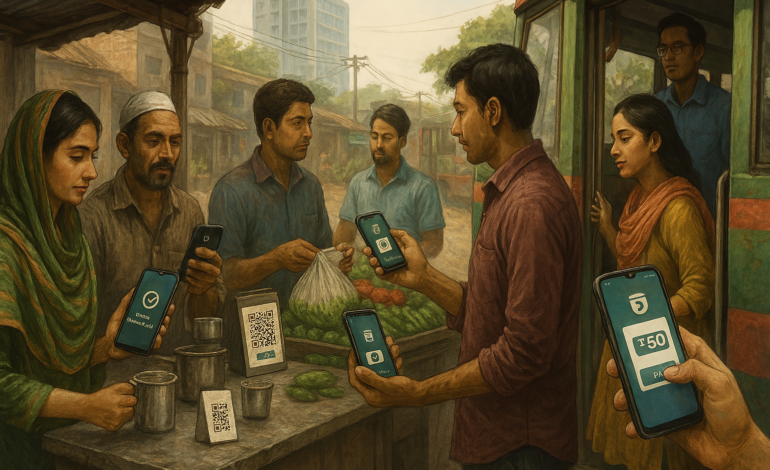
E-commerce platforms and ride-hailing apps increasingly integrate mobile wallets. Merchant payments via QR codes and online checkouts create a networked digital economy that reduces reliance on cash at point-of-sale.
4. Government Disbursements
Mobile banking plays an important role in government services, especially during emergencies. For example, digital platforms have been used to deliver:
- Social safety net payments
- COVID-19 relief funds
- Subsidies and pension disbursements
This reduces leakage and ensures funds reach intended beneficiaries quickly.
5. Economic Efficiency
Electronic payments offer detailed transaction records that improve economic planning and reduce the informal cash economy. Tax compliance, business reporting, and formal economic integration all benefit from tracked digital flows.
The Limits and Challenges
Despite rapid growth and clear opportunities, a fully cashless Bangladesh faces significant hurdles.
1. Digital Divide and Literacy
A substantial proportion of the population still lacks the digital literacy needed to use mobile financial services effectively. Barriers include:
- Illiteracy
- Limited exposure to technology
- Language obstacles in apps and menus
Without targeted education and support, digital adoption remains uneven, particularly in rural or underprivileged areas.
2. Infrastructure and Connectivity
Reliable internet and mobile networks are critical to mobile banking. While urban centres often have adequate coverage, rural regions can suffer from poor connectivity, slowing transaction processing and reducing user confidence.
3. Trust and Cash Preference
Cash remains a trusted medium due to its tangibility and anonymity. Users may hesitate to fully transition to digital payments due to concerns about fraud, technological complexity, or lack of trust in digital vendors.
4. Transaction Limits and Regulation
Regulators often impose transaction limits to reduce fraud risk. While important for security, these caps can discourage high-value digital transactions, pushing users back toward cash for larger payments.
5. Security and Fraud Risks
Digital financial services, like any online platform, are susceptible to fraud, data breaches, and phishing attempts. Protecting users from these risks requires strong cybersecurity infrastructure and ongoing awareness campaigns.
Regulatory Framework and Government Role
The Bangladesh Bank has played an active role in shaping the mobile finance ecosystem. Regulations govern:
Licensing of mobile financial service providers
Anti-money-laundering (AML) and know-your-customer (KYC) requirements
Transaction limits and interoperability
Consumer protection standards
Recent initiatives include support for QR code payments, linking mobile wallets with bank accounts, and expanding agent networks as part of financial inclusion strategies.
The government’s Digital Bangladesh Vision 2021 and beyond emphasises digital transformation across sectors, positioning mobile finance as a cornerstone of that strategy.
The Path Forward: What’s Needed for a Cashless Future
A fully cashless society may remain aspirational for Bangladesh, but incremental progress continues. Key areas that will support this transition include:
1. Improved Financial Education
Programs that teach users how to safely manage digital payments, identify scams, and utilise mobile banking features are essential.
2. Stronger Digital Infrastructure
Expanding reliable internet access, particularly in rural areas, will reduce barriers to mobile banking adoption.
3. Interoperability
Ensuring that mobile wallets, bank accounts, and payment platforms work seamlessly together will make digital transactions more convenient.
4. Security and Consumer Trust
Enhanced security protocols, rapid fraud response, and clear dispute resolution mechanisms will strengthen user confidence in digital systems.
5. Affordable Services
Balancing transaction fees and service charges to remain accessible to low-income users will be critical to retaining broad use.
Global Comparisons and Lessons
Bangladesh’s journey toward cashlessness mirrors trends in countries such as:
Kenya: Where the M-Pesa platform revolutionised mobile money and financial inclusion
India: Where Unified Payments Interface (UPI) dramatically expanded digital payments
China: Where mobile wallets reign supreme for daily transactions
These examples show that mobile finance can transform economies, but only when supported by robust infrastructure, regulatory clarity, and user trust.
Conclusion: Opportunity and Reality
Mobile financial services have already reshaped how Bangladesh transacts, saves, and interacts with money. Platforms like bKash, Nagad, and Rocket have brought millions into digital finance and expanded the reach of financial services in unprecedented ways.
However, a truly cashless Bangladesh remains a work in progress. Structural barriers, technological limits, and behavioural preferences mean cash will likely continue to play a role in daily life for years to come.
The journey toward cashlessness is not just about technology; it is about education, trust, infrastructure, and inclusion. For Bangladesh to realise its digital finance ambitions, policymakers, private sector innovators, regulators, and communities must work together in unison.
In the meantime, mobile banking continues to offer a powerful bridge between a cash-based economy and a digital future one transaction at a time.