




Inside Dhaka’s Shadow Economy: How Street Businesses Survive Without Licenses
The Economy You See but Don’t Notice
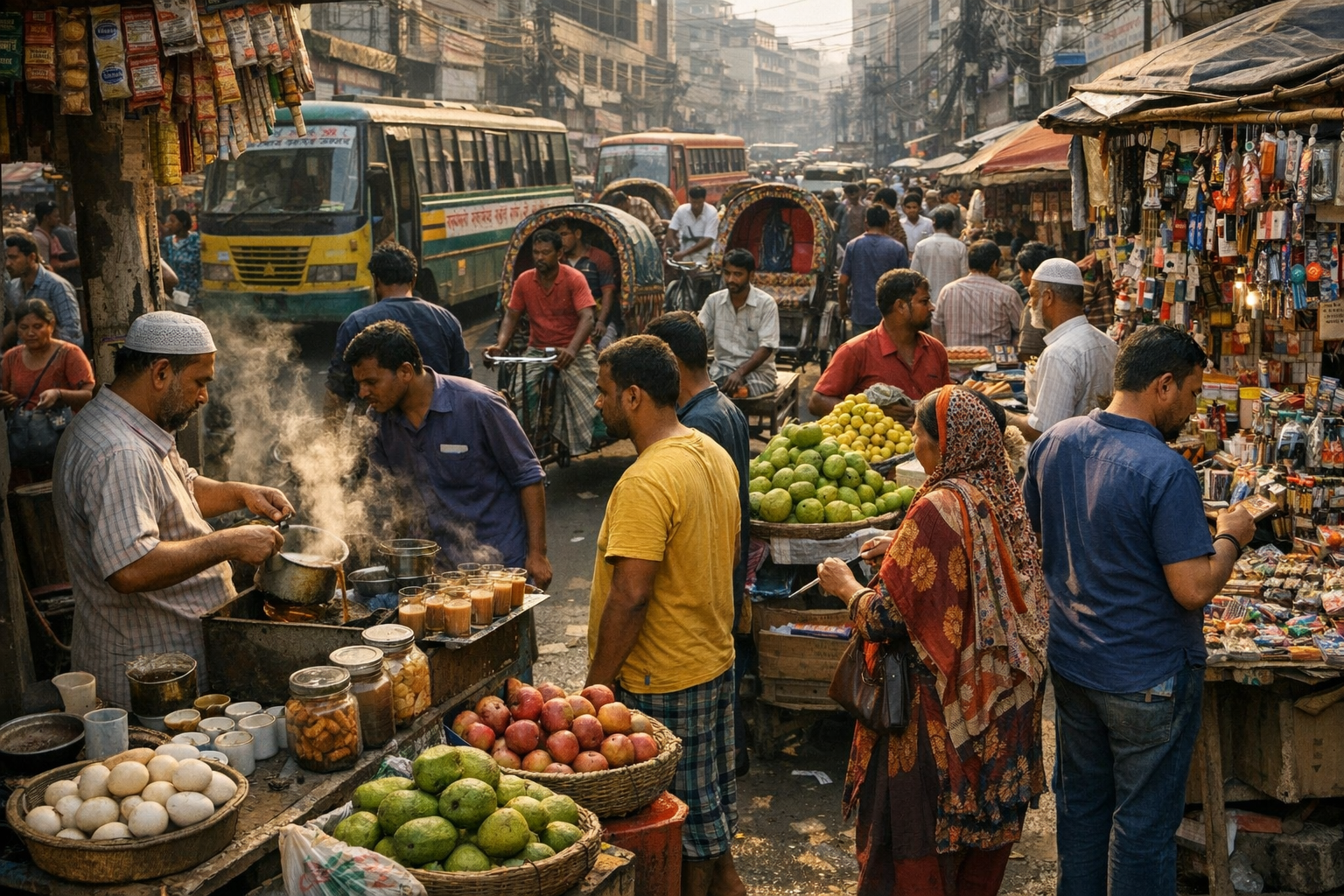
Walk through any busy area of Dhaka like Gulistan, New Market, Farmgate and you’ll encounter a parallel economy operating in plain sight. Tea stalls, fruit carts, mobile phone accessory vendors, roadside tailors, all functioning without formal registration, licenses, or tax records.
This is Dhaka’s shadow economy: vast, unregulated, and deeply embedded in everyday life. It is not hidden in the traditional sense. Instead, it exists openly, woven into the city’s streets and sidewalks.
Yet behind this visibility lies a complex system of survival. These businesses operate without licenses not by choice alone, but often because the formal system is structurally out of reach.
A Massive Informal Workforce
Dhaka’s street businesses are part of a much larger informal economy that dominates Bangladesh’s labor market. Estimates suggest that a significant majority of workers in the country are engaged in informal employment, making it the backbone of economic activity.
In fact, millions depend on informal work for survival, including street vendors, day laborers, and small-scale traders.
Street vending alone employs a large number of people in Dhaka. It provides low-cost goods and services to urban residents while offering income opportunities to those who might otherwise remain unemployed.
This scale explains why the shadow economy persists—it is not a marginal system, but a central part of how the city functions.
Why Most Street Businesses Operate Without Licenses
At first glance, operating without a license may appear to be a legal shortcut. In reality, for many vendors, it is the only viable option.
To obtain a trade license in Bangladesh, a business owner must provide documents such as:
- A permanent business address
- A bank account
- Utility bills
- Tax identification details
Street vendors typically lack these requirements. They operate on footpaths, move locations frequently, and often do not have formal financial access.
This creates a structural barrier: the system is designed for fixed, formal businesses—not mobile, low-capital enterprises.
As a result, many vendors remain outside the formal economy, not because they reject it, but because they cannot enter it.
Survival Economics: Low Capital, High Risk
Street businesses in Dhaka operate on minimal investment. A tea stall may start with just a kettle, a few cups, and basic ingredients. A fruit seller may rely on daily purchases from wholesale markets.
Financing typically comes from:
- Personal savings
- Borrowing from friends or family
- Informal loans
Formal bank loans are rarely accessible, as vendors lack collateral or documentation.
This creates a fragile economic model. Vendors must earn daily to survive, with little capacity to absorb shocks such as illness, eviction, or bad weather.
Despite this, many continue because the alternative—unemployment—is worse.
Location Is Everything
One of the most critical factors in the survival of street businesses is location.
High-traffic areas like bus stops, markets, and office zones provide steady customer flow. Vendors often compete intensely for these spots, as a good location can determine daily earnings.
However, these spaces are rarely secure. Vendors may face:
- Evictions by authorities
- Competition from other vendors
- Informal “fees” to maintain their spot
This creates a dynamic where businesses are constantly adapting—moving, negotiating, and rebuilding.
The Role of Social Networks
In the absence of formal systems, social networks become essential.
Vendors rely on:
- Family members for labor
- Peer networks for information and support
- Informal associations to manage disputes
Social capital often determines success. Knowing the right people can help secure a better location, access supplies, or navigate challenges.
These networks act as a substitute for formal institutions, providing a level of stability in an otherwise uncertain environment.
Why the System Persists
The persistence of Dhaka’s shadow economy is not accidental, it serves important functions for both vendors and consumers.
For vendors:
- Provides immediate income opportunities
- Requires low entry barriers
- Offers flexibility
For consumers:
- Affordable goods and services
- Convenient access in everyday locations
- Faster transactions
Street vendors often sell products at lower prices, making them essential for low- and middle-income urban residents.
Without them, many daily needs from tea to fresh produce would become less accessible.
The Cost of Informality
While the shadow economy offers survival, it also comes with significant drawbacks.
1. Legal Insecurity
Vendors can be removed at any time, often without notice or compensation.
2. Lack of Protection
There is no access to labor rights, health insurance, or social safety nets.
3. Income Instability
Earnings fluctuate daily, making long-term planning difficult.
4. Limited Growth
Without formal recognition, businesses struggle to expand or access credit.
These challenges highlight the trade-off at the heart of the informal economy: accessibility versus security.
A Gendered Reality
Street vending in Dhaka is largely male-dominated, although women also participate, often facing additional barriers.
Social norms, safety concerns, and mobility restrictions limit women’s participation in public street businesses.
Those who do engage often operate in less visible roles or in specific sectors such as food preparation.
This gender imbalance reflects broader societal structures, showing how the informal economy is shaped by cultural as well as economic factors.
The Hidden Contribution to the Economy
Despite being unregistered, street businesses contribute significantly to Dhaka’s economy.
They:
- Generate employment
- Support urban supply chains
- Reduce pressure on formal job markets
Some estimates suggest that informal economic activities account for a large share of Bangladesh’s overall economic output.
This creates a paradox: the system is economically vital, yet institutionally invisible.
The Future: Formalization or Flexibility?
The key question facing policymakers is whether and how to integrate these businesses into the formal economy.
Full formalization may not be realistic or even desirable for all vendors. Strict regulations could push vulnerable workers out of income-generating activities.
Instead, experts suggest more flexible approaches, such as:
- Simplified licensing systems
- Designated vending zones
- Access to microfinance and digital payments
These measures could improve stability without undermining the flexibility that makes street businesses viable.
Survival in Plain Sight
Dhaka’s shadow economy is not hidden it is visible in every street corner, every tea stall, and every makeshift shop.
It survives because it meets a fundamental need: providing livelihoods in a city where formal opportunities are limited.
Street businesses operate without licenses not because they ignore the system, but because the system often excludes them. They navigate uncertainty, build networks, and adapt constantly, all to sustain daily survival.
Understanding this reality is essential. Because behind every roadside stall is not just a business, but a story of resilience in one of the world’s most complex urban economies.