

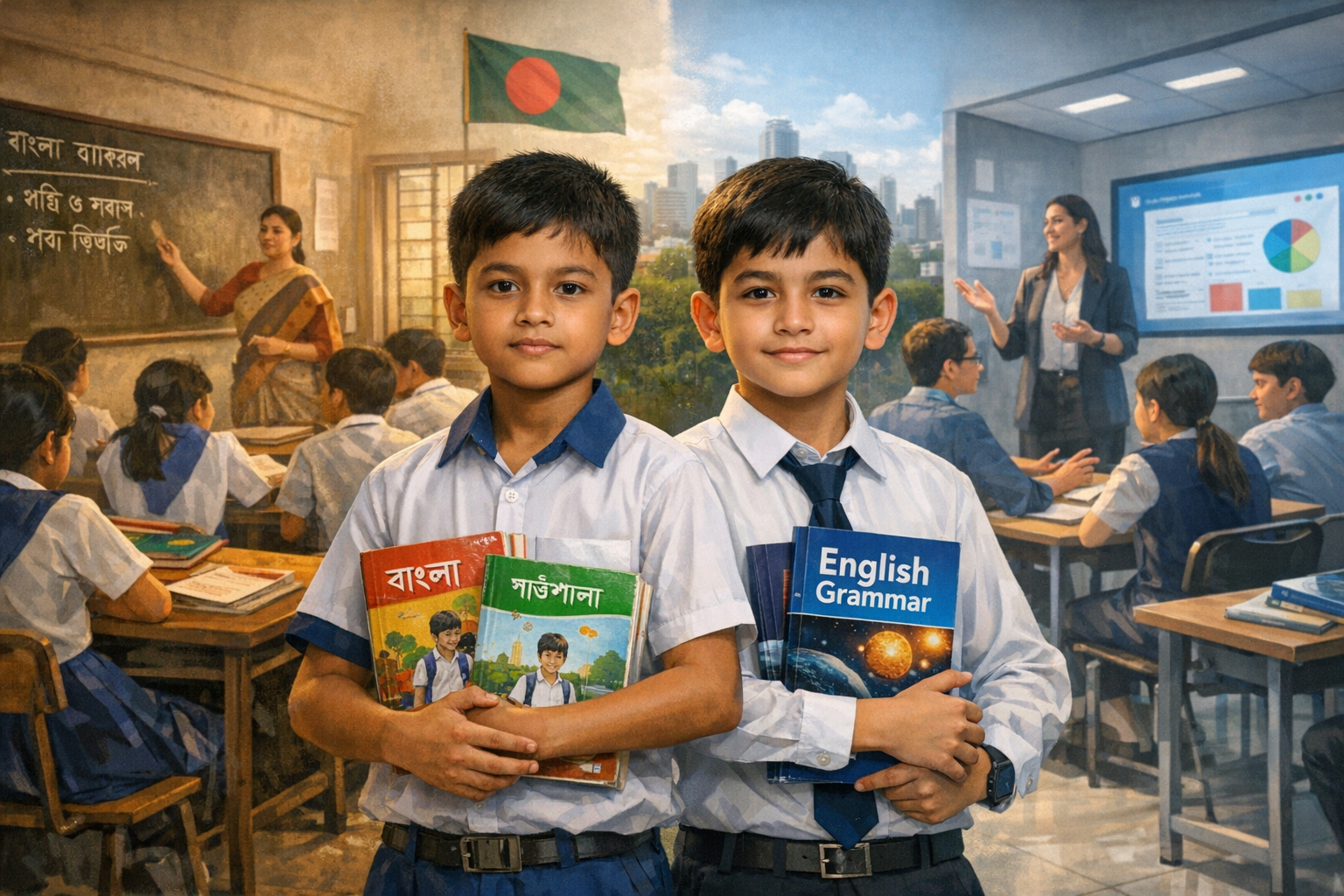



English Medium vs Bangla Medium: Which One Really Prepares Students Better in Bangladesh?
The debate between English medium and Bangla medium education in Bangladesh has existed for decades, often shaping how parents, students, and policymakers perceive success. For many families, choosing a schooling system is not just about academics, it is about future opportunities, social mobility, and global competitiveness.
In 2026, as Bangladesh continues to integrate into the global economy while preserving its cultural identity, the question remains highly relevant: which system truly prepares students better?
Understanding the Two Systems
In Bangladesh, the Bangla medium system follows the national curriculum set by the National Curriculum and Textbook Board. It emphasizes education in Bengali, the country’s mother tongue, and culminates in public exams like SSC and HSC.
On the other hand, English medium schools follow international curricula such as Cambridge or Edexcel, offering O Levels and A Levels. These institutions focus heavily on English language proficiency and global academic standards.
Each system reflects a different educational philosophy one rooted in national identity, the other in global exposure.
Academic Structure and Learning Style
One of the key differences lies in how students are taught and assessed.
Bangla Medium:
- Structured syllabus with standardized textbooks
- Focus on memorization and exam performance
- Strong emphasis on theoretical knowledge
English Medium:
- Flexible curriculum with analytical learning
- Focus on critical thinking and problem-solving
- Coursework, presentations, and practical assessments
Students in English medium schools are often encouraged to question, debate, and analyze, whereas Bangla medium students typically focus on mastering prescribed content.
However, this does not necessarily mean one is superior as it depends on how effectively each system is implemented.
Language Advantage and Communication Skills
Language plays a crucial role in shaping future opportunities.
Students from English medium backgrounds tend to have:
- Strong English communication skills
- Higher confidence in international settings
- Easier access to global education and job markets
In contrast, Bangla medium students:
- Have a stronger grasp of Bengali language and literature
- Are more connected to local culture and society
- Often face challenges in spoken English, especially early in their careers
In a globalized job market, English proficiency can be a significant advantage. However, being fluent in one’s native language is equally important for national identity and communication within Bangladesh.
Career Opportunities and Higher Education
One of the biggest reasons parents choose English medium education is the perception of better career prospects.
Students from English medium backgrounds often:
- Apply to universities abroad
- Perform well in multinational companies
- Have exposure to international academic standards
However, Bangla medium students dominate in:
- Public universities in Bangladesh
- Government jobs and civil services
- Competitive exams within the country
It is worth noting that many successful professionals in Bangladesh come from Bangla medium backgrounds, proving that the system itself is not a limitation.
Cost and Accessibility
A major difference between the two systems is affordability.
English Medium:
- High tuition fees
- Additional costs for books, exams, and activities
- Mostly limited to urban areas
Bangla Medium:
- Low-cost or free education in government schools
- Accessible across the country
- Inclusive for lower- and middle-income families
This makes Bangla medium the dominant system, educating the majority of students in Bangladesh.
Cultural Identity vs Global Exposure
Education is not just about academics—it also shapes identity.
Bangla medium education:
- Promotes national history and culture
- Strengthens connection to Bengali heritage
- Reinforces linguistic pride rooted in movements like Language Movement of 1952
English medium education:
- Provides global perspective
- Encourages multicultural understanding
- Prepares students for international environments
The challenge lies in balancing these two aspects global readiness without losing cultural roots.
Skill Development: Who Has the Edge?
In terms of skill development, English medium students often have an advantage in:
- Presentation skills
- Critical thinking
- Creativity and independent learning
Meanwhile, Bangla medium students often excel in:
- Academic discipline
- Competitive exam performance
- Strong foundational knowledge
However, the gap is gradually narrowing. Many Bangla medium institutions are now incorporating:
- Digital learning tools
- English language training
- Modern teaching techniques
The Reality in 2026 Bangladesh
In today’s Bangladesh, the divide between English and Bangla medium is not as rigid as it once was.
Key trends include:
- Increasing demand for English skills even among Bangla medium students
- Growth of English version schools under the national curriculum
- Expansion of private universities accepting both backgrounds
Employers are also shifting their focus. Instead of educational background alone, they now prioritize:
- Skills
- Experience
- Communication ability
This means that students from either system can succeed if they develop the right competencies.
Which One Prepares Students Better?
There is no one-size-fits-all answer.
English Medium is better if:
- You aim for international education or careers
- You want strong communication and analytical skills
- You can afford the cost
Bangla Medium is better if:
- You plan to build a career in Bangladesh
- You value cultural and linguistic grounding
- You need an affordable and accessible education
Ultimately, success depends more on the student than the system.
The Ideal Approach: A Balanced Education
Many education experts suggest that the best solution is not choosing one over the other, but combining the strengths of both systems.
An ideal education in Bangladesh would:
- Teach strong English communication skills
- Maintain Bengali cultural and historical knowledge
- Encourage critical thinking and creativity
- Provide equal opportunities regardless of background
This hybrid approach is already emerging in some institutions and could define the future of education in Bangladesh.
Looking Ahead
The debate between English medium and Bangla medium education in Bangladesh is complex and deeply rooted in social, economic, and cultural factors.
English medium offers global exposure and communication advantages, while Bangla medium provides accessibility and strong local grounding. Both systems have strengths and limitations.
In 2026, the real question is no longer which system is better but how students can maximize their potential within whichever system they choose.
Because in the end, education is not defined by the medium of instruction, but by the skills, mindset, and opportunities it creates.