




From Prison Walls to Public Space: How Old Dhaka Central Jail Became a Cultural Centre

From Prison Walls to Public Space: How Old Dhaka Central Jail Became a Cultural Centre
For centuries, the towering brick walls of the Old Dhaka Central Jail stood as one of Dhaka’s most enduring symbols of isolation. In the heart of one of the world’s most densely populated cities, the jail was once an unmistakable reminder of punishment and exclusion. After its transformation, the site is set to become an emblem of urban renewal, cultural memory, and ecological design.
The Old Dhaka Central Jail Conservation project, led by FORM.3 architects, has captured global attention for its ambitious scale and innovative approach. Named the regional grand prize winner of the prestigious Holcim Foundation Awards 2025, this 113,028 m² redevelopment reframes the former prison as a vibrant public realm designed for heritage, community, and sustainable urban life.
Breaking Down the Walls: A New Urban Vision
The first and most striking change is the site’s shift away from its historic carceral layout. For centuries, the sprawling compound, originally a Mughal fort, then a British colonial outpost, and eventually a state prison operated through layered walls, enclosed blocks, and restricted access. Each era contributed to a legacy of separation from the urban fabric.
Rather than demolish these architectural layers, designers chose adaptive reuse and repurposed former wards, cells, and workshops into community assets. Three former workshops, for example, have been transformed into art galleries and exhibition spaces, where visitors can now engage with creativity instead of confinement.
Old perimeter walls have been reimagined as porous boundaries. The project introduces an “osmotic” wall concept, which strategically opening parts of the jail’s edges to create urban pockets, green passages, and a new public road that helps ease local traffic movement. Rather than cutting the city off, the site now invites it in.
The new Chawk Complex, one of the project’s signature architectural additions, demonstrates a careful balance between old and new. Rejecting stark glass-and-steel modernism, its red-hued facade and traditional lime-mortar plaster echo the city’s historic aesthetic, ensuring harmony with Old Dhaka’s centuries-old streetscape.
Ecological Revival: A Green Lung in the Urban Core
In a neighbourhood notoriously starved for open space, the site’s ecological metamorphosis is transformative.
Old Dhaka’s intense urban density has long meant limited breathing room, excessive heat, and chronic flooding. The conservation project directly addresses these challenges with environmentally intelligent design.
The redevelopment has revived two existing water bodies and introduced three new ponds. These water features serve multiple purposes: they are public gathering points, natural cooling elements, ecological habitats, and even critical water reservoirs for fire safety in an area with constrained access for emergency services.
To combat Dhaka’s intense heat, often climbing above 40°C, a new buildings are oriented north-south to maximise natural ventilation, while Mashrabiya screens and green roofs help filter sunlight and lower ambient temperatures. Instead of vast expanses of concrete, porous pavers and vegetated ground surfaces improve groundwater recharge and reduce surface runoff during monsoon rains.
This environmental strategy positions the former jail site as a new “green lung” for Old Dhaka — a place that not only invites people to breathe but also enables the ground beneath them to absorb rainwater, cool the city, and support urban biodiversity.
Preserving History, Reimagining Use
One of the most carefully calibrated aspects of the project is its cultural center.
The site is divided into three zones, each with a distinct purpose:
Zone C — Historical Preservation:
This zone houses the Memorial Museum and the Four National Leaders Memorial Museum, preserving cells where some of Bangladesh’s founding figures were once held. These spaces anchor the site’s historical narrative, offering visitors a place to reflect on the nation’s struggle and triumph.
Zones A & B — Community Life and Recreation:
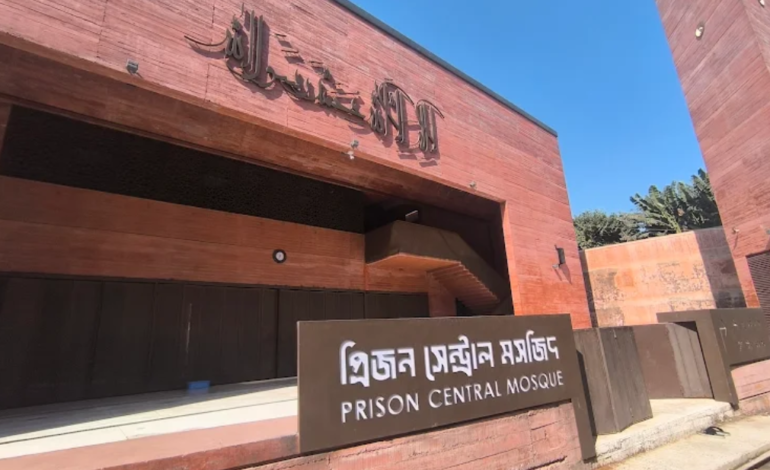
These zones introduce amenities that had long been missing in Old Dhaka: a cineplex, swimming pool, gymnasium, and a convention hall. A playground invites children and families, while a new mosque, adorned with intricate cast-iron ‘jali’ work, provides a space for daily prayer and community gathering. These additions transform the site into a location for everyday life, not just occasional visits.
The balance between memory and modern life honoring those who suffered within these walls while creating a place where people can live, play, and connect.
Economic Sustainability and Public Accessibility
A critical departure from earlier government proposals is the incorporation of a sustainable economic model. Rather than converting the prime land into luxury residences or commercial high-rises, the current plan integrates retail spaces, bookshops, and ticketed museum entries as revenue sources.
These income streams will help ensure that the site remains a public asset, one that funds its own maintenance while keeping access open to residents and visitors alike. Retail spaces have been allocated to local vendors and artisans, supporting small businesses and generating consistent foot traffic.
This economic strategy acknowledges the practical realities of urban redevelopment in rapidly growing cities like Dhaka, where public land can easily be lost to private interests without such safeguards.
Engaging the City: Events, Learning, and Cultural Exchange
More than physical transformation, the Old Dhaka Central Jail project is designed as a catalyst for cultural exchange and learning. The adaptive reuse zones host exhibitions, performances, workshops, and community programming that empower local voices and highlight creative engagement.
The architectural narrative emphasizes continuity with local traditions while incorporating new forms of expression, meaning the site serves as an interface between history and contemporary culture.
Architects and planners have also emphasised educational outreach — inviting school groups, university students, and neighbourhood associations to participate in ongoing dialogue about heritage, sustainability, and community design.
A Global Model for Urban Renewal
The Old Dhaka Central Jail Conservation project has drawn international recognition precisely because it offers a replicable model for cities facing similar challenges: dense urban cores, historical sites with difficult pasts, and pressing environmental needs.
Instead of choosing demolition or static preservation, the project illustrates how historical layers can be woven into living urban systems, combining ecology, heritage, public life, and economic viability.
The 2025 Holcim Foundation Award regional grand prize highlights this achievement, acknowledging that the project goes beyond aesthetics to address social justice, climate resilience, and inclusive public space.
Public Reaction and Cultural Resonance
In Old Dhaka, reactions have been overwhelmingly positive. Residents and city watchers alike appreciate the concerted effort to preserve memory while creating space for community life. In a city where public parks are rare and usable civic space is limited, the jail site’s transformation represents an unusual opportunity for daily social interaction.
Local filmmakers, artists, and cultural organisers have already begun to reimagine the site as a venue for storytelling and creativity. Its new role as a cultural hub complements Dhaka’s growing arts scene and provides a setting in which traditional and contemporary practices can coexist.
Completion and Legacy
With major phases of construction reaching completion by 2025, the Old Dhaka Central Jail Conservation site is poised to open fully as a new civic heart for the area. Future phases include expanded programming, enhanced public facilities, and ongoing interpretation of the site’s historical layers.
By turning a legacy of confinement into a future of connection and community, this project offers a powerful lesson in urban design:
“Heritage can be a resource, not a barrier; history can be honoured without being static; and old walls can give way to new possibilities.”
In a rapidly urbanising world where cities struggle to balance growth, memory, and sustainability, Old Dhaka’s former jail stands as a testament to what is possible when design, culture, and community come together for the common good.