


Bizhu Festival: The Chakma New Year Celebration Rooted in Culture and Community

Bizhu Festival: The Chakma New Year Celebration Rooted in Culture and Community
Bizhu is the most important traditional festival of the Chakma community, one of the largest indigenous ethnic groups of Bangladesh, primarily living in the Chittagong Hill Tracts. Celebrated every year in mid-April, Bizhu marks the beginning of the Chakma New Year, symbolising renewal, harmony with nature, and collective identity.
Deeply rooted in agrarian life and Buddhist cultural values, Bizhu is not merely a festival of joy; it is a social and spiritual occasion that reinforces family bonds, respect for elders, and gratitude for nature. Over time, Bizhu has also evolved into a cultural marker representing indigenous heritage within Bangladesh’s diverse social fabric.
Historical and Cultural Background of Bizhu
The origins of Bizhu are closely linked to the agricultural calendar and the seasonal transition from the old year to the new one. Traditionally, this period followed the completion of certain farming activities, allowing time for rest, reflection, and celebration.
For the Chakma people, Bizhu has long served three purposes:
- Cultural renewal
- Spiritual purification
- Social reconnection
While the festival has religious influences, particularly from Theravada Buddhism, which many Chakmas follow Bizhu itself is primarily a cultural and social celebration, observed by Chakmas regardless of varying levels of religious practice.
When Is Bizhu Celebrated?
Bizhu is observed annually in April, usually coinciding with the broader South Asian new year period. The festival traditionally lasts three days.
The three days are commonly understood as:
1. Phool Bizhu (Flower Bizhu)
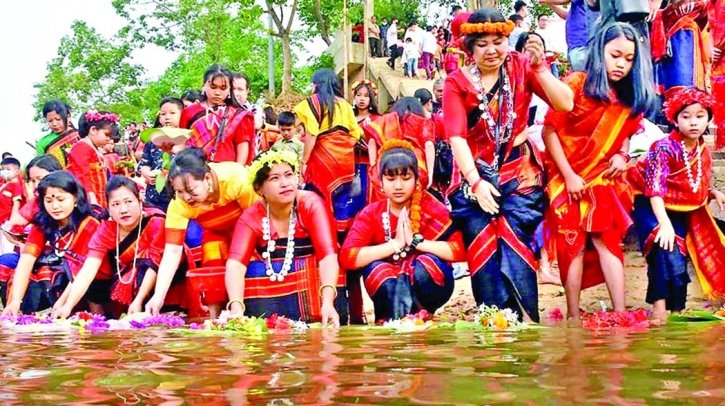
The first day focuses on purification and preparation. Homes are cleaned, and people collect flowers from nearby hills and forests. These flowers are offered by young women and children as they immersed the flowers in the river in the morning, seeking blessings.
Bathing in rivers, streams, or water sources is an important part of the day, symbolising the washing away of negativity from the past year. In some areas, offerings are also made at Buddhist monasteries.
2. Mul Bizhu (Main Bizhu Day)
The second day is the core of the festival. Families prepare traditional foods, visit relatives, and take part in communal gatherings. Cultural programmes, including traditional songs and dances, are commonly organised.
This day is marked by joy, music, and social interaction, reinforcing unity within the community. The main attraction is an indigenous delicacy named ‘Pachon’ that is cooked in every household.
3. Final Day (Community and New Year Observances)
The final day welcomes the Chakma New Year and marks the end of the festival with Boisabi. Respect for elders is emphasised, and younger members often seek blessings.
The Bizhu Dance: A Cultural Signature
One of the most recognisable elements of the festival is the Bizhu dance, a traditional Chakma folk performance. The dance is usually performed in groups and reflects themes of harmony, balance, and collective movement rather than individual expression.
Accompanied by traditional music, the Bizhu dance is characterised by:
- Gentle rhythmic steps
- Circular or linear formations
- Coordinated hand movements
Rather than being purely performative, the dance functions as a shared cultural expression, reinforcing social bonds and cultural continuity.
In modern times, the Bizhu dance is also performed on public stages during cultural festivals, university programmes, and indigenous heritage events across Bangladesh.
Traditional Food and Festive Meals
Food plays an essential role in Bizhu celebrations, reflecting both hospitality and gratitude for agricultural abundance. Meals are typically prepared at home and shared with neighbours and relatives.
Common elements include:
- Rice-based dishes, central to Chakma cuisine
- Seasonal vegetables
- Traditional preparations of fish
- Homemade snacks and sweets, especially during communal visits
The emphasis is not on extravagance but on sharing and togetherness, reinforcing the social spirit of the festival.
Bizhu and Buddhist Cultural Practices
Although Bizhu is not exclusively a religious festival, Buddhist values influence many of its observances. Visits to monasteries, offerings to monks, and reflections on ethical living are common, particularly on the first and last days.
These practices highlight core principles such as:
- Respect for life
- Compassion
- Community harmony
Such elements add a spiritual dimension to the festival without overshadowing its cultural essence.
Modern Celebrations and Urban Adaptation
As Chakma communities have expanded beyond the Chittagong Hill Tracts into urban centres such as Dhaka, Chattogram, and Rangamati townships, Bizhu celebrations have adapted to new settings.
Urban observances often include:
- Organised cultural programmes
- Stage performances of Bizhu dance
- Exhibitions on Chakma history and language
- Youth-led cultural initiatives
These adaptations help younger generations maintain a connection to their heritage while presenting Chakma culture to a broader audience.
Bizhu as a Marker of Indigenous Identity
For the Chakma people, Bizhu represents more than a festival, it is a symbol of identity and continuity. In a rapidly changing social environment, such traditions play a crucial role in preserving language, customs, and collective memory.
Cultural organisations, student groups, and community leaders actively work to:
- Document traditional songs and dances
- Promote Chakma language use
- Encourage youth participation in cultural events
These efforts ensure that Bizhu remains relevant while retaining its core meaning.
Bizhu in the Broader Cultural Landscape
Bangladesh is home to multiple indigenous new year and harvest celebrations, and Bizhu contributes to this rich cultural diversity. While it shares seasonal similarities with other regional festivals, Bizhu remains distinct in its customs, symbolism, and historical context.
Internationally, Bizhu can be understood alongside other new year festivals that emphasise renewal, such as those found across South and Southeast Asia. This global context highlights shared human values while preserving cultural uniqueness.
Challenges and Cultural Preservation
Like many indigenous traditions, Bizhu faces challenges:
- Urbanisation and migration
- Limited mainstream media representation
- Generational gaps in cultural transmission
Despite these challenges, continued community engagement and cultural advocacy have helped sustain the festival’s relevance.
Looking Ahead
The Bizhu festival stands as a powerful expression of the Chakma community’s cultural resilience, social unity, and connection to nature. Rooted in agrarian rhythms and enriched by spiritual values, Bizhu bridges the past and present through shared celebration.
As Bangladesh continues to recognise the importance of cultural diversity, Bizhu remains a reminder that indigenous traditions are living, evolving practices, essential not only to the communities that celebrate them, but to the broader understanding of national heritage.