


Bangladesh’s Cycling Culture: Why More Citizens Are Choosing Alternatives Over Buses

Bangladesh’s Cycling Culture: Why More Citizens Are Choosing Alternatives Over Buses
In cities and towns across Bangladesh, a quiet shift is taking place on the roads. Amid traffic congestion, rising transport costs, and growing climate concerns, more citizens especially young people are choosing bicycles over buses, rickshaws, and even motorcycles. Once viewed primarily as a rural or low-income mode of transport, cycling is now being redefined as a practical, affordable, and environmentally conscious urban mobility choice.
From university students in Dhaka to delivery workers in Chattogram and fitness-focused youth in Sylhet, cycling culture in Bangladesh is expanding despite infrastructure gaps and safety challenges. This shift reflects changing attitudes toward mobility, health, and sustainability in a country facing rapid urbanisation.
Why Buses Are Losing Appeal
Public transport remains the backbone of urban mobility in Bangladesh, but it comes with significant drawbacks. Overcrowded buses, irregular schedules, long waiting times, and traffic gridlock have made daily commuting physically exhausting and time-consuming—particularly in major cities like Dhaka.
For many commuters, short-distance travel that should take 15 minutes can stretch into an hour. In this context, bicycles offer a surprising advantage. For trips under five kilometres, cycling is often faster, more predictable, and less stressful than waiting for buses stuck in traffic.
Young professionals and students increasingly describe cycling as a way to reclaim control over their time. Instead of being dependent on traffic conditions or public transport availability, cyclists can plan their journeys with greater certainty.
Youth at the Centre of the Cycling Movement
The growth of cycling culture in Bangladesh is being driven largely by young people. University students, freelancers, delivery workers, and fitness-conscious youth are embracing bicycles as symbols of independence and modern urban identity.
Social media has played a major role in this shift. Online cycling groups, weekend riding clubs, and community pages have helped normalize cycling as a lifestyle choice rather than a necessity. These platforms also provide safety tips, route suggestions, and peer encouragement—helping new riders gain confidence.
For many young Bangladeshis, cycling represents more than transportation. It is tied to ideas of:
- Physical fitness
- Mental well-being
- Environmental responsibility
- Low-cost mobility
This cultural rebranding has been crucial in changing perceptions, especially in urban areas where cycling was once considered impractical or unsafe.
Infrastructure Gaps: The Biggest Barrier
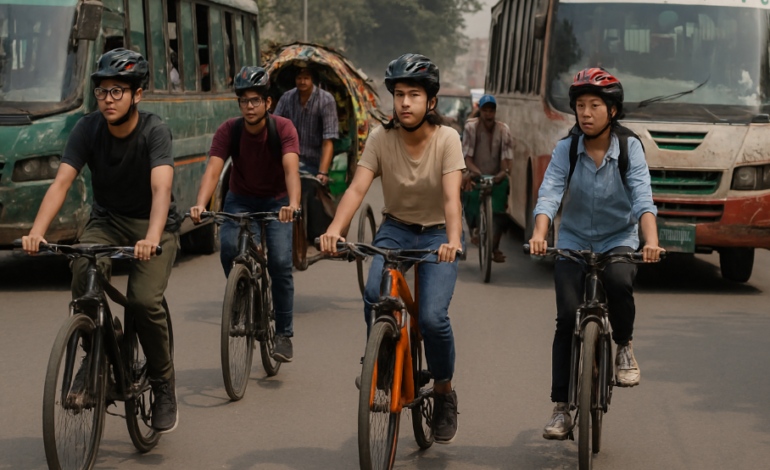
Despite growing interest, Bangladesh’s cycling infrastructure remains severely limited. Dedicated bicycle lanes are rare, and most roads are designed primarily for motor vehicles. Cyclists often share space with buses, trucks, rickshaws, and motorcycles, creating safety risks and discouraging wider adoption.
Key infrastructure challenges include:
- Lack of protected bike lanes
- Poor road conditions in some areas
- Inadequate street lighting
- Limited secure bicycle parking
Urban planning in Bangladesh has historically prioritised motorised transport. As a result, cyclists must navigate an environment that does not yet fully recognise them as legitimate road users.
Still, many cyclists continue riding despite these obstacles, arguing that visibility itself is a form of advocacy. The more bicycles appear on roads, the harder it becomes for policymakers to ignore the need for safer cycling infrastructure.
Safety Concerns and Road Awareness
Safety remains one of the most cited concerns among current and potential cyclists. Traffic accidents, aggressive driving, and limited enforcement of road rules contribute to a sense of vulnerability.
However, cycling advocates note that awareness is slowly improving. Helmet use is becoming more common among urban cyclists, and some schools and universities promote basic road safety education. Cycling communities often organise group rides, which provide safety in numbers and help riders feel more secure.
There is also growing discussion around shared road responsibility, the idea that motorists, cyclists, and pedestrians must coexist with mutual respect. While progress is gradual, these conversations mark an important cultural shift.
Climate and Environmental Benefits
Bangladesh is among the countries most vulnerable to climate change, facing rising temperatures, air pollution, and environmental stress. In this context, cycling offers clear environmental advantages.
Bicycles:
- Produce zero emissions
- Reduce dependence on fossil fuels
- Help lower urban air pollution
- Require minimal infrastructure compared to roads for cars
For environmentally conscious citizens, cycling is a tangible way to contribute to climate action at an individual level. While one bicycle may seem insignificant, collective behaviour change can reduce congestion and emissions in densely populated cities.
Environmental awareness campaigns and youth-led climate movements have increasingly linked cycling with sustainable living—further strengthening its appeal.
Economic Practicality: Cycling as Cost-Effective Mobility
Beyond environmental and health benefits, cycling makes strong economic sense. The cost of owning and maintaining a bicycle is far lower than that of motorbikes or cars, and it eliminates daily transport fares.
For students and low-income workers, bicycles offer reliable mobility without recurring expenses. Delivery riders and gig workers also benefit, as cycling reduces fuel costs and maintenance burdens while allowing access to narrow streets.
In a country where transport costs take a noticeable share of household income, bicycles provide an accessible alternative that supports economic resilience.
Gender and Inclusivity in Cycling
Cycling in Bangladesh has traditionally been male-dominated, particularly in urban settings. However, this is slowly changing. More women especially students and young professionals are taking up cycling, often supported by women-only riding groups and awareness initiatives.
Barriers remain, including safety concerns, social expectations, and limited access to women-friendly cycling spaces. Still, increased visibility of female cyclists is helping challenge stereotypes and broaden participation.
Inclusive cycling culture is essential if bicycles are to become a truly mainstream transport option.
Policy Attention and the Road Ahead
While cycling has not yet received large-scale policy prioritisation, urban planners and transport experts increasingly recognise its potential. Integrating cycling into broader transport planning—alongside buses, pedestrians, and mass transit—could ease congestion and improve urban quality of life.
Key steps for the future include:
- Pilot bike lanes in major cities
- Public awareness campaigns on road sharing
- Secure parking near schools and offices
- Inclusion of cycling in city mobility plans
International experience shows that even modest infrastructure improvements can significantly increase cycling participation.
A Culture Pedalling Forward
Bangladesh’s cycling culture is still in its early stages, but momentum is clearly building. Driven by youth, necessity, environmental awareness, and economic logic, bicycles are emerging as a serious alternative to buses and congested roads.
While infrastructure gaps and safety challenges persist, the growing presence of cyclists reflects changing attitudes toward urban mobility. With supportive policies and inclusive planning, cycling has the potential to transform how Bangladesh moves one pedal stroke at a time.
In a country searching for sustainable, affordable, and human-scaled transport solutions, the bicycle is no longer just a vehicle. It is a statement of possibility.