



Bangladesh, China Sign Deal to Establish Drone Manufacturing — What It Means for Defence and Industry
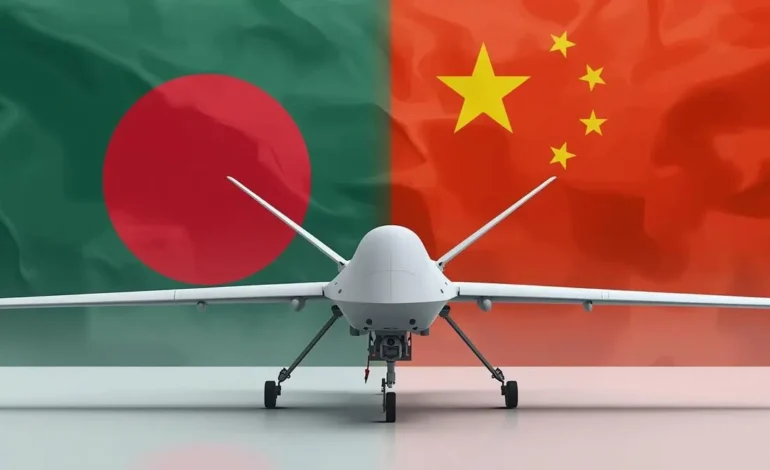

Bangladesh, China Sign Deal to Establish Drone Manufacturing — What It Means for Defence and Industry
In a significant development for Bangladesh’s defence and aerospace sector, the Bangladesh Air Force (BAF) has signed a government-to-government agreement with China Electronics Technology Group Corporation International (CETC) to establish an Unmanned Aerial Vehicle (UAV), commonly known as drone manufacturing and assembly facility in Bangladesh. The agreement, formalised at Dhaka Cantonment’s Air Force Headquarters, aims to foster local production capacity, technology transfer, and long-term self-reliance in UAV manufacturing.
The project represents a major step in Bangladesh’s broader military modernisation plans and industrial capability building, reflecting growing cooperation with international partners and a strategic focus on securing and expanding domestic defence production.
A Landmark Agreement in Defence Industrialisation
Signed on 27 January 2026, the agreement between the Bangladesh Air Force and CETC International outlines plans to create a state-of-the-art UAV manufacturing and assembly plant in Bangladesh. The deal was signed under a government-to-government (G2G) framework, with senior officials from both sides in attendance, including Air Chief Marshal Hasan Mahmood Khan, Chief of Air Staff of the Bangladesh Air Force, and the Chinese Ambassador to Bangladesh, Yao Wen.
The facility will be designed to produce various types of unmanned aircraft, including Medium Altitude Low Endurance (MALE) UAVs and Vertical Take-off and Landing (VTOL) UAVs, platforms widely used for surveillance, reconnaissance, and other dual-use functions. The partnership also includes technology transfer, capacity building, and industrial skills development, enabling Bangladesh to swiftly absorb and deploy advanced UAV technologies domestically.
Unlike previous arrangements where militaries purchased completed systems, this initiative is focused on enabling local manufacturing and assembly with proactive technology sharing, which would help reduce long-term dependence on imports.
The Financial Framework and Implementation
The project’s financial framework was approved by the Bangladesh finance ministry earlier in January 2026, which endorsed a Tk608.08 crore (approximately US$49–50 million) plan titled “Establishment of Manufacturing Plant and Transfer of Technology (ToT) for Unmanned Aerial Vehicles (UAVs)”. The funding will cover the importation and installation of manufacturing infrastructure and ToT, along with local costs such as VAT and administrative expenses.
Of the total cost, a significant portion approximately Tk570.60 crore, will be disbursed over four fiscal years, with funds released progressively through letters of credit (LCs) from Bangladesh’s Air Force budget without the need for additional budget allocations. The remainder covers local charges associated with taxes and bank fees.
Finance advisers emphasised that no extra budget appropriation is required, and the project will be financed within existing allocations for machinery and equipment within the Air Force. This approach is intended to ensure continuity and financial discipline while advancing strategic industrial capabilities.
What the Drone Facility Will Produce
Under the agreement, the Bangladesh Air Force will develop the capacity to manufacture and assemble its own UAVs, with particular emphasis on medium altitude systems suited for surveillance, reconnaissance, and tactical applications. Such systems are often valued for their extended flight endurance and operational flexibility, enabling both military and civilian uses.
Today’s drones include various categories, from lightweight small UAVs to larger MALE platforms. While details about specific models to be produced under the project have not been publicly disclosed, industry observers note that local manufacturing could eventually extend from assembly to partial production of critical components.
In a global context, drones, including models such as the Turkish Bayraktar TB2 and Chinese Wing Loong series have become key elements of modern air power because of their versatility in intelligence, surveillance, and reconnaissance (ISR) missions. The production of such systems locally would be an advancement for Bangladesh’s aerospace industry, offering potential applications beyond purely military objectives.
Strategic and Operational Benefits
1. Enhanced Self-Reliance and Defence Capabilities
The drone manufacturing initiative strengthens Bangladesh’s ability to support its own air defence requirements. Establishing an in-country production line reduces dependence on foreign suppliers for UAV systems and spare parts, an aspect that aligns with broader defense goals such as those outlined in Forces Goal 2030, Bangladesh’s long-term military modernisation strategy.
Domestic production capabilities also enhance operational readiness and logistical agility. Rather than importing UAVs piece by piece or as finished systems, Bangladesh’s armed forces can grow local competence in maintenance, upgrades, and variant development.
2. Transfer of Technology and Workforce Development
A key advantage of the agreement is the transfer of technology and technical knowledge from an experienced partner like China Electronics Technology Group Corporation. This will support local engineers and technicians in mastering manufacturing and quality-control processes associated with UAV production.
Over time, this could nurture a skilled workforce capable of integrating advanced avionics, sensors, and production methods, laying a foundation for future aerospace and defence innovation in Bangladesh.
3. Dual-Use and Civil Applications
While UAVs are often associated with defence, the technology has wide civil applications, including disaster response, search and rescue operations, agricultural monitoring, infrastructure inspection, and environmental surveillance. Bangladesh’s geography, with diverse terrains and frequent climate challenges, which makes such capabilities especially useful for humanitarian and civilian missions.
Local production could allow the country to tailor UAV platforms to such needs and support civilian agencies in addition to military operations.
Regional Context and Industrial Trends
Bangladesh’s move to establish local UAV manufacturing aligns with broader regional trends. Across Asia, countries are investing in domestic defence and aerospace capabilities to meet evolving security needs and reduce reliance on imported systems. For example, Pakistan’s drone sector, including systems such as Bayraktar-style and other UAVs, has attracted international attention, and the global UAV market continues to grow rapidly as demand escalates for ISR and tactical platforms.
Within Bangladesh, other defence industrial initiatives, including previous plans for advanced electronics and military hardware production signal increased focus on indigenous capability building. The drone manufacturing project fits into this wider vision of self-reliance and technological sophistication.
Implementation Outlook and Next Steps
The immediate next phases involve establishing factory infrastructure, importing machinery, and mobilising technical teams to begin assembly and production activities. While exact timelines for pilot production have not been publicly disclosed, implementation is expected to progress over the next few years as infrastructure is set up and technical cooperation advances.
Authorities will also focus on capacity building, including training programs for local engineers and technicians who will work alongside Chinese experts during the early stages of production. These efforts aim to ensure that operational know-how is transferred effectively and sustainably over time.
Broader Implications for Defence and Policy
The drone manufacturing agreement marks a significant shift in Bangladesh’s defence industrial policy from reliance on imports toward localised manufacturing and technology assimilation. By working with a major international partner under a G2G framework, the country balances strategic autonomy with practical collaboration.
The project is also noteworthy in the context of global technology transfer norms. Technology sharing on defence systems is typically sensitive and subject to strict regulatory frameworks; for Bangladesh, this agreement underscores confidence in its institutional oversight and strategic alignment with its partner.
As implementation unfolds over the coming years, stakeholders will be watching closely to assess how the facility enhances Bangladesh’s technological self-reliance, supports local industry growth, and contributes to the country’s long-term defence and socioeconomic objectives.