

2025 in Review: Key Events That Shaped Bangladesh’s Political, Social, and Economic Landscape

2025 in Review: Key Events That Shaped Bangladesh’s Political, Social, and Economic Landscape
The year 2025 proved to be one of the most consequential in Bangladesh’s recent history. Following the dramatic political shifts of 2024 that ended a 15-year premiership, the nation entered a period of transition marked by intense political turbulence, social unrest, economic uncertainty, public mobilisation, and geopolitical realignment. As the year closes, the promise of democratic renewal has been tested against rising intolerance, economic strain, fractured foreign relations, and deeply polarising domestic narratives.
From monumental political developments to natural disasters and diplomatic shifts, Bangladesh’s 2025 story reflects a nation grappling with change, challenge, and the search for stability.
A New Political Era After the 2024 Uprising
The year began under historic conditions. The student-led uprising of 2024 ended Sheikh Hasina’s long rule, ushering in an interim government led by Nobel laureate Muhammad Yunus. Expectations of democratic reform and institutional renewal were high, but as the months unfolded, those hopes encountered serious test lines.
Demolition of Dhanmondi 32 and Political Polarisation
On 5 February, a highly symbolic act set the tone for deep political divides: the demolition of Dhanmondi 32, the former residence of Bangladesh’s founding leader Sheikh Mujibur Rahman, which housed a memorial museum. Activist groups carried out the destruction during heightened tensions over a planned speech by Hasina from exile. The incident sparked public outrage, symbolic clashes over national memory, and intensified political polarisation.
Emergence of the National Citizen Party
On 28 February, former student leaders of the 2024 uprising launched the National Citizen Party (NCP). Their platform promised structural reforms and a break from traditional political culture. The formation of NCP signified a potential reconfiguration of Bangladesh’s political landscape, introducing a major new player against the backdrop of traditional rivalries.
Social Movements and Public Demonstrations
2025 saw powerful expressions of public sentiment that went beyond conventional politics.
March for Gaza: Solidarity and Protest
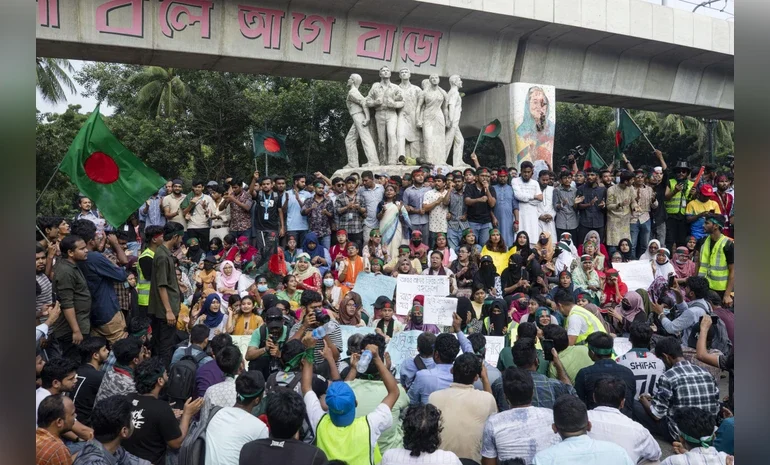
On 12 April, hundreds of thousands joined a pro-Palestine “March for Gaza” at Suhrawardy Udyan in Dhaka, expressing solidarity amid the ongoing conflict in the Gaza Strip. The massive turnout underscored Bangladesh’s vibrant civil society and the internationalist concerns of its populace.
Contested City Politics and Urban Leadership
The capital city’s politics became a microcosm of national tensions. On 27 March, BNP leader Ishraque Hossain was declared mayor of Dhaka South City Corporation by court order, overturning the previous election result. His delayed swearing-in sparked weeks of protests, sit-ins, and public debate, highlighting the influence of both local governance and national factionalism on civic life.
Historic Student-People Uprising Day
To commemorate the transformative events of the previous year, the interim government designated 5 August as Student–People Uprising Day, making it a public holiday. A 26-day program marking the anniversary included memorial activities and culminated in a parliamentary declaration of the July Declaration, seeking constitutional recognition of the 2024 uprising.
Political Repression and Legal Battles
Ban on the Awami League
On 12 May, the interim government announced a ban on the Awami League and its affiliates under the Anti-Terrorism Act until trials against its leaders concluded. The controversial move generated debate over democratic freedoms and transitional justice in the country.
High-Profile Sentences
The legal proceedings against former leaders drew intense national interest. On 17 November, former prime minister Sheikh Hasina and ex-home minister Asaduzzaman Khan Kamal were sentenced to death in absentia by a tribunal for alleged crimes against humanity linked to the 2024 crackdown. The United Nations had estimated that at least 1,400 people died in that crackdown. In early December, charges were extended to include Hasina’s niece, British MP Tulip Siddiq, who was sentenced in absentia over a separate Rajuk plot allocation case.
Natural Disaster: Earthquake Shocks the Nation
Bangladesh is no stranger to seismic activity, but on 21 November, a 5.7-magnitude earthquake struck several parts of the country, leaving at least 10 people dead and dozens injured. The tremor spread panic across major urban centres, underscoring the need for improved disaster preparedness in a region vulnerable to geological and climatic risks.
Economic Reality Check: Growth, Inflation, and Exports
Despite early optimism, Bangladesh faced serious economic pressures in 2025. Inflation rose to 8.29 percent by November, driven largely by food prices across both urban and rural areas. GDP growth remained modest, with a 3.35 percent expansion in the fourth quarter of FY2024–25, reflecting weak investment and export contraction. Export earnings declined for four consecutive months through November, though they posted a marginal annual gain for the July–November period.
This economic picture presented a stark contrast to the hopes of early transition, and policymakers confronted mounting pressure to stabilise growth while maintaining social support for vulnerable communities.
Foreign Relations and Strategic Realignment
Bangladesh’s foreign relations witnessed dramatic shifts in 2025. Relations with India once termed a “golden chapter” deteriorated sharply following tensions linked to the political unrest and Hasina’s exile in India. Rising anti-India rhetoric and attacks on Indian diplomatic missions and minority communities contributed to the diplomatic rift.
In response, the interim government pursued diversified global engagement, strengthening ties with China, Pakistan, Turkey, and the United States. Bangladesh’s chairmanship of the Bay of Bengal Initiative for Multi-Sectoral Technical and Economic Cooperation (BIMSTEC) and efforts toward ASEAN membership highlighted a shifting diplomatic strategy aimed at expanding strategic autonomy and regional influence.
Youth Politics and Campus Shifts
Student politics also experienced dramatic changes. On 10 September, the Islamist student organisation Islami Chhatra Shibir achieved a landslide victory in Dhaka University Central Students’ Union (DUCSU) elections, capturing a majority of posts. This outcome signalled a notable shift in campus political dynamics and reflected broader sociopolitical currents among the youth.
Elections and Constitutional Change
In late 2025, the Election Commission announced that the 13th national election and a constitutional referendum would be held on 12 February 2026, setting the stage for one of the most pivotal moments in the country’s post-uprising transition. Additionally, the July National Charter 2025, signed by 22 political parties on 17 October, proposed sweeping constitutional reforms, including the introduction of a bicameral parliament and term limits for the prime minister even as some major parties, such as the NCP and BNP, expressed reservations.
Tarique’s Return, Khaleda’s Legacy, and the Loss of Osman Hadi
The year also witnessed major political turning points centered around the Zia family and Bangladesh’s opposition landscape. After 17 years in exile, Tarique Rahman made a historic return to Bangladesh, marking one of the most consequential political homecomings in recent memory. His re-entry sparked immediate debate over the future direction of the Bangladesh Nationalist Party (BNP), with supporters hailing the moment as a reset for the party’s top leadership and critics questioning how his return might influence the country’s political climate. In stark contrast to this homecoming, the nation also mourned the passing of former Prime Minister Begum Khaleda Zia, a central figure in post-independence politics and one of the most influential leaders in South Asia. Her death marked the end of an era and left a significant leadership vacuum within the BNP.
Adding to the year’s emotional weight, Inqilab Moncho spokesperson Osman Hadi also passed away, leaving behind a legacy of civic activism and public mobilization that once served as an influential voice in national dialogue. Together, these events reshaped narratives around leadership, succession, and the future of political opposition in Bangladesh.
A Year of Turbulence and Transformation
2025 was a year of dramatic change for Bangladesh. The interplay between political upheaval, social mobilisation, economic strain, and diplomatic realignment tested the resilience of institutions and the public’s faith in transition. From the destruction of historical symbols to mass demonstrations and high-profile legal verdicts, the events of the year reflect a nation in flux searching for a stable political equilibrium, economic recovery, and a renewed social contract.
As Bangladesh prepares for 2026, the lessons of 2025 will shape the debates, decisions, and directions of both policymakers and the electorate, influencing the nation’s long-term journey toward democratic renewal and sustainable development.