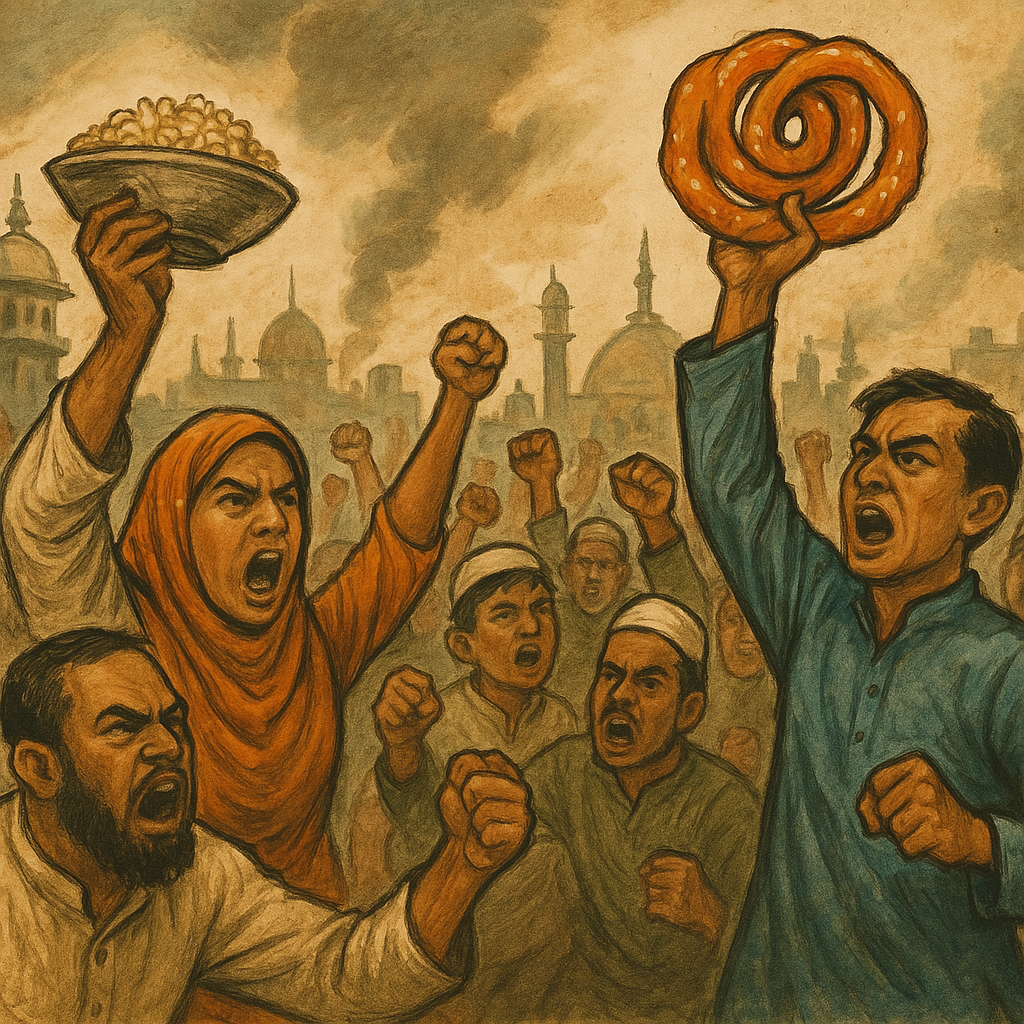




Conquest of Sylhet: How Shah Jalal’s Forces Defeated Gour Govinda


The Conquest of Sylhet: A Historic Turning Point
In 1303 CE, one of the most pivotal events in the history of Sylhet (now in Bangladesh) took place: the Conquest of Sylhet. This clash was more than a military campaign as it was a convergence of faith, politics, and Sufi spirituality. At its heart were two towering figures: Shah Jalal, the Sufi saint, and Gour Govinda, the Hindu king of the Sylhet (Gour) Kingdom. Their contest shaped the region’s spiritual and political future.
Sylhet Before the Conquest
Before 1303, Sylhet was ruled by Raja Gour Govinda, whose kingdom (the Gour Kingdom) extended across parts of present-day northeastern Bangladesh. According to historical records, Govinda’s court was powerful and his army large as he reportedly commanded over 100,000 infantry and thousands of cavalry.
Conflict began when Shaykh Burhanuddin, a Muslim resident of Sylhet, held an aqiqah (a newborn’s naming ceremony) and sacrificed a cow. This act deeply offended Govinda, who considered the cow sacred. In retaliation, Govinda punished and humiliated Burhanuddin ultimately triggering a political and religious confrontation.
King Govinda’s actions reached the ears of Sultan Shams-ud-Din Firoz Shah of the Lakhnauti Sultanate. The Sultan sent his military general Sikandar Khan Ghazi (his nephew) and Nasir-ud-Din, his military commander, to Sylhet.
Despite three earlier failed attempts to subdue Govinda, the Sultanate’s forces were determined to succeed.
Shah Jalal: The Spiritual Warrior
The turning point in the conquest came with the arrival of Shah Jalal, the revered Sufi saint, and his 360 disciples. According to tradition, after learning of Burhanuddin’s plight, Shah Jalal left his spiritual journey to support the Muslim forces.
Accompanying Sikandar Khan Ghazi and Nasir-ud-Din, Shah Jalal and his companions traveled through Bengal, likely via Habiganj and Cumilla, eventually arriving near Sylhet. Their presence changed the nature of the campaign: this was no longer just a political conquest, but a spiritual mission.
Legend recounts that Shah Jalal crossed the Surma River in a miraculous way: seated on his prayer rug. On that momentous day, he is said to have called the adhan (call to prayer), and according to mystical stories, Govinda’s palace shook, a symbolic victory rooted in faith.
When the battle came, the combined forces of Sikandar Khan, Nasir-ud-Din, and Shah Jalal engaged Govinda’s army. The final confrontation reportedly destroyed Govinda’s seven-storied Gorduar palace, and the king’s forces were defeated.
Gour Govinda: The Last Stand of a Hindu Raja
Gour Govinda, proud ruler of Sylhet, was no ordinary king. He was known for his strong military and strategic defenses. According to sources, he eliminated all river ferries to prevent the invading force from crossing.
During the battles, his archers and infantry resisted fiercely. Yet, despite his strength, Govinda could not withstand the combination of military force and spiritual fervor brought by Shah Jalal and the Muslim army.
Defeat forced Govinda to retreat. He fled to Harong Hurong cave in Mulnicherra, according to historical chronicles. From there, he moved on with his family, leaving Sylhet under the control of the victors.
The Role of Shah Jalal’s Disciples: Beyond the Battlefield
After the conquest, Shah Jalal did not return to distant lands. He settled in Sylhet, making it his spiritual home. He and his 360 disciples (sometimes called auliya) began to spread Islam, teaching and preaching to the local population.
Over time, his followers established shrines across the Sylhet and Cachar regions, in places like Sunamganj, Moulvibazar, Karimganj, and beyond. Their legacy transformed Sylhet into a center of Sufi learning and Islamic culture.
Even after Shah Jalal passed away, his tomb (dargah) became a major pilgrimage site, symbolizing his enduring spiritual authority.
Historical Significance and Impact
1. Political Shift
The Conquest of Sylhet led to the annihilation of the Gour Kingdom and integration of its territories into the Lakhnauti Sultanate. Sikandar Khan Ghazi was appointed the first wazir (governor) of Sylhet, establishing Muslim political control.
2. Spiritual Legacy
With Shah Jalal’s settlement in Sylhet, the region became a major Sufi hub. His disciples became pillars of religious and social life. Shah Jalal’s mission blended spirituality with social justice, appealing to marginalized communities and helping spread a more inclusive form of Islam.
3. Social Transformation
The campaign had long-term social effects: many local people converted to Islam, especially from underprivileged backgrounds. Shah Jalal’s teachings emphasized equality, humility, and brotherhood — values that resonated with native communities.
Controversy and Legend: Separating Myth from History
Over centuries, the story of the Conquest of Sylhet has become steeped in legend. While popular narratives emphasize miraculous events (such as Shah Jalal crossing the river on his prayer rug), historians note that not all details may be strictly factual.
Epigraphic sources, such as inscriptions from 1303, do confirm Shah Jalal’s involvement and the leadership of Sikandar Khan Ghazi in the conquest. But aspects like supernatural miracles are often part of the saint’s hagiography.
Why the Conquest Still Matters Today
Cultural Identity
For Sylhet, the conquest and Shah Jalal’s legacy are foundational to regional identity. The area is often called “Jalalabad” in historic texts — a testament to his spiritual imprint.
Religious Influence
The event marks one of the earliest major wholesale shifts to Islam in eastern Bengal. The Sufi network established by Pir Jalal and his companions created a model of non-violent missionization, deeply rooted in the local society.
Tourism & Heritage
Today, Shah Jalal’s shrine draws thousands of pilgrims from Bangladesh and abroad, making Sylhet a major spiritual tourism hub. The story of the conquest is taught in schools and commemorated in local lore, preserving a historic narrative of faith, resistance, and transformation.
Global Relevance: Sylhet in the Broader Islamic World
The Conquest of Sylhet is not just a regional event — it has broader implications for the history of Islam in South Asia:
-
Sufi Expansion: Shah Jalal’s journey echoes the Sufi tradition of combining spirituality with social change—a pattern seen across medieval Islamic movements.
-
Islamic Governance: The campaign illustrates how Sufi leaders worked alongside political powers (like Sultan Firoz Shah) to establish Muslim rule in historically non-Muslim regions.
-
Interfaith Conflict and Resolution: The conquest reflects the complex interplay of religious conflict, conversion, and cultural integration common to many parts of the Islamic world during conquests.
Conclusion
The Conquest of Sylhet in 1303 stands as a seminal moment in the history of Bengal — one where faith and force merged to reshape a region’s destiny. Shah Jalal, with his 360 disciples, provided spiritual leadership and moral purpose, while Sikandar Khan Ghazi and his army executed the political and military dimensions of the campaign. Opposing them was Gour Govinda, a powerful king whose defense of his land ultimately gave way to a new era.