



How Onion Seeds Are Transforming Farmers’ Fortunes in Bangladesh

“Black Gold” in Faridpur: How Onion Seeds Are Transforming Farmers’ Fortunes in Bangladesh
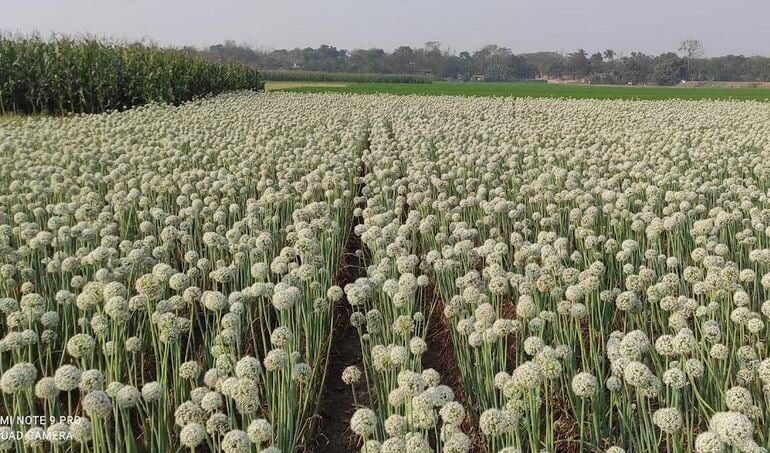
Across the fertile plains of Bangladesh’s Padma basin, a quiet agricultural transformation is taking place. In parts of Faridpur district, farmers are increasingly turning to onion seed cultivation often referred to locally as “Black Gold” as a profitable alternative to traditional crops such as rice and wheat.
The tiny black seeds harvested from flowering onion plants have become a high-value agricultural commodity, significantly improving the livelihoods of many small farmers. With strong market demand and growing cultivation areas, Faridpur is gradually emerging as one of Bangladesh’s most important centers for onion seed production.
This shift illustrates how diversification in agriculture can boost rural incomes while strengthening the country’s domestic food supply chain.
The Rise of “Black Gold” in Faridpur
In the agricultural landscape of Faridpur, especially in areas like Ambikapur union, vast fields are now filled with blooming onion plants. Their white spherical flowers hold tiny black seeds that farmers have come to call “Black Gold.”
Over the past several years, onion seed cultivation has grown rapidly as farmers realized its economic potential. Compared to staple grains such as rice, onion seeds offer significantly higher returns.
According to local market estimates, one kilogram of onion seed can sell for between Tk3,500 and Tk4,000, making it one of the most profitable winter crops in the region.
For many farmers, this crop has provided a path out of poverty. Income from onion seed farming has helped families repay debts, build permanent homes, and invest in their children’s education.
A Profitable Alternative to Traditional Crops
Traditionally, many farmers in Faridpur cultivated rice and other staple crops. However, fluctuating grain prices and rising production costs often limited profits.
Onion seeds changed that equation.
Just one kilogram of onion seed can cultivate about one bigha of land, which typically yields between 90 and 120 maunds of onions.
With proper management and favorable weather, farmers can generate far higher returns compared to conventional crops.
Production costs have also remained relatively manageable. Estimates suggest that onion seed production costs around Tk25 per kilogram, slightly lower than last year due to favorable weather conditions.
This combination of high market value and moderate costs has made onion seeds a preferred cash crop for many farmers.
Faridpur’s Growing Role in Bangladesh’s Onion Supply Chain
Faridpur’s onion seed industry does not only serve local farmers. The seeds produced in the district are distributed to farmers across the country.
Agriculture officials say that seeds from Faridpur are supplied to around 15 other districts, supporting onion cultivation nationwide.
This makes Faridpur an important hub in Bangladesh’s onion production network.
Onions are a staple ingredient in Bangladeshi cuisine, and the country has often struggled with supply shortages and price volatility. Domestic seed production helps reduce dependence on imports while improving the resilience of the agricultural sector.
Changing Agricultural Landscape
The success of onion seed farming has gradually transformed farmland in the region.
Fields that once produced rice or wheat are now increasingly dedicated to onion seed cultivation. Farmers say the shift reflects both economic necessity and market demand.
However, the transition also requires careful planning. Onion seed cultivation demands higher levels of attention and expertise compared to traditional crops.
Farmers must monitor soil conditions, irrigation, pollination stages, and harvesting techniques to ensure high-quality seed production.
Despite these challenges, the potential profits continue to attract more growers.
Challenges Facing Onion Seed Farmers
While onion seed farming is profitable, it is not without risks.
One major challenge is the fluctuation in onion prices. Farmers say that if onion prices fall significantly, it can reduce their overall profits even if seed production remains strong.
According to Daily Sun report the Local farmer noted that market prices for onions have dropped sharply in some seasons, raising concerns that growers might struggle to recover their production costs.
Another major challenge is weather vulnerability.
Unlike hardier crops such as rice, onion seed plants are particularly sensitive during pollination and drying stages. A sudden spell of rain during these critical periods can destroy an entire crop by washing away pollen before seeds develop.
Because of these risks, farmers must closely monitor weather conditions throughout the growing season.
Government Support and Agricultural Innovation
To support onion seed farmers, Bangladesh’s Department of Agricultural Extension (DAE) has introduced several initiatives.
These include:
- Training programs for improved seed cultivation techniques
- Introduction of protective polythene shielding to protect flowering plants from rain
- Improved post-harvest storage methods
Additionally, authorities have distributed 142 air-flow machines across Faridpur, each capable of storing up to 250 maunds of onions to reduce post-harvest losses.
Such technological support helps farmers preserve their harvest and maintain quality during storage.
Women Farmers Leading the Change
Another notable aspect of Faridpur’s onion seed success story is the participation of women farmers.
One example is Shahida Begum from Gobindapur village, who received recognition as an Agriculturally Important Person (AIP) from the Ministry of Agriculture in 2021, stated in the report.
Her success reflects a broader trend in Bangladesh where women are increasingly involved in commercial agriculture.
Women farmers play important roles in planting, pollination management, harvesting, and seed processing.
Their participation has helped expand the sector and inspire other rural women to pursue agricultural entrepreneurship.
Reducing Dependence on Imported Onions
Bangladesh has historically relied on onion imports particularly from neighboring countries to meet domestic demand.
However, increasing local seed production could gradually reduce that dependence.
Farmers and agriculture experts believe that expanding onion seed cultivation across multiple districts could strengthen national food security.
A Model for Agricultural Transformation
The rise of onion seed farming in Faridpur offers an important lesson for Bangladesh’s agricultural development.
By identifying high-value crops and supporting farmers with training, technology, and market access, rural communities can significantly improve their economic conditions.
This model could potentially be replicated in other regions with suitable climate and soil conditions.
With proper investment, onion seed cultivation could become a key contributor to both farmer incomes and national food production.
Looking Ahead
The story of “Black Gold” in Faridpur demonstrates how a small agricultural innovation can transform rural livelihoods.
What began as a niche crop has evolved into a profitable industry that supports thousands of farmers, strengthens Bangladesh’s onion supply chain, and contributes to the broader agricultural economy.
Although challenges remain from weather risks to market fluctuations the continued growth of onion seed cultivation offers hope for sustainable rural development.
For farmers in Faridpur, those tiny black seeds represent far more than a crop they symbolize opportunity, resilience, and a brighter future for Bangladesh’s agricultural sector.