



Independence Award 2026 Honourees: The Five Organizations Shaping Bangladesh’s Legacy
Every year, the Government of Bangladesh recognizes individuals and institutions whose contributions have shaped the nation’s history, culture, and development. The Independence Award, the country’s highest civilian honor, celebrates outstanding achievements across sectors such as Liberation War history, public service, science, healthcare, education, and social advancement.
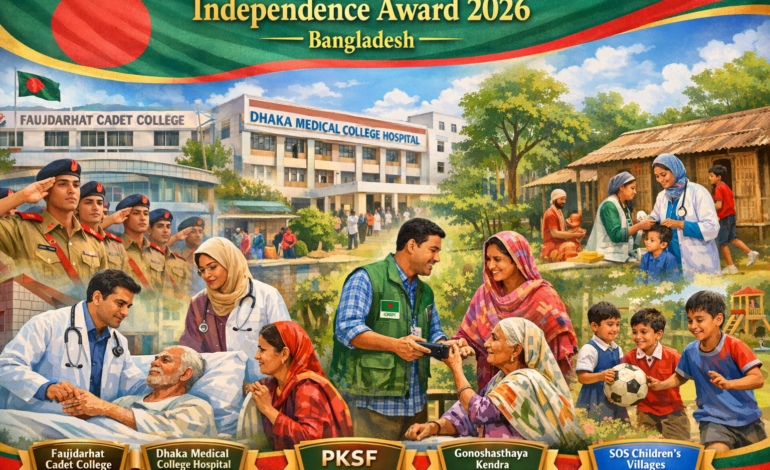
In 2026, five organizations were chosen for this prestigious award, reflecting their remarkable impact on national life. These organizations are:
- Faujdarhat Cadet College — honored in the Liberation War category
- Dhaka Medical College Hospital — honored for medical science contributions
- Palli Karma-Sahayak Foundation (PKSF) — honored for rural development initiatives
- Gonoshasthaya Kendra — honored in the social service/public service category
- SOS Children’s Villages International in Bangladesh — honored in the social service/public service category
This year’s organizational honourees represent a spectrum of efforts that have strengthened Bangladesh socially, culturally, and institutionally. Their work touches education, healthcare, social empowerment, and the ongoing development of rural communities.
Faujdarhat Cadet College: A Pillar of Liberation War Heritage
One of the most historic institutions in Bangladesh, Faujdarhat Cadet College was established in the 1950s and has since played a significant role in developing national leadership. Its contribution to the Bangladesh Liberation War of 1971 is one reason it has been selected for the Independence Award 2026.
During the Liberation War, many cadets, teachers, and alumni of Faujdarhat Cadet College supported the independence movement, both on the battlefield and in strategic organizing roles. Some joined the Mukti Bahini, the armed resistance group and made tremendous personal sacrifices in the struggle for freedom.
The award recognises the college not just as an educational institution but as a symbol of national resistance and patriotism. It stands as a testament to how educational environments can shape leaders who rise to the call of national crises.
Today, Faujdarhat Cadet College continues to be one of Bangladesh’s most respected educational establishments, producing leaders in the military, government, and civil society.
Dhaka Medical College Hospital: Advancing Medical Science and Public Health
Dhaka Medical College Hospital (DMCH) is among the most renowned medical institutions in Bangladesh. Since its establishment in 1946, DMCH has been at the forefront of health services, medical education, clinical research, and emergency care.
Over decades, DMCH has played crucial roles in:
- Treating patients in major national health crises
- Training generations of medical professionals
- Conducting clinical research influencing national health policy
During pandemics, natural disasters, and emergency situations, DMCH medical teams have been central in providing lifesaving care. Its role in improving medical science in Bangladesh stretches from pioneering clinical procedures to shaping public health responses at national levels.
In recognition of these sustained contributions, the Government of Bangladesh has selected Dhaka Medical College Hospital for the Independence Award 2026.
Palli Karma-Sahayak Foundation (PKSF): Championing Rural Development
Bangladesh’s economic progress in recent decades owes much to innovative and inclusive rural development strategies. At the heart of many such initiatives stands the Palli Karma-Sahayak Foundation (PKSF), established by the Government of Bangladesh in 1990.
PKSF is a leading microfinance and poverty alleviation institution that has helped millions of rural families through:
- Microcredit programs tailored for low-income households
- Training and support for small entrepreneurs
- Financing agricultural and non-farm enterprises
- Strengthening community organizations and cooperatives
By partnering with a wide network of Partner Organisations (POs), PKSF has expanded financial inclusion in rural areas. It empowers women and vulnerable populations with tools to generate sustainable income, access education, and build resilient communities.
The foundation’s efforts have transformed the lives of countless families and paved the way for inclusive economic growth. For its substantial contribution to rural development and poverty reduction, PKSF has been named among the Independence Award 2026 recipients.
Gonoshasthaya Kendra: Service, Sustainability and Community Healthcare
Another institutional honouree for the Independence Award 2026 is Gonoshasthaya Kendra, a pioneering community health organization founded in 1972. Its creation was driven by the need to provide comprehensive healthcare services to underserved rural populations in the aftermath of the Liberation War.
Over the last five decades, Gonoshasthaya Kendra has:
- Promoted preventive healthcare and community health education
- Trained rural health workers to serve their communities
- Established health centres and hospitals offering low-cost care
- Advocated for accessible healthcare for all citizens
The institution’s participatory model has consistently prioritized community involvement, which has made lasting impacts in rural public health systems.
Previously recognised internationally and nationally, Gonoshasthaya Kendra’s selection for the Independence Award 2026 acknowledges the enduring value of its service in Bangladesh’s social development landscape.
SOS Children’s Villages International in Bangladesh: Transforming Lives of Children
The final organization chosen for the Independence Award 2026 is SOS Children’s Villages International in Bangladesh, a humanitarian institution dedicated to supporting vulnerable children and families.
SOS Children’s Villages International began operations in Bangladesh in 1978. Its mission centres around:
- Providing family-based care for orphaned and abandoned children
- Strengthening families to prevent child abandonment
- Offering education, healthcare, and psychosocial support
- Supporting youth empowerment and employability
In a society where many children face hardship due to poverty, displacement, or family breakdown, SOS Children’s Villages has served as a protective space offering stability, education, and growth opportunities.
Through its holistic programs, the organization has transformed the lives of tens of thousands of children across Bangladesh. Its recognition with the Independence Award 2026 highlights the nation’s appreciation for compassion-driven work that contributes to long-term social wellbeing.
Why These Organizational Honourees Matter
The selection of these five institutions for the Independence Award 2026 reflects Bangladesh’s commitment to recognising broad forms of service to the nation. While individual achievements are vital, institutional contributions often shape structures that benefit generations.
Each organization honoured this year represents:
- Historical legacy and national identity (Faujdarhat Cadet College)
- Human health and scientific progress (Dhaka Medical College Hospital)
- Inclusive economic and rural development (PKSF)
- Community-based social and health service (Gonoshasthaya Kendra)
- Child welfare and family support systems (SOS Children’s Villages International in Bangladesh)
By awarding these institutions, the government celebrates collective efforts that have strengthened Bangladesh’s social fabric, preserved its history, and expanded opportunity for all citizens.
A Future Inspired by Service
As Bangladesh prepares to celebrate Independence Day on March 26, 2026, these organizational honourees will be remembered alongside individuals whose contributions have shaped the nation.
The Independence Award 2026 not only honours past achievements but also sets a benchmark for future generations. Institutions that serve education, health, rural development, social welfare, and human dignity remain pillars of national progress.
Their legacies remind all Bangladeshis that sustained, community-rooted service can create profound and lasting impact not merely in headlines, but in the lives of the people they serve.