



“What reforms should be undertaken in the education system of Bangladesh by the new government?”

Bangladesh has made remarkable progress in expanding access to education since independence in 1971. Primary school enrolment has reached nearly universal levels, and literacy has risen dramatically over the past two decades. Official data show the literacy rate climbed to about 77.9 percent in 2024, compared with just over 50 percent in the early 2000s.
This expansion has been driven by sustained government investment, international donor support, and policies such as free primary education and stipends for girls. Education consistently receives one of the largest shares of public spending in Bangladesh, reflecting its central role in poverty reduction and economic development strategies.
Despite these achievements, the broader goals of quality learning, skills development, and equity remain elusive. Roughly one in five Bangladeshis is still illiterate, and millions of students struggle to acquire basic competencies in reading, writing, and numeracy.
These challenges have gained urgency after political changes and renewed calls for reform. The new government faces a critical opportunity to undertake comprehensive educational reform that aligns the system with global standards and labour market needs.
Reality of Quality Crisis
While access to schooling has improved significantly, the quality of education remains a major concern. Experts widely agree that Bangladesh faces a learning crisis rather than an access crisis. Many students complete primary education without mastering essential skills. Studies indicate that only a small proportion of primary school graduates achieve expected competencies by the end of Grade 5.
The quality problem is rooted in several systemic weaknesses. The curriculum is often criticised as outdated and overly theoretical, failing to equip students with practical skills or critical thinking abilities. Teaching methods are another major issue. Bangladesh’s education system remains heavily exam oriented, encouraging rote memorisation rather than problem solving or creativity.
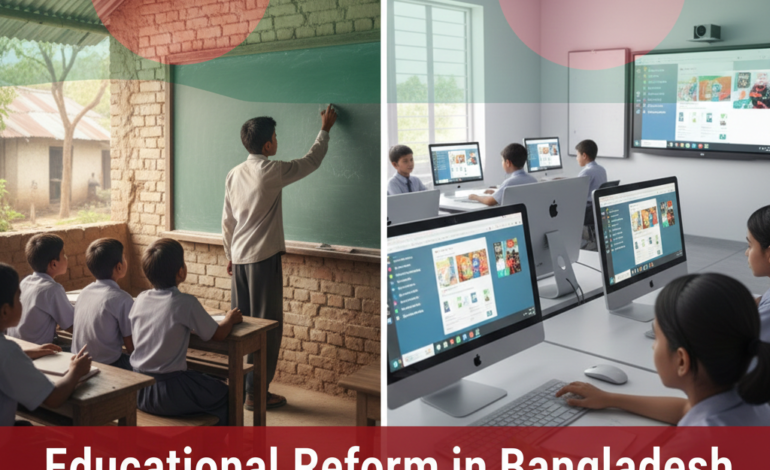
There are also significant disparities in educational outcomes between urban and rural areas, and between socio economic groups. Rural schools often lack trained teachers, modern facilities, and digital learning resources.
In higher education, challenges include limited research capacity, outdated programmes, and weak links between universities and industry. Tertiary enrolment remains relatively low compared to global averages, indicating restricted access to advanced education.
These problems highlight the urgent need for structural educational reform that addresses quality, equity, and relevance.
Barriers to Transformation
Several structural obstacles continue to hinder effective educational reform in Bangladesh. One of the most critical challenges is teacher quality. Many teachers lack proper training and professional development opportunities, which undermines classroom effectiveness. Low salaries and limited career incentives further weaken motivation.
Infrastructure gaps also remain significant. Numerous schools lack basic facilities such as libraries, laboratories, and technology resources. Climate related disruptions, including heatwaves and flooding, frequently interrupt schooling and widen learning gaps. Socio economic factors play an equally important role. Poverty, child labour, and high education costs contribute to dropout rates, particularly among boys in low income families.
Another challenge is the fragmented structure of Bangladesh’s education system, which includes general education, madrasah education, and technical training streams. Lack of coordination between these streams limits mobility and reduces overall efficiency. Without addressing these systemic barriers, educational reform initiatives are unlikely to produce sustainable improvements.
Path Towards Modernisation
Curriculum reform is widely regarded as the most urgent priority for Bangladesh’s education sector. Current curricula often emphasise theoretical knowledge over practical skills. This mismatch has contributed to rising graduate unemployment, as students lack competencies required by modern industries. Reform efforts should focus on integrating critical thinking, digital literacy, and problem solving into teaching and assessment systems. This shift would align Bangladesh’s education system with global trends and labour market demands.
Another essential component of curriculum reform is updating subject content to reflect emerging fields such as artificial intelligence, data science, and environmental sustainability. Research suggests that outdated curricula and limited computing resources hinder Bangladesh’s technological readiness. By modernising curricula, Bangladesh can transform its education system from exam centred learning to skills centred development.
Investment in Human Capital
Teacher quality is the single most important determinant of educational outcomes. Therefore, any meaningful educational reform must prioritise teacher development. Reforms should include improved teacher training programmes, continuous professional development, and performance-based incentives.
International experience shows that investing in teachers produces significant gains in student learning outcomes. In Bangladesh, the lack of training and support has been identified as a key factor behind declining education standards. Digital training platforms and mentoring systems could help address shortages of skilled educators, particularly in rural areas. Strengthening teacher capacity would create a multiplier effect across the entire education system.
Opportunity for Inclusive Education
Digital technology offers unprecedented opportunities for educational reform in Bangladesh. Expanding internet access, online learning platforms, and digital classrooms can help overcome geographic and resource constraints.
However, digital inclusion remains a major challenge. Many institutions lack adequate infrastructure, and accessibility barriers persist across government and non-government educational platforms. To address these issues, reforms should focus on expanding broadband connectivity, providing digital devices to students, and developing inclusive online learning systems. Digital transformation would not only improve access but also enhance the quality and flexibility of education.
Technical and Vocational Education
One of the most critical areas for educational reform is the expansion of technical and vocational education and training. Bangladesh’s current education system is heavily oriented towards academic degrees, which often fail to prepare students for employment. Strengthening vocational education would help address skills shortages in key sectors such as manufacturing, construction, and technology. This reform is particularly important given Bangladesh’s ambition to become a middle-income economy and transition towards knowledge-based industries. Integrating vocational training into secondary education could significantly improve youth employment prospects.
Vision for Social Justice
Ensuring equitable access to quality education is essential for sustainable development. Despite progress in enrolment, disparities remain between urban and rural areas, and among socio economic groups. Educational reform should prioritise targeted support for disadvantaged populations, including rural communities, ethnic minorities, and refugees.
Social protection measures such as stipends, school feeding programmes, and free learning materials can help reduce dropout rates. By promoting inclusive education, Bangladesh can strengthen social cohesion and reduce inequality.
Legacy of Weak Implementation
Weak governance and policy implementation have historically limited the effectiveness of education reforms in Bangladesh. Frequent policy changes, lack of coordination between ministries, and inadequate monitoring systems have created inefficiencies. Reforms should therefore focus on strengthening institutional capacity, improving accountability, and enhancing data driven decision making. Transparent evaluation mechanisms would help ensure that educational policies produce measurable outcomes.
Potential for Transformation
Bangladesh stands at a critical turning point in its educational development. With strong political commitment and strategic investment, the country has the potential to transform its education system into a globally competitive model.
Educational reform could significantly boost economic growth by improving workforce productivity and innovation capacity. As Bangladesh moves towards becoming a knowledge-based economy, education will play a decisive role in shaping its future.
Challenges Ahead to Reform Success
Despite strong potential, several risks could hinder educational reform efforts. Financial constraints remain a major concern, as comprehensive reforms require substantial investment. Political instability and policy discontinuity could also disrupt long term reform initiatives.
Resistance from institutional stakeholders and bureaucratic inertia may slow implementation. Addressing these challenges will require sustained political will and broad societal consensus.
Roadmap for Sustainable Change
Educational reform is essential for Bangladesh’s economic transformation and social progress. While the country has achieved impressive gains in access and literacy, the next phase of development must focus on quality, equity, and relevance. Comprehensive reforms in curriculum, teacher training, digital infrastructure, and vocational education can create a more inclusive and effective education system. If implemented successfully, educational reform will not only improve learning outcomes but also strengthen Bangladesh’s position in the global economy.
