



Dhaka’s Eid Anondo Michil Returns After 35 Years

The Grand Revival: Dhaka’s Eid Anondo Michil Returns After 35 Years
The streets of Dhaka have come alive with a spectacle that feels both historic and new in this year’s Eid-ul- Fitr. After more than three decades, the Eid Anondo Michil, once a defining symbol of the city’s festive identity has returned in , reconnecting modern Dhaka with its Mughal past.
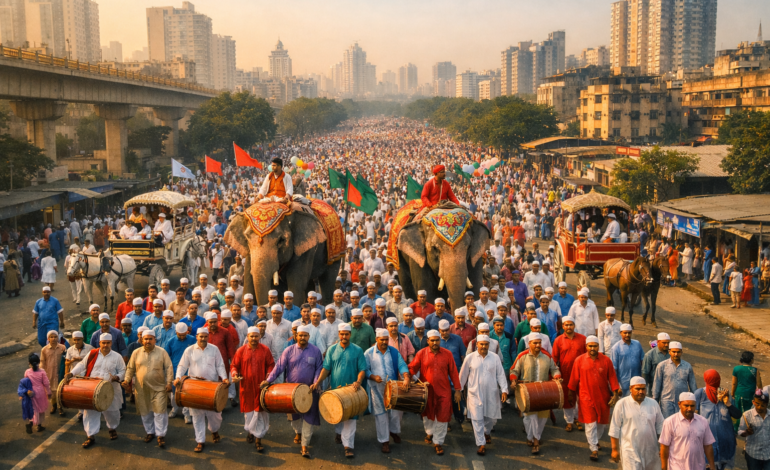
The event, which began in the capital’s Agargaon area and culminated at the National Parliament Building in the city center, featured a marching band and a cavalry parade.
The parade was the reminiscent of Dhaka’s Eid celebrations in the 18th century, when its governors, known as Naib Nazim, would lead vibrant parades snaking through the streets of the capital.
The grand procession is more than a cultural event. It is a reawakening of a forgotten tradition, one that once transformed Eid into a public celebration of power, unity, and joy.
For many residents especially in Old Dhaka, it feels like history walking again through the streets.
A Legacy Rooted in Mughal Grandeur
The origins of Eid Anondo Michil date back over 400 years, deeply embedded in Dhaka’s Mughal heritage.
During the Mughal period, Eid was not limited to religious observance. It was transformed into a state-sponsored spectacle, where rulers used public celebrations to demonstrate authority and connect with citizens.
Mughal Patronage
The tradition was introduced by Mughal administrators-Nazims and Subahdar, who organized grand Eid processions as royal displays. These were not ordinary parades. They featured:
- Soldiers marching in formation
- Court musicians and drummers
- Decorated elephants and camels
- Royal officials in ceremonial attire
These processions turned Dhaka into a stage where governance, culture, and religion intersected.
The Nawabi Era
The tradition reached its peak during the Nawabi period in the late 18th century.
The Naib Nazims institutionalized the Eid procession, making it an annual event of prestige and participation. Historical records show that the procession began at the iconic Nimtoli Palace (built in 1766) and passed through key areas of Old Dhaka:
- Chawk Bazaar
- Hussaini Dalan
- Islampur
It eventually returned to the palace gates, completing a ceremonial loop that symbolized unity between ruler and people.
Historical depictions, including 19th-century artworks by Alam Musawwir, vividly capture the scale and elegance of these events, which offered a visual archive of a time when Eid in Dhaka was celebrated with unmatched grandeur.
A Tradition That Evolved Through Time
The Eid procession did not disappear overnight. Instead, it evolved with changing political and social realities.
Even during the mid-20th century, Dhaka witnessed community-based Eid processions, though on a smaller scale. Notably, historical accounts mention processions in the 1950s that reflected both celebration and political awareness, with participants sometimes carrying banners addressing contemporary issues.
This indicates that Eid Anondo Michil was never just about festivity but it also served as a platform for public expression, blending joy with social consciousness.
Why the Tradition Faded
Despite its rich legacy, the grand Eid procession gradually vanished from Dhaka’s public life.
Several factors contributed to this decline:
1. Colonial and Post-Colonial Shifts
The fall of Mughal authority and the end of the Naib-Nazim system weakened institutional support for such large-scale events.
2. Rapid Urbanization
As Dhaka expanded into a dense city open spaces and traditional routes became increasingly difficult to manage for large processions.
3. Changing Cultural Patterns
Eid celebrations became more private and family-oriented, reducing the emphasis on public festivities.
4. Security and Administrative Constraints
Large gatherings outside formal religious settings faced growing restrictions, making it harder to organize processions.
By around 1990, the grand, organized Eid Anondo Michil had effectively disappeared, surviving only in memories, oral histories, and museum archives.
For years, it remained a losttradition remembered but not experienced.
Reclaiming Dhaka’s Cultural Identity
The revival of Eid Anondo Michil in 2025 marked a turning point in Dhaka’s cultural landscape.
Led by the Dhaka North City Corporation (DNCC) in collaboration with the Eid Utsab Ayojak Committee, the initiative aimed to restore a historic tradition while adapting it for modern audiences.
The most recent procession, held on the first day of Eid 2026, demonstrated how the past can be reimagined for the present.
The Route
Unlike the Mughal-era routes of Old Dhaka, the modern procession followed a broader urban path, including:
- Bangladesh-China Friendship Conference Centre
- Agargaon main road
- Manik Mia Avenue
- Ending near the National Parliament building
This shift reflects the city’s expansion while maintaining the essence of a public celebration.
Cultural Displays
The revived procession retained elements of its historical roots while adding contemporary features:
- Colorful banners and festoons
- Traditional band parties and drummers
- Decorated horse carts
- Cultural performances by groups
The result was a fusion of “Sultani-style” grandeur and modern festival energy.
Communal Solidarity
Perhaps the most important aspect of the revival is its inclusivity.
Just like in the past, the procession aims to erase social and economic boundaries, bringing together:
- Students
- Families
- Professionals
- Elderly residents
In a city often divided by class and pace, the Eid Anondo Michil creates a rare moment of shared joy.
More Than Nostalgia: A Cultural Reawakening
The return of Eid Anondo Michil is not simply about revisiting history but it is about redefining identity.
In recent years, Bangladesh has shown a growing interest in preserving and celebrating its cultural heritage. The revival of this procession fits into that broader movement.
It also highlights a shift among younger generations, who are increasingly eager to:
- Reconnect with historical traditions
- Participate in public cultural events
- Create a sense of collective identity
By bringing back the procession, Dhaka is not just honoring its past as it is building a bridge between generations.
Challenges and the Road Ahead
While the revival has been widely celebrated, sustaining it will require careful planning.
Key challenges include:
- Managing traffic
- Ensuring public safety during large gatherings
- Maintaining authenticity without over-commercialization
If successfully addressed, the Eid Anondo Michil could become a permanent fixture in Dhaka’s cultural calendar much like it once was.
A Living Testament to Dhaka’s Heritage
The return of Eid Anondo Michil after 35 years is a powerful reminder that traditions, no matter how long forgotten, can find their way back.
From Mughal-era royal processions to modern civic celebrations, this journey reflects the resilience of culture.
As drums echo through Dhaka’s streets and crowds move together in celebration, the city rediscovers a part of itself that was never truly lost.