




Darasbari Mosque: A Forgotten Sultanate Landmark Connecting Bangladesh to Islamic Heritage
Darasbari Mosque in Chapainawabganj stands as one of the most remarkable yet understated monuments of the Bengal Sultanate. Built in 1479 during the reign of Sultan Shamsuddin Yusuf Shah, the mosque belongs to the historic Gaur region, once the heart of medieval Bengal and a thriving center of Islamic architecture and scholarship. Today, Darasbari Mosque is a rare archaeological treasure that not only reflects Bangladesh’s cultural identity but also connects the country to a wider global network of Islamic architectural traditions that spanned from the Middle East to South Asia.
A Glimpse into Gaur, the Lost Capital of Bengal
The ancient city of Gaur was one of the most influential urban centers of medieval India. Its ruins stretch across the border between Bangladesh and India, offering evidence of a highly developed city with palaces, mosques, madrasas, gateways, and fortified walls. Darasbari Mosque is among the finest surviving structures of this lost capital.
The city once attracted scholars, traders, and religious teachers from across Persia, Arabia, and Central Asia. Many came seeking knowledge at the madrasas of Gaur, including the one located beside Darasbari Mosque. As a result, Darasbari became an important hub for Islamic education in Bengal, giving the site historical significance far beyond its geographic location.
Architecture that Blends Local Craftsmanship with Global Influence
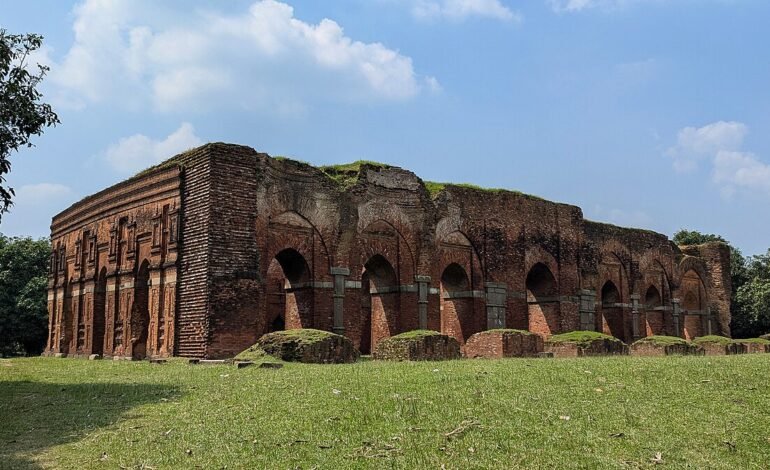
The architecture of Darasbari Mosque highlights the unique fusion of local Bengali craftsmanship with wider Islamic architectural features. The mosque is built primarily from brick, a material commonly used in Bengal due to the scarcity of stone. This choice contributed to the development of the region’s distinctive terracotta art style, which remains visible in the mosque’s surviving ornamentations.
Key Architectural Features
-
A rectangular prayer hall measuring about 34 by 20 meters
-
Eleven arched doorways at the entrance
-
A row of intricately designed mihrabs
-
Terracotta floral and geometric designs
-
Wide ornamented arches supporting the structure
Although the original roof has long disappeared, the elegant arches and walls reflect the engineering excellence of the Bengal Sultanate. The iconic pointed arch design used in Darasbari Mosque creates a visual connection to other Islamic architectural marvels, from Iran’s mudbrick mosques to Turkey’s Seljuk structures. This connection shows how Bengal was part of an interconnected artistic world during the medieval period.
A Place of Learning and Spirituality
The name Darasbari means “place of lessons,” a reference to the madrasa complex that stood adjacent to the mosque. Historical accounts indicate that it was one of the largest Islamic learning centers in the region. Students from surrounding areas studied theology, mathematics, astronomy, and Arabic literature.
This close link between education and worship is seen in many Islamic civilizations. Darasbari Mosque mirrors the layout of educational complexes in cities like Bukhara, Samarkand, and Cairo, where madrasas were often built alongside grand mosques. The design shows how medieval Bengal participated in a global intellectual tradition that valued scholarship and spiritual discipline.
Why Darasbari Matters in Today’s Bangladesh
Darasbari Mosque is more than just a historical ruin. It is an important symbol of Bangladesh’s cultural heritage and a reminder of the region’s sophisticated past. The mosque attracts researchers, historians, and tourists interested in Islamic art, archaeology, and medieval history.
However, like many heritage sites in Bangladesh, Darasbari faces challenges including environmental decay, lack of restoration, and low public awareness. Preserving this site is essential not only for the nation’s history but also for global heritage studies, since the mosque provides insights into how Islamic architecture evolved in South Asia.
Connecting Darasbari to a Global Context
Around the world, heritage sites like Alhambra in Spain, the Great Mosque of Xi’an in China, and the mud mosques of Mali showcase how Islamic architecture adapted to local cultures. Darasbari Mosque represents Bangladesh’s place in this global story. While each region developed its own materials and artistic styles, they all share a broader heritage of geometry, calligraphy, and architectural harmony.
Darasbari also offers opportunities for international collaboration in preservation. Partnerships between Bangladeshi authorities, global conservation groups, and academic institutions can help restore the mosque, promote archaeological research, and attract cultural tourism. Such efforts can bring global visitors to lesser known heritage sites in Bangladesh, contributing to local economies and raising the country’s international profile.
A Heritage Tourism Opportunity for Bangladesh
With growing interest in sustainable and educational tourism, Darasbari Mosque could become a key attraction for travelers seeking cultural and historical experiences. The surrounding Gaur region contains other important Sultanate structures such as:
-
Choto Sona Mosque
-
Khania Dighi Mosque
-
Dakhil Darwaza
-
Lattan Mosque
Together, these sites form a powerful narrative of medieval Bengal’s architectural brilliance. With proper infrastructure, signage, preservation, and promotion, the region can emerge as a major heritage tourism zone, similar to historic circuits in India, Turkey, or Iran.
Preservation Challenges and the Need for Action
Despite its importance, Darasbari Mosque remains vulnerable. Vegetation growth, soil erosion, and weather damage have weakened its structure over the years. Many of its terracotta decorations are slowly fading, and the remains of the madrasa are barely visible.
Experts recommend:
-
Regular restoration and maintenance
-
Protective landscaping around the structure
-
Visitor facilities to encourage tourism
-
Research grants for academic studies
-
Digital documentation for preservation
Preserving Darasbari is not only a national responsibility but also part of safeguarding global cultural heritage.
Conclusion
Darasbari Mosque stands as a powerful symbol of Bangladesh’s historical connection to the wider Islamic world. Its architectural beauty, scholarly legacy, and historical significance highlight how Bengal played an important role in global cultural exchanges during the medieval era. Today, the mosque offers Bangladesh an opportunity to strengthen heritage preservation, promote cultural tourism, and share its rich history with a global audience. Darasbari is not just a relic from the past, but a reminder of a vibrant cultural identity that continues to shape the nation’s future.