




Coding as a Second Language: Inside the Growing Demand for Programming Skills in Bangladesh

Coding as a Second Language: Inside the Growing Demand for Programming Skills in Bangladesh
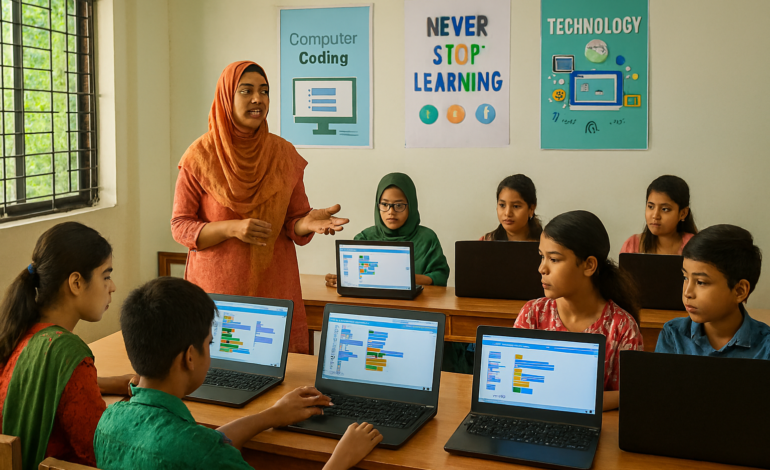
In Bangladesh, coding is rapidly evolving from a niche technical skill into a mainstream educational priority. With digital industries expanding and global demand for tech talent skyrocketing, students, parents, and educators increasingly view programming not just as an optional extra, but as a language of the future, essential for tomorrow’s careers. From grassroots coding classes to policy discussions about introducing programming in school curricula, the rise of coding education reflects broader shifts in how Bangladesh prepares its youth for a digitized world.
Why Coding Matters: A Digital Imperative
Coding, the process of instructing computers using programming languages is widely recognised as a foundational modern skill. Tech leaders often compare it to literacy or numeracy: more than a technical tool, it teaches problem-solving, logical thinking and computational reasoning. According to global education research, students who learn to code early develop stronger analytical skills and adaptability traits crucial in diverse fields beyond technology.
Bangladesh’s growing interest in coding reflects these global trends and the country’s own goal of building a competitive digital workforce. The government’s Digital Bangladesh vision has placed technology at the centre of economic growth, and coding education aligns with this priority by preparing future generations to innovate within and beyond national borders.
From Curiosity to Career Planning
For many young learners in Bangladesh, coding is more than just a class, it is a pathway toward future opportunity.
Take Arif, a class 9 student in Dhaka, who began learning programming through an after-school course. “At first, coding seemed like just typing symbols,” he says, “but once I built my first game in Scratch, I realised how creative it can be.” His interest has now shifted toward more advanced languages like Python and JavaScript, which he hopes will open doors to future careers in software development and data analytics.
Some students, like Saifur Rahman Udoy, a young programmer originally from Habiganj see coding as a tool for both creative expression and community impact. Udoy, who learned Python and HTML through online courses and self-study, has built small web projects and is actively engaging in volunteer work that promotes digital skills among peers.
These stories reflect a broader trend: students are turning curiosity into intentional skill-building, seeing coding not as an abstract concept but as a practical advantage for careers in software engineering, data science, artificial intelligence, robotics, and even entrepreneurship.
Parents Embrace Coding: Hope and Investment
Parents are playing an increasingly proactive role in supporting their children’s coding journeys. For many families, the choice to invest in programming classes is driven by the belief that future economies will reward digital proficiency.
“I want my child to have an edge,” says Rumana, a parent in Dhaka whose daughter attends a local coding academy. “In a world where technology shapes every industry, coding is like learning a new language. It builds confidence and opens opportunities.” This sentiment is echoed across many households, where parents now prioritise coding alongside traditional academic subjects.
Social enterprises and community programs aimed at underprivileged students also highlight the broader social value of coding. In Dhaka, initiatives such as the Kids Go Coding programme help children from disadvantaged backgrounds gain valuable programming skills that could increase their employability and economic independence in the future. Participants like Nila, a student engaged in this initiative, describe coding classes as empowering and filled with potential.
Coding Academies and After-School Programmes
Over the past decade, a network of coding academies and training centres has emerged across Bangladesh. These organisations cater to different age groups, from primary school children learning basic logic to teens preparing for careers in software and data.
Academies such as Dreamers Academy offer live online classes tailored for kids and teens, teaching core programming concepts and interactive project skills. These courses often include languages like Scratch, Python, and JavaScript, designed to engage learners from ages 7 to 16 with hands-on projects and real-world applications.
Similarly, institutions like Cybernetics Robo Academy provide not just coding, but a blend of coding with robotics and electronics, exposing students to STEAM (Science, Technology, Engineering, Arts, Mathematics) concepts from a young age.
At the same time, online learning platforms and boot camps are also gaining traction. Students who cannot attend physical classes whether due to location or time constraints, now have access to virtual coding courses that offer practical, intense training in shorter periods.
These offerings highlight a key shift: coding education is no longer confined to hobbyist clubs or university IT departments. It is becoming part of a diverse and accessible learning ecosystem tailored to different skill levels and socio-economic contexts.
A National Shift Toward Early Coding
Interest in coding education has not gone unnoticed by policymakers. In recent years, Bangladesh has taken steps toward integrating coding into formal education frameworks, recognising the value of computational thinking as a core competency.
Earlier proposals aimed to introduce coding concepts into the primary school curriculum, teaching age-appropriate logic and basic programming from as early as Grades 3 or 4. Simple activities and block-based languages like Scratch were included to make foundational concepts accessible to young learners without advanced technical equipment.
Educators argue that early exposure to coding can make logical reasoning more intuitive for students and equip them with skills that complement mathematics, science, and critical thinking, strengthening overall academic performance and future readiness.
Challenges: Equity, Infrastructure, and Teacher Training
Despite rapid growth, coding education in Bangladesh faces significant challenges. One of the most persistent issues is timing: traditional schooling often introduces formal programming only in later grades, limiting early engagement. Many students begin coding explorations informally or through extra classes before they encounter structured coursework.
Infrastructure remains another constraint. Reliable internet access, computing devices, and electricity can vary widely between urban and rural regions, making consistent participation in coding classes more difficult for some learners.
Teacher training is also a central concern. While there are many passionate coding tutors and private academy instructors, scaling high-quality programming instruction across mainstream schools requires sustained investment in teacher development and teaching materials.
Preparing for a Digital Economy
Despite the challenges, prospects for coding education in Bangladesh remain strong. As digital transformation accelerates across industries, programming skills are increasingly relevant not just for tech companies, but for sectors such as finance, e-commerce, healthcare, and manufacturing.
Employers in Bangladesh are seeking graduates with well-rounded skill sets that combine domain knowledge with digital competency. Coding proficiency signals adaptability, a trait vital to navigating an economy shaped by automation, artificial intelligence, and online services.
Many experts believe that as coding becomes more integrated into national education strategies and as after-school programmes expand, Bangladesh’s next generation of digital workers will be well-equipped to contribute to both local innovation and global tech ecosystems.Coding as a Core Skill for the Future
In Bangladesh, coding is increasingly viewed as a second language, not just for computer scientists, but for every student preparing for a competitive global landscape. Driven by curiosity, parental support, and a growing ecosystem of academies and online platforms, learners are embracing programming earlier and with greater purpose than ever before.
By investing in accessible coding education from primary schools to advanced tech training, Bangladesh is laying the foundation for a digitally capable workforce ready to engage with opportunities across industries. With continued policy support, expanded infrastructure, and a strong community of educators, coding could soon be as fundamental as reading, writing, or mathematics in the country’s education narrative.