



Why Everyone Is Googling for “Mosque which Serve Biryani for Iftar” in Bangladesh (A Satirical Look at a Ramadan Trend)
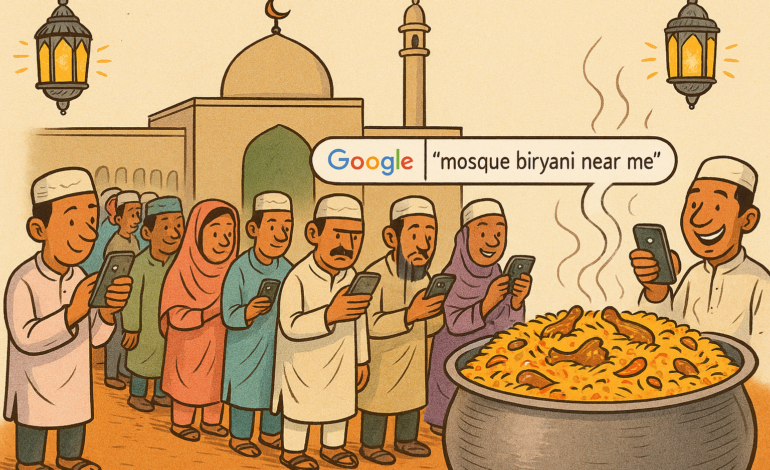
Every Ramadan, Bangladesh witnesses a familiar spiritual rhythm: fasting during the day, prayers at the mosque, and iftar at sunset. But this year, something new has emerged as people searching about where biryani is being served for iftar in Google.
Yes, alongside prayer times and moon sighting updates, many people now seem to be searching:
- “Which mosque has biryani today?”
- “Best iftar near me.”
- “Is there kacchi biryani iftar tonight?”
It almost feels like Ramadan has accidentally launched a national food discovery app except the platform is Google, and the rating system is word-of-mouth.
Let’s take a satirical but realistic look at why this trend is happening.
The Unofficial Ramadan Food Index
In theory, Ramadan is about spirituality, reflection, and charity. In practice, some Bangladeshis are running what appears to be a daily biryani intelligence network.
Someone always knows:
- A cousin who heard about a mosque serving kacchi.
- A friend who confirmed beef tehari is on the menu.
- A Facebook post revealing tonight’s “premium iftar.”
Before sunset, information spreads faster than breaking news.
In neighborhoods of Dhaka, people sometimes joke that there are two types of mosques during Ramadan:
- The prayer-focused mosque
- The “biryani confirmed” mosque (crowd guaranteed)
Guess which one trends on Google.
Biryani Dibe App
‘Biryani Dibe’ an app has recently gone viral on social media, which provides real-time updates showing which mosques are serving biryani, allowing users to check in advance where food will be distributed.
The fun and innovative app was developed by Abdullah Al Jubayer Prince, a university student studying Computer Science and Engineering at the International University of Business Agriculture and Technology (IUBAT) in the capital.
When Trends Meets Iftar
If someone analyzed Google Trends during Ramadan in Bangladesh, they might find an unexpected keyword cluster:
- Mosque iftar biryani
- Free iftar Ramadan
- Kacchi biryani mosque
- Best iftar Dhaka mosque
From an SEO perspective, this is fascinating. A religious practice has created a search-driven food culture.
Imagine if mosques started optimizing their announcements:
The Economics of Hunger (and Curiosity)
Of course, the satire hides a serious reality. Many people attend mosque iftars because:
- They are students living away from home.
- Workers cannot return home before sunset.
- Some simply need a proper meal.
But then there’s another group the Ramadan food explorers.
These individuals are not just breaking their fast; they are conducting field research on:
- Rice quality
- Meat tenderness
- Portion size
- Reputation of donors
Unofficially, Bangladesh might already have a Ramadan Biryani Review System just not documented.
The Social Media “Biryani Leak”
The real catalyst behind this trend is social media.
Every Ramadan evening, photos appear:
- Massive pots of biryani
- Long rows of plates
- Crowds waiting for iftar
Once posted, the information spreads like a viral update.
Suddenly:
- A mosque known for quiet prayers becomes a trending location.
- Attendance doubles the next day.
- Google searches spike.
This phenomenon proves something interesting:
Food news travels faster than political news during Ramadan.
The Psychology of Biryani After Fasting
From a scientific perspective, the appeal is logical.
After fasting for more than 12 hours, people crave:
- Energy
- Protein
- Flavor
- Satisfaction
Biryani conveniently provides all four in a single plate.
So while satire makes the trend funny, the psychology is simple:
If you’re fasting all day, biryani feels like a reward system designed by the universe.
When Mosques Accidentally Become Food Influencers
Traditionally, mosques are spiritual centers. But during Ramadan, some unintentionally become:
- Community dining hubs
- Charity distribution centers
- And apparently… food influencers.
If a mosque serves good biryani consistently, its news spreads quickly.
In digital terms, it gains:
- Organic reach
- Word-of-mouth marketing
- Repeat visitors
Not bad for an institution that never asked for publicity.
The Debate: Spirituality vs Biryani
Of course, the trend has sparked debates.
Some people argue:
- Too much focus on food distracts from prayer.
- Crowds come for biryani rather than worship.
Others respond:
- At least people are coming to the mosque.
- Charity is being distributed.
- Community bonds are growing.
And somewhere in the middle, someone is still Googling: “Biryani iftar near me today.”
The Real Reason It’s Trending
At its core, the “biryani mosque iftar” trend reflects three realities of modern Bangladesh:
- Community culture is still strong.
People enjoy gathering together. - Ramadan charity is widespread.
Donors want to serve meaningful meals. - The internet amplifies everything.
What used to be local knowledge is now searchable.
The Mosque Biryani Paradox
One important aspect often overlooked in the online excitement is who these iftar meals are actually meant for. In many mosques across Bangladesh, biryani or other hearty meals during Ramadan are primarily prepared for underprivileged people, travelers, day labourers, and those who may not have a proper meal to break their fast.
Donations from well-wishers and community members are intended to ensure that no one goes hungry at sunset. However, the trend has taken an ironic turn: alongside those who genuinely need the meal, many relatively privileged people now show up just to “experience the famous mosque biryani.”
Some arrive after hearing about it on social media or Google searches, treating it almost like a food event. While most mosques continue to welcome everyone in the spirit of Ramadan, the situation has sparked conversations online about whether people should be more mindful and ensure that those the meal was intended for are served first.
A mosque volunteer explained the intention behind the initiative:
“The biryani is mainly arranged so that people who cannot afford a good iftar can eat properly during Ramadan.”
The Great Ramadan Search
So why is everyone Googling biryani iftar in mosques?
Part hunger.
Part curiosity.
Part social media.
And a little bit of national obsession with biryani.
But beyond the satire, the bigger picture is positive. Mosques are feeding people, communities are gathering, and Ramadan’s spirit of sharing remains strong.
Even if just sometimes the search begins with biryani and ends with prayer.