



Bangladesh’s 13th Parliament Begins a New Chapter as Hafizuddin Ahmed Becomes Speaker,Kayser Kamal Named Deputy

Bangladesh’s 13th Parliament Begins a New Chapter as Hafizuddin Ahmed Becomes Speaker,Kayser Kamal Named Deputy
Bangladesh has entered a new parliamentary chapter as the 13th Jatiya Sangsad convened its first session in Dhaka. The session marked a significant milestone following the recent national elections, with Major (Retd.) Hafizuddin Ahmed elected as Speaker of Parliament and Kayser Kamal chosen as Deputy Speaker.
The formation of the new parliamentary leadership comes amid a changing political environment in Bangladesh after the February 2026 general election. The opening session not only established key parliamentary roles but also set the tone for the legislative agenda that will shape the country’s governance over the next five years.
First Sitting of the 13th Parliament
The inaugural session of the 13th Jatiya Sangsad began at 11:05 am in the National Parliament building in Dhaka. The proceedings started with the recitation of the Holy Qur’an, following the traditional parliamentary protocol. Initially, the Speaker’s chair remained vacant as members gathered for the formal opening procedures.
One of the first tasks during the opening session was the election of the Speaker and Deputy Speaker positions that play crucial roles in managing parliamentary debates and ensuring the legislative process functions smoothly.
According to parliamentary rules, these elections typically take place during the first sitting of a newly formed parliament. The Speaker presides over parliamentary proceedings, maintains order in debates, and represents the institution in constitutional matters.
Hafizuddin Ahmed Elected Speaker
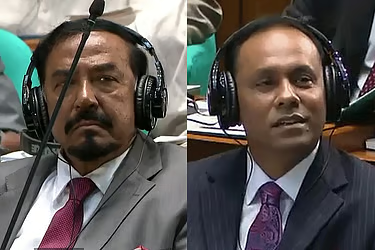
BNP Standing Committee member and newly elected Member of Parliament Major (Retd.) Hafizuddin Ahmed was elected Speaker of the 13th Jatiya Sangsad.
During the session, Khondkar Mosharraf Hossain, who presided over the opening meeting, announced that only one nomination had been submitted for the Speaker’s position. The nomination was for Hafizuddin Ahmed, and he confirmed his willingness to take on the role.
The proposal for his election was formally placed by MP Nurul Islam and seconded by MP Rakibul Islam, after which Hafizuddin Ahmed was declared elected without opposition.
His appointment reflects the ruling party’s parliamentary majority, which traditionally ensures that its nominee secures the Speaker’s post.
Kayser Kamal Becomes Deputy Speaker
Alongside the election of the Speaker, Kayser Kamal was elected as the Deputy Speaker of the 13th Parliament.
The Deputy Speaker assists the Speaker in conducting parliamentary business and presides over sessions in the Speaker’s absence. The role is essential for maintaining continuity in parliamentary operations and ensuring debates and legislative procedures proceed without disruption.
Together, the Speaker and Deputy Speaker form the core leadership responsible for upholding parliamentary rules and guiding legislative discussions.
Political Context: Elections and Transition
The formation of the new parliament follows the 13th national election held on 12 February 2026 under an interim government.
The election marked a significant political shift, as the Bangladesh Nationalist Party (BNP) secured a two-thirds majority in parliament and formed the new government.
The elections came nearly two years after a major political upheaval in Bangladesh that led to the fall of the previous government during a nationwide mass uprising in August 2024.
Under Bangladesh’s constitution, a newly elected parliament must convene its first session within 30 days of the election results. Accordingly, the President summoned the inaugural session on 12 March 2026, initiating the country’s new legislative cycle.
Significance of the Speaker’s Role
The Speaker holds one of the most influential positions in Bangladesh’s parliamentary system. The responsibilities of the office include:
- Presiding over parliamentary sessions
- Interpreting parliamentary rules and procedures
- Maintaining discipline and order during debates
- Representing parliament in official and constitutional matters
- Ensuring the neutrality of parliamentary proceedings
Although the Speaker is elected from among members of parliament, the office is expected to function with impartiality, balancing the interests of both the ruling party and the opposition.
In the 13th Parliament, Hafizuddin Ahmed’s experience as a senior political leader and parliamentarian is expected to shape how parliamentary debates and legislative processes unfold.
Expectations from the New Parliament
The first session of a new parliament is typically longer than regular sessions. During this period, several important tasks are completed, including:
- Formation of parliamentary committees
- Determining the duration and agenda of the session
- Outlining the legislative priorities of the government
Once the Parliamentary Advisory Committee is formed, it will determine the exact duration of the session and finalize the legislative schedule.
Observers expect the 13th Parliament to focus on key national issues such as:
- Economic recovery and stability
- Institutional reforms
- Governance and accountability
- Constitutional and political reforms
- Strengthening democratic institutions
A New Legislative Era
The inauguration of the 13th Jatiya Sangsad signals the beginning of a new phase in Bangladesh’s political journey. The election of Hafizuddin Ahmed as Speaker and Kayser Kamal as Deputy Speaker establishes the parliamentary leadership responsible for steering legislative debates and maintaining institutional stability.
As the new parliament begins its work, attention will turn to how effectively lawmakers address the country’s political, economic, and social challenges.
With a strong parliamentary majority and a newly elected leadership team, the coming years will determine whether the 13th Parliament can deliver meaningful reforms and strengthen democratic governance in Bangladesh.