

Bangladesh Launches Sports Card and Monthly Allowance Programme for National Athletes
Bangladesh has officially launched a new Sports Card and Sports Allowance Programme for national athletes, marking an important move toward improving athlete welfare and making sports a more secure profession in the country.
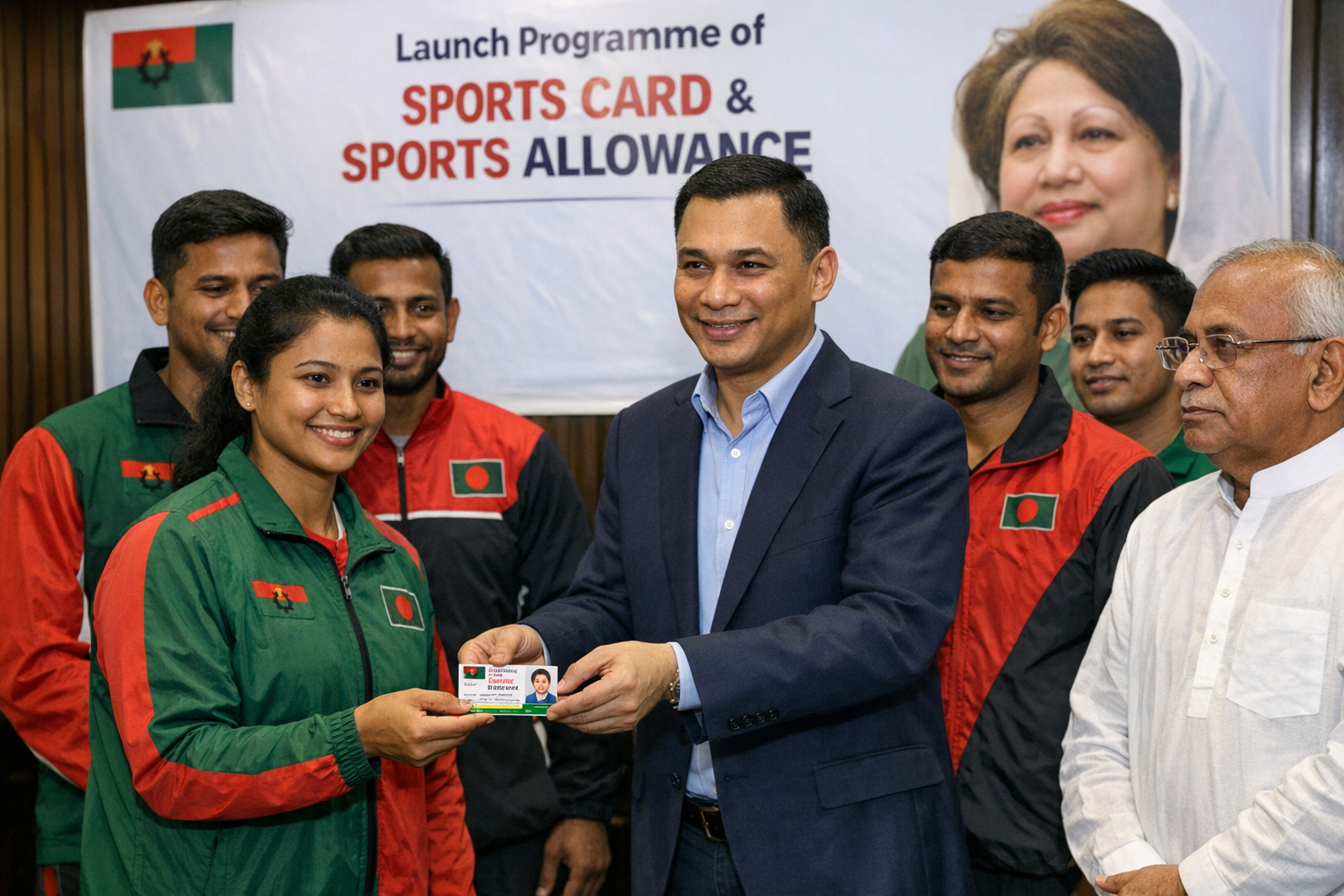
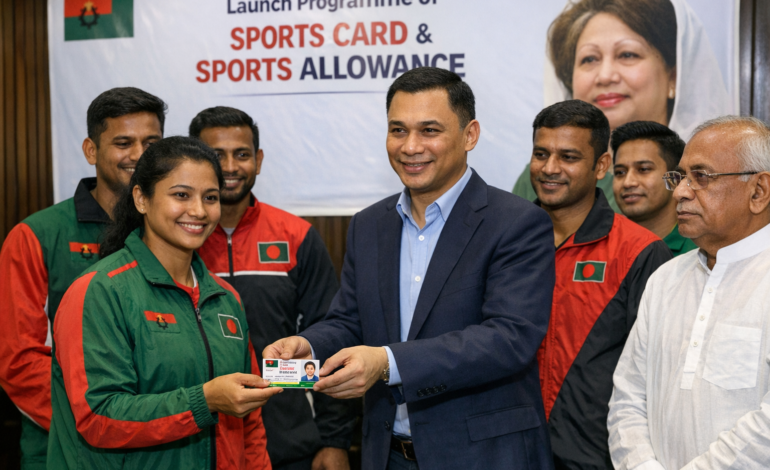
The programme was inaugurated on March 30, 2026, at the Prime Minister’s Office in Tejgaon, Dhaka, where Prime Minister Tarique Rahman formally introduced the initiative. Under the new system, about 129 national athletes will receive Tk 100,000 per month, with the first batch of payments transferred digitally through Sonali Bank.
For Bangladesh’s sporting community, this is more than just a government announcement. It is a policy that could help reshape the future of sports by offering athletes the kind of financial support and recognition they have long needed.
What is the Sports Card and Sports Allowance Programme?
The newly launched programme is designed to bring national athletes under a more structured support system. In simple terms, it is a state-backed initiative that gives selected athletes both official recognition through a Sports Card and regular monthly financial assistance.
The government introduced the programme with the slogan:
“When sports become a profession, families gain security”
That message reflects the core purpose of the initiative. In Bangladesh, many talented athletes have historically struggled with financial instability, uncertain career prospects, and limited long-term support. For many of them, representing the country has brought pride—but not always financial security.
This programme aims to change that.
At the launch event, 129 athletes were handed sports cards, and officials said the programme would be expanded to include 500 athletes within seven days. Athletes from 20 sports disciplines have been included in the initial phase.
Why this programme matters for Bangladesh sports
This initiative matters because it addresses one of the biggest long-term weaknesses in Bangladesh’s sports system: the lack of financial protection for athletes outside a few popular games.
For years, many athletes in Bangladesh have had to compete, train, and represent the country while also worrying about their personal income and family responsibilities. In many cases, this has made it difficult for promising athletes to continue their careers at the highest level.
A monthly allowance can help reduce that pressure.
Making sports a real profession
One of the biggest strengths of this programme is the message it sends. It tells athletes and their families that sports can be treated as a serious profession rather than just a passion or side pursuit.
This is especially important in a country where many parents remain uncertain about allowing their children to pursue athletics full-time. For many families, the fear is simple: what happens after school if sports do not provide stability?
By offering regular financial support, the government is trying to make that path more realistic.
If this programme continues and expands properly, it could encourage more young athletes to stay in competitive sports instead of leaving early because of economic pressure.
Support beyond cricket
Another important aspect of the programme is that it focuses on athletes from multiple sports, not just the most commercially successful ones.
The first phase includes athletes from 20 disciplines, including the SAFF Futsal-winning women’s team, kabaddi, and volleyball, among others.
This is significant because Bangladesh’s sports landscape has often been dominated by cricket in terms of attention, money, and sponsorship. While cricket has grown into a major national sport with its own strong financial ecosystem, many other sports have remained underfunded for years.
By including athletes from less-prominent disciplines, the government is acknowledging that national pride and sporting success do not come from one sport alone.
How the launch took place
The inauguration event was held at the Prime Minister’s Office in Dhaka, where the programme was officially launched through a digital payment process. The first allowances were transferred directly to athletes through Sonali Bank, showing an effort to make the system more transparent and efficient.
This digital payment system is an important detail. In public programmes, direct financial transfer often helps reduce delays and administrative complications. If maintained properly, it can also make the allowance process more reliable for athletes.
The event also included recognition for athletes who have brought international success to Bangladesh. That public acknowledgement matters because athlete support is not only about money but also about respect, visibility, and institutional backing.
Why cricketers are not included
One notable point from the programme is that cricketers are not part of the allowance scheme.
According to the government’s explanation, cricket has been excluded because the Bangladesh Cricket Board (BCB) is considered financially self-reliant. In other words, cricket already has a stronger financial structure than most other sports in the country.
This decision will likely be seen as practical by many observers. Since cricket already receives major funding, sponsorship, and administrative support, it makes sense for the government to focus public financial assistance on athletes from sports that are more neglected.
At the same time, the exclusion also highlights a wider issue in Bangladesh sports: the huge gap between cricket and almost every other discipline.
A much-needed boost for under-supported athletes
For athletes in sports like volleyball, kabaddi, futsal, athletics, and others, this programme could become a major source of stability.
In Bangladesh, many athletes outside cricket often face a difficult reality. They train hard, compete internationally, and represent the national flag, but still struggle with daily living costs, career uncertainty, and limited opportunities.
That is one of the reasons why athlete retention has been a challenge in many disciplines. Some talented athletes leave the sport too early. Others are forced to divide their focus between training and financial survival.
A fixed monthly allowance cannot solve every problem, but it can provide breathing room. It can help athletes focus more on training, competition, recovery, and long-term improvement.
And in sport, that kind of stability can make a major difference.
What this could mean for women’s sports
One of the most encouraging elements of the programme is the inclusion of the SAFF Futsal-winning women’s team.
Women’s sports in Bangladesh have made visible progress in recent years, especially in football and other team-based competitions. But despite those achievements, many women athletes still face structural disadvantages, including lower funding, fewer opportunities, and less media exposure.
A government-backed support system could help change that.
When women athletes are not only celebrated after victories but also supported through consistent financial policy, it creates a stronger foundation for long-term growth. It also sends a wider message to families and communities that women’s participation in sports deserves equal seriousness and respect.
This could have a positive effect far beyond the current group of athletes. It could influence the next generation of girls who want to compete at a high level.
The bigger picture: more than just a monthly payment
The Sports Card and Allowance Programme is important, but it will matter even more if it becomes part of a wider sports development plan.
At the launch event, a documentary reportedly highlighted broader goals related to sports development in Bangladesh, including:
- improving athletes’ living standards
- creating or improving playgrounds
- supporting grassroots talent development
- strengthening the overall sports structure
These are crucial areas.
Because while financial support for current athletes is necessary, true sporting progress also depends on what happens at the grassroots level. Bangladesh needs stronger school-level and district-level development systems, better training facilities, improved coaching, and long-term athlete pathways.
Without that, the country may continue producing talented individuals but struggle to build a sustainable sporting culture.
Can this programme change Bangladesh sports?
It has the potential to.
If managed fairly and consistently, the Sports Card and Sports Allowance Programme could become one of the most important athlete support policies Bangladesh has introduced in recent years.
But its success will depend on implementation.
Several questions will matter moving forward:
- How will athletes be selected in the future?
- Will the monthly payments continue regularly and transparently?
- Will more sports and athletes be included over time?
- Will the support system eventually expand beyond allowances to include healthcare, nutrition, sports science, and post-career planning?
These are the issues that will determine whether the programme becomes a lasting reform or simply a short-term headline.
Still, even at this early stage, the initiative sends a strong message: Bangladesh is beginning to treat athletes as professionals who deserve structured support.
A positive beginning for athlete welfare in Bangladesh
The launch of the Sports Card and Sports Allowance Programme is a meaningful and timely development for Bangladesh sports.
With Tk 100,000 in monthly support, an initial rollout covering 129 athletes, and plans to expand to 500 athletes, the programme has the potential to improve the lives of national athletes in a very real way.
More importantly, it could help shift the culture around sports in Bangladesh from one where athletes often struggle silently, to one where their work, sacrifice, and national contribution are properly valued.
For years, many athletes in Bangladesh have competed with passion but without enough support.
This programme does not solve every problem overnight. But it may be the beginning of something the country’s athletes have needed for a long time: recognition backed by action.