





AI in Classrooms: Are Bangladeshi Schools Ready for the Next Learning Revolution?
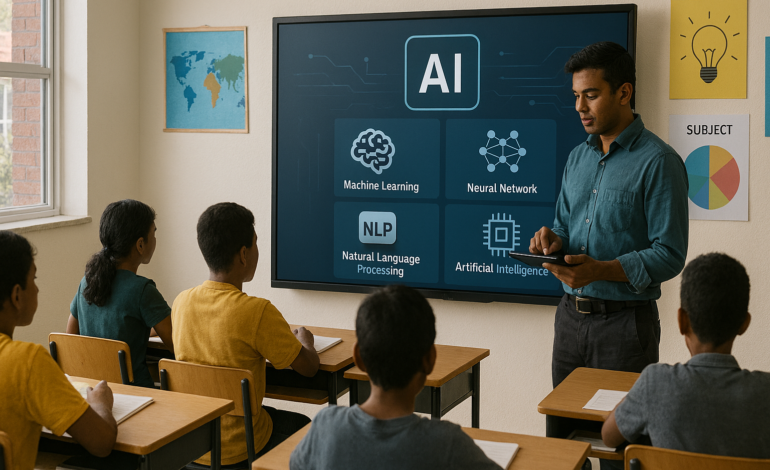

AI in Classrooms: Are Bangladeshi Schools Ready for the Next Learning Revolution?
As the world enters the era of artificial intelligence, classrooms are becoming one of its most transformative frontiers. Globally, AI tools are helping teachers personalise lessons, track student progress, and make learning interactive. In Bangladesh, the momentum is growing too: pilot programs, private ed-tech initiatives, and government interest suggest the country may be entering its next academic revolution.
Yet, the question remains are Bangladeshi schools ready for AI-powered education?
This article examines the current landscape, key opportunities, pilot initiatives, and the real risks that educators and parents must manage responsibly to protect students, especially teens.
Bangladesh’s First Steps: How AI Is Entering Classrooms
AI integration in Bangladeshi education is still in early stages, but progress is visible across three fronts:
1. Government and Institutional Initiatives
ICT Division and Education Ministry have publicly discussed using AI to improve syllabi planning and digital assessment.
The Smart Bangladesh Vision 2041 includes language about “smart learning environments” supported by automation and algorithm-driven evaluation.
Several universities (BUET, IUT, NSU, BRAC University) have introduced AI-based curriculum modules and research spaces, indirectly supporting school-level capacity.
2. School-Level Pilots
A handful of schools are experimenting with technology similar to but not yet fully dependent on AI models:
English-medium schools in Dhaka using AI-based language apps for grammar assistance.
STEM programs in Chattogram testing AI-powered robotics kits in collaboration with local IT companies.
Digital classrooms in Sylhet and Rajshahi integrating adaptive testing software to personalise difficulty levels based on student response patterns.
These are not widespread yet, but they signal a shift toward AI-assisted pedagogy.
3. Private Ed-Tech Adoption
Startups are entering the market with learning tools that use:
Automated quiz generation
Pronunciation assistance for English and Bangla
Predictive progress analysis for parents
Offline AI-lite models for low-bandwidth areas
While adoption varies by affordability and location, these solutions are gradually building familiarity with AI-enhanced study.
Opportunities: How AI Can Improve Learning in Bangladesh
1. Personalised Learning Paths
AI can adapt to a student’s pace fast for advanced learners, supportive for those who need more time. This directly addresses a major challenge in schools: overcrowded classrooms where teachers cannot always give individual attention.
2. Support for Teen Learners
For teenagers preparing for SSC, HSC, IELTS or university admissions, AI tools can:
Provide structured practice tests
Give immediate feedback on writing tasks
Help with pronunciation practice for media, debate, and presentations
Suggest study plans without replacing teachers
These uses are supportive, not substitutive, and can reduce pressure while improving confidence.
3. Teacher Assistance, Not Replacement
AI can automate low-value tasks like:
Marking objective tests
Drafting lesson materials
Tracking student performance data
This frees up teachers to focus on classroom interaction, mentoring, and emotional support areas where AI cannot replace human care.
4. Overcoming Resource Gaps
Many Bangladeshi schools lack specialist teachers in:
Advanced mathematics
Modern science labs
Foreign language practices
AI-assisted tools can provide entry-level exposure to these fields until trained professionals are available.
The Risks: What Students, Schools, and Parents Should Consider
AI in schools is not risk-free. To protect students especially minors several issues must be acknowledged responsibly.
1. Misinformation and Accuracy Issues
AI can generate incorrect answers. Students should never rely on AI as the only source of truth. Teachers must train students to verify information.
2. Privacy and Data Safety
Some AI apps collect personal data. Schools must evaluate:
What information is being stored
Where it is sent
Whether it is necessary or safe
Parents and educators should avoid tools that ask minors for sensitive or identifying details beyond what is required.
3. Over-Dependence
AI should not replace critical thinking. If teens use AI for:
Every homework answer
Essay writing
Problem solving
They risk limiting their own learning. Schools need clear policies that define “acceptable use” versus “plagiarism”.
4. Mental Health and Pressur
While AI can reduce stress, it can also cause comparison anxiety if students constantly monitor performance analytics. Teachers should supervise usage to ensure AI supports well-being, not performance obsession.
5. Unequal Access
Rural and low-income students may not have the same access to devices or stable internet. Policies must focus on equity first, so AI adoption does not widen the education gap.
Are Bangladeshi Teachers Prepared?
Teachers are central to AI readiness. Interviews and field observations suggest:
Many teachers feel anxious or untrained regarding AI tools.
Professional development programs are needed.
Schools should avoid implementing AI before teachers receive guidance, or the tools will sit unused.
Training priorities include:
1. Digital literacy
2. Ethical use policies
3. AI accuracy checking
4. Effective supervision strategies for teenagers
Implementation Roadmap: What Needs to Happen Next
For Bangladesh to unlock the full potential of AI in education, the following steps will be essential:
Short-Term Actions
Clear Ministry guidance on AI use for minors
School-level policy papers on homework and assessments
Teacher training modules through ICT Division
Partnerships with safe, regulated AI service providers
Long-Term Actions
Affordable device access programs for marginalised students
National AI literacy curriculum integrated from class 6 onward
Research fund for Bangla-language educational AI development
Inclusion of AI learning outcomes in the Smart Bangladesh roadmap
The Revolution Is Coming Preparedness Will Decide Success
AI has the potential to transform learning in Bangladesh reducing inequality, improving student confidence, and supporting overworked teachers. However, rushing into adoption without preparation could create new risks in privacy, accuracy, and unequal access.
The future of AI in Bangladeshi classrooms is promising, but it requires caution, policy, training, and student-first design. With thoughtful planning, Bangladesh is not just ready for the next learning revolution, it could lead it.


